
In 2026, the word “Orwellian” has been stripped of its teeth, tossed around to describe everything from a generic HR policy to a glitchy algorithm. But for those of us who actually sit down with the text, George Orwell’s 1984 feels less like a dusty political allegory and more like a high-stakes psychological autopsy.
This isn’t just a book summary for a history test; it is a mirror reflecting our own digital fingerprints and the slow erosion of our private selves. Reading 1984 today is a heavy lift—not because the prose is dense, but because the implications are exhausting.

The Slow Burn of Submission: A Plot Refresher
The story centers on Winston Smith, a man whose entire existence is a study in quiet desperation. He lives in Oceania, a world where the past is a draft that is constantly being edited. Working at the Ministry of Truth, Winston spends his days incinerating “inconvenient” facts and replacing them with Party-approved lies.
Winston’s rebellion is tragically small. He buys a diary. He falls in love with Julia. He dreams of a “Brotherhood” that might not even exist. To understand the world Winston is fighting against, it helps to look at the structure of the society he inhabits:
| Concept | Party Definition | Real-World Function |
| The Ministry of Truth | Responsible for news, entertainment, and education. | The fabrication of history and propaganda. |
| The Ministry of Peace | Responsible for Oceania’s military. | The perpetuation of endless, low-level warfare. |
| The Ministry of Love | Responsible for law and order. | State-sponsored surveillance and torture. |
| The Ministry of Plenty | Responsible for economic affairs. | Maintaining poverty and rationing resources. |
The real gut-punch of the novel isn’t that Winston is caught—it’s that he is converted. The Party doesn’t want to make him a martyr; they want to make him a fan. By the time he reaches Room 101, the horror isn’t just the rats; it’s the realization that under enough pressure, the human mind will betray its most sacred truths just to make the pain stop.
The Mechanics of Control: Why it Sticks
To get the real ROI of reading Orwell, you have to look at the psychological machinery he describes. These aren’t just literary devices; they are real-world cognitive traps. For more on how literature builds these “mental models,” check out our guide on reading for growth.
1. Doublethink as a Survival Mechanism
We often talk about Doublethink as a “bad thing people do,” but Orwell shows it as a survival skill. It’s the mental gymnastics required to stay employed or socially accepted while knowing that the “official narrative” is a lie. In modern life, we see this when we ignore the ethical costs of the technology we use every day.
2. Newspeak and the Death of Nuance
Orwell’s most chilling insight was that if you shrink the language, you shrink the thought. Newspeak isn’t about adding fancy words; it’s about deleting them. In an age of character limits and “vibe-based” communication, we are living through a version of this.
What Most Book Lists Get Wrong
When you look for dystopian recommendations, most lists just swap one famous title for another without explaining why they matter to you right now. They treat these books like museum pieces.
At ZestRead, we believe a book summary is only useful if it helps you navigate Monday morning. Most lists miss the connection between Orwell’s “Ministry of Truth” and the current “Attention Economy.” We don’t just want you to know what Winston did; we want you to know how to avoid his fate.
The 2026 Perspective: Where Orwell Was Wrong (and Right)
| Aspect | Orwell’s Vision (1984) | 2026 Reality |
| Surveillance | Forced via state-owned Telescreens. | Voluntary via smart devices and apps. |
| Information | Total censorship and scarcity. | Information overload and distraction. |
| Motivation | Controlled through fear and pain. | Influenced through algorithms and dopamine. |
| The Past | Actively rewritten by bureaucrats. | Obscured by digital “rot” and AI hallucinations. |
- Where it hits: The concept of “gaslighting” on a civilizational scale. The idea that “The Party told you to reject the evidence of your eyes and ears” feels uncomfortably close to the modern “fake news” and AI-deepfake cycle.
- Where it misses: Orwell imagined a world of scarcity. Our modern dystopia is often filled with a surplus of distractions. We aren’t being starved of information; we are being drowned in it until we stop caring what’s true.
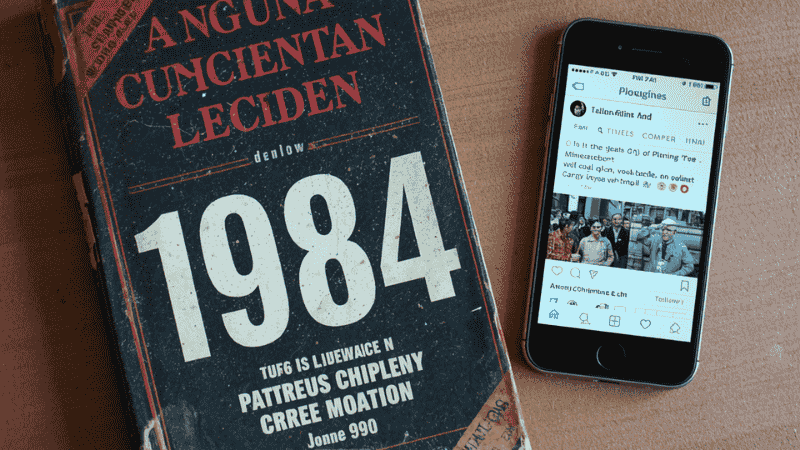
Applying the “Winston Audit” to Your Life
- Resist the “Slogan-Speak”: Whenever you hear a phrase that sounds too perfect—whether in a political ad or a corporate meeting—break it down.
- Protect Your “Memory Hole”: Digital history is fragile. If you find an essay that changes how you think, print it or save it offline.
- Find Your “Alcove”: Winston’s first act of defiance was sitting where the screen couldn’t see him. Find your “offline” space.
Which Book Should You Read First?
If you’re ready to move beyond the summary and experience the narrative yourself, here is how to choose your entry point:
| Edition Type | Recommendation | Best For… |
| Visual | 1984: The Graphic Novel | Those short on time or visual learners. |
| Standard | 1984 (Annotated Edition) | Readers who want historical context and depth. |
| Comparative | The Dystopian Trio | Strategic thinkers looking for the big picture. |
- Best for Beginners: 1984: The Graphic Novel (Fido Nesti). If you’re a visual learner, this 2-hour investment makes the surveillance feel visceral rather than theoretical.
- Best Overall: 1984 (Annotated Edition). This is the gold standard for those who want to understand the 1940s political context Orwell was actually reacting to.
- Best for Advanced Readers: The Dystopian Trio. Read 1984 alongside Brave New World and Fahrenheit 451 to see the full spectrum of how societies lose their way.
[Explore our curated list of the best dystopian novels for professionals]
FAQ: What We Get Wrong About Orwell
Is 1984 just about “Big Government”? No. It’s about power, period. That power can be a government, a tech monopoly, or even a social media mob. It’s about any force that demands you trade your objective truth for a collective lie.
Why is the ending so depressing? Because Orwell wanted to scare us. By having Winston lose, Orwell leaves the responsibility of “winning” to the reader. It is a call to action.
What are the “3 Slogans” and why do they matter? “War is Peace. Freedom is Slavery. Ignorance is Strength.” They are designed to exhaust the brain. If you can accept those, you can accept anything.
What is the “Golden Country”? It is the landscape Winston sees in his dreams—a place of natural beauty and freedom. It represents the human spirit that exists outside the Party’s control.
Does Winston ever actually meet Big Brother? No. Big Brother is a face on a poster, an embodiment of the Party. Whether he is a real person or a composite image is irrelevant; his power is real because people believe in it.
Final Thought
Reading 1984 shouldn’t make you a conspiracy theorist; it should make you a curator of your own mind. The book is a reminder that as long as you have a private interior world that remains uncolonized by outside narratives, you are still free. As Winston famously wrote: “Nothing was your own except the few cubic centimetres inside your skull.” Keep them.