

The first time I realized my daughter was reading with the door closed, I didn’t know whether to feel proud or a little left out.
Around fourth grade, something quietly changes. Children begin choosing books on their own. The bedtime stories become independent reading, and parents suddenly move from reading beside them to helping them choose what comes next.
That’s when choosing books becomes surprisingly difficult. The books that had worked so beautifully in second and third grade — the ones where I just had to put them in her hands and step back — weren’t landing the same way. She’d start things and not finish them. She’d read something technically “at her level” and tell me it was boring. Once I brought home a book with a Lexile score that impressed even me, and she handed it back after two chapters looking vaguely sad.
“It’s fine,” she said. “Just kind of heavy.”
That’s when I started thinking differently about choosing books for fourth graders. Not by difficulty. By fit.
In this guide, you’ll find books grouped by reading personality—not just grade level—including recommendations for reluctant readers, advanced readers, graphic novel fans, and children who need emotionally gentle stories. You’ll also find practical ways to keep reading enjoyable, even when school reading logs and book reports start to feel like homework.
Quick Picks: Best Books for 4th Graders
| Child type | Start with | Why it works |
|---|---|---|
| Reluctant reader | The Bad Guys | Fast, visual, funny |
| Advanced but sensitive | The Phantom Tollbooth | Challenging language, gentle themes |
| Animal lover | The Wild Robot | Nature, emotion, short chapters |
| Adventure lover | Percy Jackson | Fast pacing and humor |
| Sensitive reader | Because of Winn-Dixie | Emotional but reassuring |
| Graphic novel fan | Hilo | High-energy bridge reading |
Why Fourth Grade Is a Turning Point for Young Readers
Fourth grade is often the year when reading becomes more independent—but also more complicated. Many children can handle longer books, yet their emotional development doesn’t always keep pace with their reading ability. Understanding this shift helps parents choose books that build both confidence and a lifelong love of reading.
Why Reading Changes Around Ages 9–10
Something shifts in fourth grade that nobody quite prepares you for.
In the early grades, reading is the goal. Children are working toward it, measuring themselves against it, celebrating every milestone. By fourth grade, reading is assumed — and now it has to do something. It has to carry them through longer texts, more complex ideas, less visual support. The books get thicker. The chapters get longer. The plots require holding more in memory at once.
This is also the year that reading for pleasure starts to compete with everything else. Video games. YouTube. Group chats on borrowed devices. The cultural landscape a fourth grader navigates is fundamentally different from what it was in second grade, and books have to earn their place in that landscape by being genuinely worth the time.
Children who find books worth their time in fourth grade are significantly more likely to be readers at fourteen and twenty-four. Children who spend fourth grade slogging through books that bore or frustrate them often make a quiet decision around age ten that reading just isn’t for them — a decision that can take years to undo.
Reading Level Doesn’t Always Match Emotional Maturity
Many parents discover this when their children reach fourth grade. A child may read well above grade level yet still find certain books emotionally overwhelming.
She was reading well above grade level — fluent, fast, good comprehension. So I handed her a book that a teacher had recommended for “strong readers her age.” She got through it. But when I asked what she thought, she just said it felt heavy. Not too hard. Heavy. The book was well-written and age-appropriate by Lexile standards. It was also full of themes she wasn’t ready to sit with alone.
Reading level measures what a child can decode and comprehend. It doesn’t measure what they’re ready to feel. A nine-year-old who reads at a sixth-grade level can technically access books with sixth-grade vocabulary — but may not yet have the emotional scaffolding to process sixth-grade themes like parental abandonment, systemic injustice, or mortality handled at length.
The best books for fourth graders are the ones where both things align: the words are accessible and the emotional territory feels safe enough to explore.
Why the “Right” Book Matters More Than the “Hard” Book
Here’s what I’ve come to believe after years of watching children read and not read: the right book always beats the hard book.
A child who reads a book two levels below their Lexile score because they love it will read it twice, talk about it at dinner, and ask for the sequel. A child who reads a book at their precise Lexile level because they’re supposed to will finish it and feel nothing.
The right book produces something no reading program can manufacture: intrinsic motivation. The desire to find out what happens next. The willingness to sit still for thirty minutes because the story is worth it. That desire, once built, transfers. It builds reading stamina, vocabulary, and comprehension more effectively than any targeted instruction — because it operates through volume, and volume is what actually moves the needle.
Find the right book first. Challenge can come later, and it comes more easily when reading already feels like something worth doing.
How to Choose the Right Books for Your 4th Grader
Choosing the right book isn’t about finding the highest reading level—it’s about finding the right match for your child. Before exploring our recommendations, consider your child’s interests, emotional readiness, and reading habits. A book that feels exciting and achievable today is far more valuable than one that’s simply more challenging.
Choose by Personality — Not Just Reading Level
Before you look at Lexile scores or grade-level recommendations, ask yourself a simpler question: what kind of child is this?
Is your child the one who asks why about everything — why the sky is blue, why rules exist, why people make the choices they make? Give them books with ideas at the center. The Phantom Tollbooth. A Wrinkle in Time. Stories where the journey is also an argument.
Is your child the one who laughs easily and needs books to be fun before they can be anything else? Don’t fight that. Lean into it. Big Nate. Diary of a Wimpy Kid. Sideways Stories from Wayside School. Humor is a completely legitimate literary mode, and a child who reads six funny books a month is building more skills than one who reads one “appropriate” book a month under protest.
Is your child the one who feels everything deeply — who cried at the end of a movie that wasn’t even that sad? Give them books that honor feeling. Because of Winn-Dixie. Wonder. The One and Only Ivan. Stories where emotional honesty is the whole point.
Personality-matching works better than level-matching because it solves the actual problem: a child who doesn’t want to read.
Think About Emotional Readiness
When you’re choosing a book for a fourth grader, it helps to run a quick internal check before you hand it over.
Ask: what is this book really about underneath the plot? A book about a dog can be about loss. A book about a robot can be about identity. A book about a school can be about belonging or its absence. The surface story is not always the emotional story, and the emotional story is what will either land well or land too hard.
For children who are sensitive, who process difficult emotions slowly, who are already navigating something hard at home or school — lean toward books that contain difficulty but resolve it with warmth. Charlotte’s Web contains death but resolves it with love. Because of Winn-Dixie contains loneliness but resolves it with community. These are not easy books. But their emotional architecture is safe.
For children who are more emotionally resilient, more ready to sit with ambiguity — they can handle more. Hatchet doesn’t resolve everything neatly. Wonder asks children to hold multiple perspectives on a painful situation simultaneously. These books are right for children who are ready for them, and too much for children who aren’t.
Mix Comfort Reads with Stretch Reads
The most useful framework I’ve found for home reading in fourth grade is this: not every book needs to be a stretch.
In fact, research on reading development consistently suggests that fluency — the smooth, automatic reading that frees up cognitive space for comprehension — is built through easy and comfortable reading, not through constant challenge. Children who read a lot of easy-for-them books develop stronger reading muscles than children who read only books at their instructional level.
A simple home approach: for every book that stretches your child, let them read one or two that feel completely comfortable. A reread of a beloved third-grade book is not regression. It is fluency practice wearing a story’s clothes.
Graphic Novels Are Part of Healthy Reading
I’m going to say this clearly before we get to the book recommendations: graphic novels are reading. Full stop.
The cognitive demands of a graphic novel — tracking visual narrative, interpreting facial expressions, understanding how panel transitions convey the passage of time, following multiple plot threads across images and text simultaneously — are distinct and legitimate literary skills. Children who read graphic novels are not taking a shortcut. They are building a different set of skills, and those skills matter.
More practically: for many fourth graders, graphic novels are the bridge. They’re the thing that keeps a child reading during a period when chapter books feel too long and picture books feel too young. A child who reads ten graphic novels this year will almost certainly be more ready for longer chapter books next year than a child who read nothing.
Let your child read graphic novels without guilt, without negotiation, and without the requirement that they also read a “real” book alongside.
Best Books for 4th Graders by Reading Personality
No two fourth graders read for the same reasons. Some are drawn to adventure, while others love humor, animals, or thoughtful stories that help them make sense of the world. Instead of organizing this list by popularity alone, we’ve grouped these books by reading personality to help you find titles your child is more likely to enjoy, finish, and remember.

For Curious Nature Lovers
These are the children who look things up after finishing a book. Who want to know if the science is accurate. Who come home from a nature walk and immediately ask if there’s a book about what they saw.
The Wild Robot by Peter Brown
Roz is a robot who washes up on a wild island and must learn to survive by observing the animals around her. She accidentally becomes the mother of a gosling named Brightbill. The book is about adaptation, belonging, and what it means to love something you didn’t plan to love.
Why kids love it: The science of animal behavior is woven into every chapter — Roz learns from actual animal behavior, and children learn alongside her. The emotional arc is slow and earned. Brown’s illustrations appear throughout, making the book feel more accessible than its themes suggest.
Gentle Reading Tip: Read the first chapter together and then let your child continue independently. The opening chapter establishes Roz’s voice so clearly that children rarely want to stop.
Conversation Starter: “Roz had to learn to survive by watching. What’s something you’ve learned by watching instead of being taught?”
Maturity Tag: ⭐ Gentle Adventure — contains loss but resolves with warmth.
📦 Series — The Wild Robot Escapes, The Wild Robot Protects
⭐ Worth the Splurge — illustrated hardcover
My Side of the Mountain by Jean Craighead George
Sam Gribley runs away from his New York City apartment and lives alone in the Catskill Mountains for a year. He hollows out a tree. He trains a peregrine falcon. He survives. The book is told in Sam’s journal entries, which gives it an intimate, confiding quality that children find completely absorbing.
Why kids love it: The survival details are specific and accurate — George did her research. Children who read this book start thinking about what they would do, what they would need, whether they could do it. That imaginative engagement is the book’s greatest gift.
Conversation Starter: “If you had to live outside alone for a month, what’s the one skill you’d most want to have?”
Maturity Tag: ⭐ Safe & Sweet — no difficult themes, pure adventure.
💰 Budget Pick
Hatchet by Gary Paulsen
Brian Robeson’s plane crashes in the Canadian wilderness. He is alone. He has a hatchet. He survives for fifty-four days. The writing is lean and precise; the survival details are accurate; the emotional experience of being completely alone with yourself is handled with extraordinary honesty.
Gentle Reading Tip: This book works best for children who are emotionally ready to sit with sustained difficulty. It’s not traumatic — but it doesn’t resolve quickly, and children who need faster resolution may find it frustrating. For the right child, it’s unforgettable.
Maturity Tag: ⭐ Emotional Growth — deals with fear, self-doubt, and earned resilience.
💰 Budget Pick
For Kids Who Love Laughing
The children who pick up a book and immediately flip to the funniest-looking page. Who read passages aloud to their parents unprompted. Who consider “making me laugh” the highest compliment a book can receive.
Diary of a Wimpy Kid by Jeff Kinney
Greg Heffley is not particularly admirable. He is honest in his diary about his own selfishness, his schemes, his willingness to let others take blame. Children love this because it says the true things — the slightly embarrassing, completely recognizable true things — that no other children’s book quite says.
Why it works: The mix of prose and cartoons means every page offers something visually interesting. The humor is specific enough to feel true but universal enough that any fourth grader recognizes the social dynamics Greg is navigating.
Maturity Tag: ⭐ Gentle Adventure — some mild social scheming, nothing heavy.
📦 Series — 18+ books
💰 Budget Pick
The Bad Guys by Aaron Blabey
A wolf, a shark, a piranha, and a snake want to be heroes. They are terrible at it. Each book is a new adventure in which they cause chaos while accidentally saving the day. The books are structured like graphic novels, move very fast, and are genuinely, consistently funny.
Why it works for reluctant readers: The format — short chapters, comic-style panels, constant physical comedy — removes nearly all activation energy. A child who says they hate reading will frequently pick up a Bad Guys book and not put it down until it’s finished.
Maturity Tag: ⭐ Safe & Sweet — pure comedy, zero heavy themes.
📦 Series — 20 books
💰 Budget Pick
Big Nate by Lincoln Peirce
Nate Wright is certain he is destined for greatness. School has not confirmed this yet. The mix of prose and comics gives reluctant readers something to look at on every page, and Nate’s relentless optimism in the face of constant defeat is one of the most reliable sources of humor in middle-grade literature.
Conversation Starter: “What’s something Nate is genuinely good at that nobody gives him credit for?”
Maturity Tag: ⭐ Safe & Sweet.
📦 Series — 25+ books
💰 Budget Pick
For Big Thinkers and Sensitive Readers
These children feel things more completely than most. They cry at books and aren’t embarrassed about it. They ask questions about the characters after the story is over. They carry books with them in the way they carry people — carefully, with attention.
Wonder by R.J. Palacio
Auggie Pullman has a facial difference and is starting school for the first time in fifth grade. The book shifts between multiple perspectives — Auggie, his sister, his sister’s friend, his friends — giving each voice its own emotional logic. The cumulative effect is a profound exercise in perspective-taking.
Why sensitive readers need it: Palacio writes difficulty with enormous care. The book contains cruelty, but it also contains people choosing kindness when they don’t have to. That balance — the real world’s mix of both — is what makes Wonder more useful than books where goodness is simply assumed.
Conversation Starter: “Which character did you understand the most? Which one was hardest to understand? Did that change as you kept reading?”
Maturity Tag: ⭐⭐ Emotional Growth — contains bullying and social pain, handled with warmth and resolution.
💰 Budget Pick
Because of Winn-Dixie by Kate DiCamillo
Ten-year-old Opal moves to a new town in Florida with her preacher father and finds a large, ugly, smiling dog in a grocery store and names him Winn-Dixie. The dog opens up her summer in ways she couldn’t have predicted. This is a quiet book — nothing explodes, no one saves the world — but it is one of the most emotionally complete novels in children’s literature.
Why sensitive readers need it: DiCamillo writes loneliness with extraordinary precision. Every character in this book is lonely in a different way, and Opal’s growing understanding of that — that loneliness doesn’t make someone lesser, just human — is one of the best lessons a nine-year-old can encounter in a story.
Gentle Reading Tip: This is a perfect read-aloud. DiCamillo’s sentences are best heard as well as read.
Maturity Tag: ⭐ Gentle Adventure — contains loss and loneliness, resolves with community.
💰 Budget Pick — Newbery Honor
The One and Only Ivan by Katherine Applegate
A gorilla who paints lives in a mall. His friend Stella the elephant is sick. He makes a promise he doesn’t know how to keep. Based on a true story. The prose is spare and the emotion is enormous, and children who read this book often sit quietly after the last page in a way that says the book did something real.
Maturity Tag: ⭐ Emotional Growth — contains animal captivity and loss, handled gently.
💰 Budget Pick — Newbery Medal
For Adventure Lovers
Children who approach books the way they approach playgrounds — looking for the highest point, the fastest slide, the longest swing. They want stakes, urgency, and a plot that doesn’t let them stop.
Percy Jackson and the Olympians by Rick Riordan
Percy discovers he is the son of Poseidon and attends Camp Half-Blood for demigods. Each book sends him on a quest drawn from Greek mythology. The plotting is precise, the humor is consistent, and the stakes feel genuinely enormous throughout.
Why it works: The books are long enough to feel substantial but move fast enough that the length doesn’t intimidate. Children who start Book One rarely stop before Book Five.
Gentle Reading Tip: Some violence — it’s monsters versus demigods — and some emotional weight around absent parents. Preview for sensitive readers. Most confident fourth graders handle it completely well.
Maturity Tag: ⭐ Gentle Adventure / ⭐ Emotional Growth depending on the child.
📦 Series — 5 books; Kane Chronicles and Magnus Chase extend the mythology universe
💰 Budget Pick
Hatchet by Gary Paulsen
Already listed above. Worth noting again here because the adventure element is total — Brian survives completely alone for fifty-four days, and every chapter is a problem to solve. For adventure lovers, this book is pure engine.
From the Mixed-Up Files of Mrs. Basil E. Frankweiler by E.L. Konigsburg
Claudia runs away from home and hides in the Metropolitan Museum of Art, where she discovers a mystery about a statue that might be a lost Michelangelo. The adventure is cerebral and the mystery is genuinely satisfying.
Maturity Tag: ⭐ Safe & Sweet.
💰 Budget Pick — Newbery Medal
For Advanced Readers with Younger Emotional Maturity
This is the category almost no one addresses — and it’s one of the most common situations fourth-grade parents face.
Your child reads everything. They finish books in a day. Their Lexile score is in the seventh or eighth grade range. And you’re standing in the bookstore looking at the section labeled “Advanced Readers” and everything there either has a cover that looks like a teen drama or deals with themes you’re not sure they’re ready for.
The mistake is equating reading ability with emotional readiness. A nine-year-old who reads at a high level has advanced decoding and comprehension — they do not necessarily have advanced emotional processing. Handing them a book written for thirteen-year-olds because their Lexile score matches is not meeting them where they are.
What to look for: books with rich, complex prose and sophisticated plotting that are emotionally safe for a nine-year-old. Thematic complexity is fine; content that requires life experience they don’t yet have is not.
Best options:
The Phantom Tollbooth by Norton Juster — Milo drives through a magical tollbooth and enters a world where words and numbers are at war. The linguistic complexity is genuine and the wordplay rewards intelligent readers. Completely emotionally safe.
Maturity Tag: ⭐ Safe & Sweet — pure linguistic adventure.
A Wrinkle in Time by Madeleine L’Engle — Meg Murry travels through time and space to find her father. The science and philosophy are genuine; the emotional territory is accessible for a nine-year-old.
Maturity Tag: ⭐ Gentle Adventure.
The Westing Game by Ellen Raskin — Sixteen heirs, one dead millionaire, a will that is a puzzle. The plotting is so precise that every reread reveals new clues. A genuine challenge for strong readers that never requires emotional maturity beyond what a nine-year-old has.
Maturity Tag: ⭐ Safe & Sweet.
For Reluctant Readers
One thing I want to say before this list: if your fourth grader is a reluctant reader, they are not broken. They haven’t found their book yet. That’s all.
The books that work for reluctant fourth-grade readers share a few characteristics: they move fast, they have visual support, they’re funny or high-stakes or both, and they end chapters in places that make stopping feel wrong.
Dog Man by Dav Pilkey — the most reliable reluctant-reader gateway at this age, no competition.
Amulet by Kazu Kibuishi — fantasy epic in graphic novel form. The artwork is extraordinary; the story is genuinely absorbing.
Hilo by Judd Winick — a robot falls from space. His new friends help him figure out where he came from. Science fiction comedy that moves at the pace children who hate sitting still need.
Big Nate, Bad Guys, Wimpy Kid — all listed above. All work.
The key with reluctant readers is not to negotiate. Don’t offer a graphic novel as a reward for reading a chapter book. Don’t make them alternate. Just give them the graphic novel and let reading be something that happens without a transaction attached.
Graphic Novels vs. Chapter Books: Stop Thinking of Them as Opposites

This is the question I see most often in parent forums, reading groups, and every conversation I have with parents of nine and ten-year-olds: My kid only wants to read graphic novels. Is that okay?
Yes. It is more than okay.
Here’s the research: reading graphic novels requires children to simultaneously process written text and visual information, understand how panel transitions convey the passage of time, track character emotions through facial expression and body language, and follow complex narratives across multiple visual planes. These are not simplified literacy tasks. They are different literacy tasks, and they are cognitively demanding.
Children who read graphic novels read more pages per week than children who read only prose fiction. More pages means more vocabulary exposure. More vocabulary means stronger reading — including stronger prose reading. The graphic novel reader is not falling behind. They are building a foundation that transfers.
What actually happens when you force a child to put down a graphic novel and pick up a chapter book: they read the chapter book reluctantly, absorb less, associate reading with being managed, and are less likely to pick up either format voluntarily.
What happens when you let a child read graphic novels freely: they eventually encounter a story that they need more of than the format can give, and they go looking for it in chapter books. This transition is not something you manage. It happens when the child is ready.
Mixed reading — alternating between graphic novels and chapter books based purely on interest — is not a compromise. It is actually the most effective approach for building a lifelong reading identity. Let both formats live on the shelf without hierarchy.
When School Reading Starts Feeling Like Homework
Fourth grade is when I start hearing from parents that their child, who used to love reading, now seems to just… tolerate it.
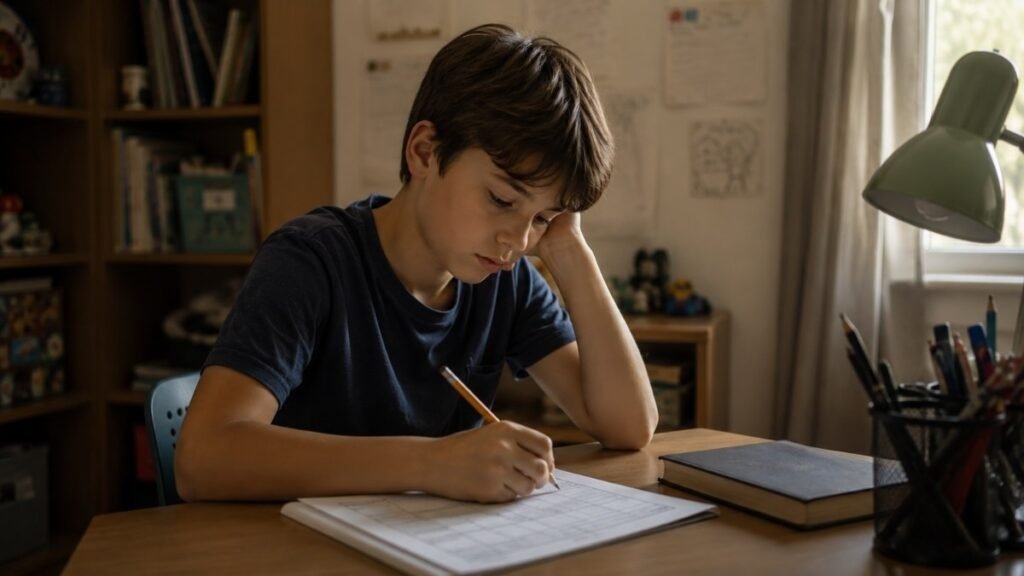
And when I ask more questions, the pattern is almost always the same. The school introduced a reading log. Or a quarterly book report. Or an Accelerated Reader quiz system where every book has a point value. Or — the one that makes me most tired — a Battle of the Books competition where children are tested on specific details from a prescribed list.
Why Motivation Drops
All of these systems have good intentions. They are also, for many children, precisely what turns reading from pleasure into performance.
When reading is measured, it becomes something you do to produce a score. And when reading is something you do to produce a score, the intrinsic motivation that makes voluntary reading possible — the desire to read because you want to find out what happens — gets crowded out by the extrinsic motivation to complete the task. Research on motivation consistently shows that introducing external rewards for intrinsically motivated behavior reduces the intrinsic motivation over time. This is not a controversial finding. It is one of the most replicated results in educational psychology.
The children who do best with reading logs and AR points are the ones who were already motivated readers before the system was introduced. The children who are harmed most are exactly the ones the systems are designed to help.
How to Keep Reading Joyful
You can’t control what happens at school. But you can control what reading looks like at home.
The most important thing you can do is protect home reading from the logic of school reading. At home, reading is not measured. Books are not assigned. There are no quizzes. Your child doesn’t have to finish anything they don’t want to finish. And you are genuinely curious about what they think, not checking whether they paid attention.
This sounds simple. It requires real commitment, especially if the school is sending home reading logs that need parental signatures. Sign them. But don’t let the log become the conversation.
A Simple Family Reading Routine
The routines that work best are the ones with the lowest friction.
Ten minutes before bed, consistently, with no requirement about format or subject. Graphic novel, chapter book, nonfiction about sharks, a magazine — it all counts. The only rule is that it’s quiet and it’s reading.
One dinner conversation per week about something someone read. Not a report. A conversation. “I read something this week that surprised me” is a different kind of sentence than “tell me about your book.”
A trip to the library every two weeks where your child chooses everything and you choose nothing.
That’s the whole routine. It works because it’s sustainable, and sustainability beats intensity every time.
Simple Ways Parents Can Keep Reading Fun at Home
A great book is only part of the equation. The everyday habits children build at home often have an even bigger influence on whether they continue reading as they grow. These simple, low-pressure ideas can help turn reading into a natural part of family life instead of another item on a to-do list.

The Two-Minute Dinner Question
Once a week, replace “how was school” with something more specific:
“Is there anything you’ve read recently that you’d actually recommend to someone?”
“Is there a character you’ve been thinking about since you stopped reading?”
“Did anything in a book surprise you this week?”
These questions signal that reading is a source of experience worth talking about — not a task to be reported on. Children who have these conversations become more engaged readers because they understand, implicitly, that their responses to books matter.
Let Kids Abandon Books Guilt-Free
Adults quit books all the time. We do it without shame. We return them to the shelf and find something else.
Children should be able to do the same.
A child who is allowed to quit a book that isn’t working will approach the next one with more hope. A child who is forced to finish something they’ve stopped caring about learns that reading requires endurance of things that don’t reward you — which is precisely the wrong lesson.
The working rule in our house: try twenty pages. If a book hasn’t grabbed you by twenty pages, it probably won’t. Return it and find something else. There are too many good books to spend time on bad fits.
Create a Family Reading Ritual
The ritual doesn’t have to be elaborate. It just has to be consistent.
In our house, it was Sunday afternoons. Both of us reading. Sometimes in the same room, sometimes not. Sometimes I’d read something aloud. Sometimes we’d read independently and then compare. The consistency is what created the expectation — reading is something this family does, in this way, at this time.
Rituals work because they remove decision fatigue. A child who knows that Sunday afternoon is reading time doesn’t have to negotiate with themselves about whether to read. It just happens, the way dinner happens.
Celebrate Conversations — Not Page Counts
The most valuable outcome of a fourth grader reading a book is not the pages logged. It’s the thoughts generated.
When your child finishes something and wants to talk about it — celebrate that, not the number of books they’ve read this month. When they disagree with a character’s choice, or wonder what happens after the ending, or want to know if the author wrote anything else — those are the indicators of a reader being formed, and they are worth more than any Lexile score.
How to Know You’ve Found the Right Book
You don’t always need to ask. There are signs.
They talk about the characters like real people. “Auggie would hate this” or “Percy would have a plan for this” means the book has populated their imagination.
They want to tell you what happened. Not because you asked. Because they need to.
They look for the next book before finishing this one. A child who asks “is there a sequel?” before they’ve reached the last chapter has been caught by a story.
They reread it. Rereading is not regression. It is the highest compliment a child can give a book, and it signals deeper engagement than moving on to something new.
They recommend it. A child who hands a book to a friend and says “you have to read this” has crossed from reader into advocate. That’s the whole goal.
None of these things are measured by a reading log. All of them matter more than a Lexile score.
The 4th Grade Reading List: Quick Reference
For curious nature lovers: The Wild Robot, My Side of the Mountain, Hatchet, Charlotte’s Web
For kids who love laughing: Diary of a Wimpy Kid, The Bad Guys, Big Nate, Sideways Stories from Wayside School
For big thinkers and sensitive readers: Wonder, Because of Winn-Dixie, The One and Only Ivan, Matilda
For adventure lovers: Percy Jackson, From the Mixed-Up Files, Hatchet, The Secret Garden
For advanced readers with younger emotional maturity: The Phantom Tollbooth, A Wrinkle in Time, The Westing Game
For reluctant readers: Dog Man, Amulet, Hilo, Big Nate, The Bad Guys
Classic books for 4th graders: Charlotte’s Web, Matilda, From the Mixed-Up Files, The Phantom Tollbooth, A Wrinkle in Time
Mystery books for 4th graders: From the Mixed-Up Files, The Westing Game, Encyclopedia Brown, A to Z Mysteries
Related Reading for Growing Bookworms
Fourth grade is a great starting point for building a reading life that extends in many directions. Some topics we’re building out on ZestRead:
Books for reluctant readers at every age. Books for advanced readers who need challenge without inappropriate content. Historical fiction that makes the past feel immediate. Mystery books calibrated for this age group. STEM books that combine science with story. Animal books — realistic and fictional both. Graphic novels worth taking seriously. And for families navigating competitive reading programs: guidance on using Battle of the Books lists without letting competition replace joy.
Every one of these directions starts with the same foundation: a child who still believes reading is worth their time.
FAQ: What Parents Actually Ask About Books for 4th Graders
What reading level should a 4th grader be at? The typical Lexile range by end of fourth grade is approximately 645L–1000L, corresponding roughly to Guided Reading Level P–S. But the range in any classroom is enormous, and level is less important than progress and engagement. A child who reads below grade level but is genuinely engaged is in a better position than one who reads at grade level but has stopped choosing books voluntarily.
My 4th grader only wants to read graphic novels. Is that okay? Completely. Graphic novels develop real and distinct literacy skills. Children who read graphic novels read more total pages, which builds vocabulary and reading stamina. The transition to longer prose books happens naturally when the child finds a story they need more of than the graphic format can give. Don’t manage the transition — let it happen.
How long should a 4th grader read every day? Fifteen to twenty minutes of genuinely engaged reading outside school produces meaningful gains — more than mechanical reading for longer periods. Quality of engagement matters more than duration. A child who reads for fifteen minutes and then wants to talk about what they read has done more than one who reads for thirty minutes while thinking about something else.
How do I choose books for an advanced 4th-grade reader? Look for books with rich, complex prose and sophisticated plotting that are emotionally appropriate for a nine or ten-year-old. The Phantom Tollbooth, The Westing Game, A Wrinkle in Time, and From the Mixed-Up Files of Mrs. Basil E. Frankweiler all offer genuine challenge without requiring emotional maturity beyond this age. Avoid books written for teenagers regardless of reading level match.
What books are good for reluctant 4th-grade readers? Graphic novels first: Dog Man, Amulet, Hilo. Then humor: Big Nate, The Bad Guys, Diary of a Wimpy Kid. Then fast-paced adventure with visual support: the Magic Tree House series for children who are still building stamina. The key is giving reluctant readers exactly what they want rather than negotiating toward what you wish they wanted.
How can I make school reading logs less stressful? Sign the log and don’t make it the conversation. Keep home reading separate from school reading in tone and structure — at home, books are pleasure, not performance. When your child reads at home, ask what they thought, not what happened. The log measures compliance; what you’re actually building is a habit and an identity.
Should my child reread favorite books? Yes, always. Rereading builds fluency, deepens comprehension, and reinforces the positive emotional association with reading that sustains the habit over time. A child who rereads a beloved book is not falling behind. They are doing exactly what passionate readers do.
What if my child stops enjoying reading in fourth grade? Don’t raise the difficulty. Lower it. Go back to funny books, graphic novels, whatever they loved in second or third grade. Reading identity — the belief that you are a person who reads and that reading is worth your time — is more important than reading level. Once the identity is intact, level follows. Once the identity is damaged, level is almost beside the point.
Final Thoughts
Fourth grade isn’t about reading the hardest books—it’s about discovering the ones that make children want to keep reading.
Every child follows a different reading journey. Some will dive into long novels, while others will happily revisit a favorite graphic novel again and again. What matters most isn’t the format or the reading level—it’s the joy, curiosity, and confidence they build along the way.
If this guide helps your child find one book they can’t wait to pick up again, you’ve already given them something far more valuable than a higher reading score: a reason to keep turning the page.
📚 ZestRead Editor’s Picks
| Book | Best For | Confidence |
|---|---|---|
| The Wild Robot | Animal Lovers | ⭐⭐⭐⭐⭐ |
| Wonder | Empathy | ⭐⭐⭐⭐⭐ |
| The Bad Guys | Reluctant Readers | ⭐⭐⭐⭐☆ |
Keep exploring on ZestRead:
Every child’s reading journey is different. Explore more age-specific book guides and reading tips to help your young reader grow with confidence, curiosity, and joy.
- Books for 3rd Graders: A Parent’s Complete Reading Guide
- Best Books for 9-Year-Olds: The Independent Reader Who Still Needs You
- Best Books for 10-Year-Olds: The Last Year Before Everything Changes
- Graphic Novels for Kids: The Best Picks That Turn Reluctant Readers Into Devoted Ones
- Funny Books for Kids: The Ones That Make Parents Laugh Too
Laura Bennett is the editor behind ZestRead, where she researches children’s literature, family reading habits, and practical ways to help young readers build confidence through books.She writes about children’s reading, the books that fit, and the habits that last. Reach her at info@zestread.com