
Around seventh grade, many kids become more selective about what they read. Books that once kept them turning pages may suddenly feel too simple, too slow, or no longer relevant to their lives.
The best books for 7th graders are the ones that match their interests, challenge them just enough, and keep them turning the page.
In this guide, you’ll find teacher-approved favorites, page-turners for reluctant readers, recommendations for advanced readers, and practical tips to help you choose the right book with confidence—whether your seventh grader already loves reading or just needs one great book to get started again.
Overview / Quick Answer
Start here based on what your child needs most right now:
- Wants the best all-around books: Wonder, The Giver, Refugee
- Gets bored with slow books: Hatchet, Peak, Ghost
- Doesn’t enjoy reading: New Kid, The Crossover, audiobooks paired with print
- Loves fantasy or adventure: Percy Jackson, The Hobbit
- Enjoys real-world stories: Refugee, Restart, A Long Walk to Water
- Reads above grade level: The Westing Game, Roll of Thunder, Hear My Cry, The Book Thief (with guidance)
- Needs books for school book reports: Wonder, The Giver, A Long Walk to Water
- Preparing for high school reading: To Kill a Mockingbird, The Hobbit, The Book Thief
Key takeaway: The best book is the one your child is excited to finish — not the longest or most advanced one on the list.
How to Choose the Best Books for 7th Graders
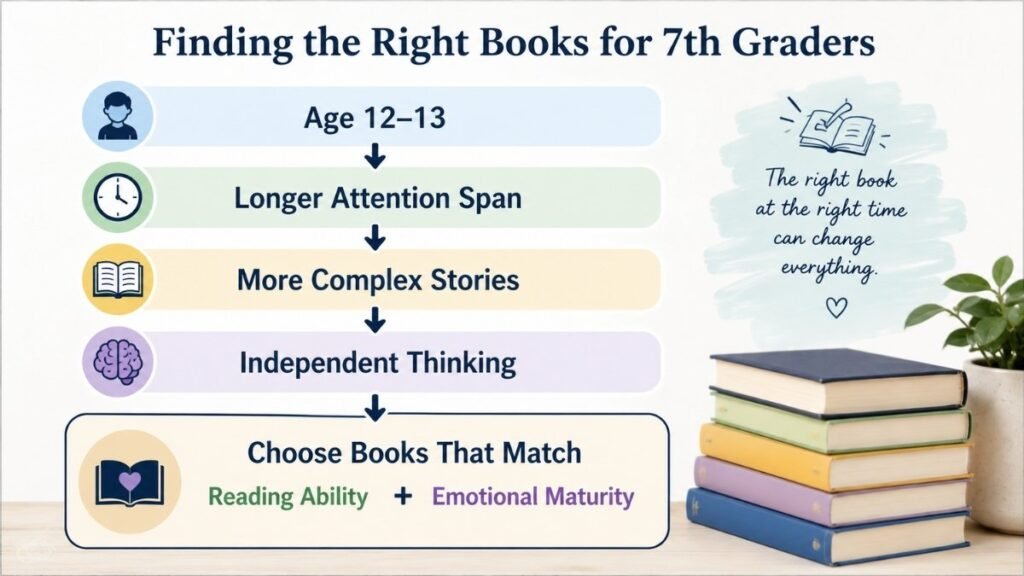
At 12 and 13, children are capable of handling more nuanced plots, moral complexity, and layered characters than they could just a year or two earlier. But reading ability and emotional readiness don’t always grow at the same pace — and that gap is where a lot of book-selection stress comes from.
Why Reading Changes in Seventh Grade
Kids this age are becoming sharper critical thinkers. They start noticing subtext, questioning character motives, and forming opinions about how a story “should” end. At the same time, school reading often becomes more assignment-driven, with less room for choice. It’s fairly common for even strong readers to lose some motivation during this stretch — not because they’ve stopped liking stories, but because reading has started to feel more like a task than a choice.
Challenge Without Frustration
A book that’s technically “on level” can still frustrate a child if the pacing drags or the plot doesn’t hook them early. The goal isn’t maximum difficulty — it’s finding books complex enough to feel rewarding without becoming a slog.
Matching Books to Emotional Readiness
Vocabulary and sentence complexity are only part of the picture. A 13-year-old might read at a high school level while still needing content that’s emotionally appropriate for a middle schooler. This is exactly why Upper Middle Grade — books written for the older end of the middle-grade range — tends to be such a strong fit for most seventh graders. It offers depth and complexity without rushing kids into themes meant for older teens.
Best Books for 7th Graders: Our Top Picks
Not every child enjoys the same kind of book, but these recommendations are a great place to start. Chosen by teachers, librarians, and longtime favorites among young readers, they offer something for nearly every interest and reading level.
Wonder by R.J. Palacio — Realistic fiction, moderate difficulty, ~320 pages. Themes of kindness, belonging, and empathy. Best for readers who enjoy character-driven stories. No significant content concerns. Strong discussion potential and one of the most reliable book report choices at this age.
Refugee by Alan Gratz — Historical fiction, moderate-to-challenging, ~340 pages. Follows three refugee children across different historical eras. Best for kids interested in history and global perspectives. Some intense wartime content worth previewing. Excellent for discussion and school reports.
Ghost by Jason Reynolds — Realistic fiction, easy-to-moderate, ~180 pages. A fast-paced story about a boy discovering running as an outlet for anger and grief. Best for reluctant readers who want a shorter, emotionally honest book. Minimal content concerns; first in a series.
The Giver by Lois Lowry — Dystopian fiction, challenging, ~230 pages. Explores a controlled society hiding a dark truth. Best for readers who enjoy thought-provoking, discussion-heavy books. Mature themes handled thoughtfully; a Newbery Medal winner and a strong pick for readers exploring more titles from our Newbery Award Winners list.
Restart by Gordon Korman — Realistic fiction, easy-to-moderate, ~250 pages. A bully with amnesia gets a chance to become someone new. Best for kids interested in identity and second chances. Light tone, minimal content concerns.
Hatchet by Gary Paulsen — Survival/adventure, moderate, ~195 pages. A boy survives alone in the wilderness after a plane crash. Best for reluctant readers who want nonstop action. Some intense survival scenes; a classic choice for book reports.
The Crossover by Kwame Alexander — Verse novel/sports, easy, ~240 pages. A basketball-driven story about twin brothers, told in verse. Best for readers intimidated by long chapter books. Newbery Medal winner; fast-reading and emotionally resonant.
When You Reach Me by Rebecca Stead — Mystery/sci-fi, moderate-to-challenging, ~200 pages. A layered, time-bending mystery. Best for advanced readers who enjoy piecing together clues. No significant content concerns.
A Long Walk to Water by Linda Sue Park — Historical fiction, moderate, ~140 pages. Based on real events in South Sudan. Best for readers who want a short but powerful book report option. Some difficult survival content.
New Kid by Jerry Craft — Graphic novel, easy-to-moderate, ~250 pages. Follows a Black student navigating a mostly white private school. Best for reluctant readers and visual learners. Excellent discussion starter on identity and belonging; a Newbery Honor book.
Best Books for School Book Reports
If your child needs a book with a clear structure for a report, look for strong character arcs and defined themes. Wonder, The Giver, A Long Walk to Water, and Hatchet all fit this well — each has an obvious beginning, turning point, and resolution that make outlining a report much easier.
Editor’s Picks Comparison Table
| Book | Genre | Difficulty | Length | Book Report Rating |
|---|---|---|---|---|
| Wonder | Realistic fiction | Moderate | ~320 pp | Excellent |
| Refugee | Historical fiction | Moderate-Hard | ~340 pp | Excellent |
| Ghost | Realistic fiction | Easy-Moderate | ~180 pp | Good |
| The Giver | Dystopian | Hard | ~230 pp | Excellent |
| Restart | Realistic fiction | Easy-Moderate | ~250 pp | Good |
| Hatchet | Survival | Moderate | ~195 pp | Excellent |
| The Crossover | Verse/sports | Easy | ~240 pp | Good |
| A Long Walk to Water | Historical fiction | Moderate | ~140 pp | Excellent |
Many of these titles have been classroom favorites for years while also earning a place on family bookshelves. That combination is often a strong sign that a book is both meaningful and enjoyable to read.
Best Fast-Paced Books for 7th Graders
If your child gives up on books after a chapter or two, the problem isn’t always reading ability—it may just be the wrong book. These fast-paced stories get to the action quickly and are great for keeping young readers interested.
Peak by Roland Smith — A teenager attempts to climb Mount Everest. High-stakes pacing from the start; great for adventure-driven readers.
Hatchet by Gary Paulsen — Immediate, high-tension survival story with almost no slow buildup.
Ghost by Jason Reynolds — Opens mid-conflict, with short chapters that keep momentum high.
Refugee by Alan Gratz — Alternates between three urgent storylines, which keeps pacing brisk throughout.
Percy Jackson and the Olympians by Rick Riordan — Fast, funny, and action-driven from page one; a reliable pick for reluctant readers.
I Am Still Alive by Kate Alice Marshall — A survival thriller with a slow-reveal mystery layered in; good for kids who want suspense.
Dry by Neal and Jarrod Shusterman — A fast-moving crisis story about a Southern California drought; intense pacing, some mature content worth previewing for younger 7th graders.
Fast-Paced Books Comparison
| Book | Pace | Suspense Level | Best Reader Personality |
|---|---|---|---|
| Peak | Fast | Moderate | Adventure-seekers |
| Hatchet | Very fast | High | Action-driven readers |
| Ghost | Fast | Moderate | Emotionally engaged readers |
| Refugee | Fast | High | History-curious readers |
| Percy Jackson | Very fast | Moderate | Humor-loving readers |
| Dry | Fast | High | Thriller fans (older 7th graders) |
If a story doesn’t grab them quickly, motivation tends to drop fast — which is exactly why these page-turners are so useful for re-engaging a child who’s lost interest in reading.
Find the Right Book by Interest
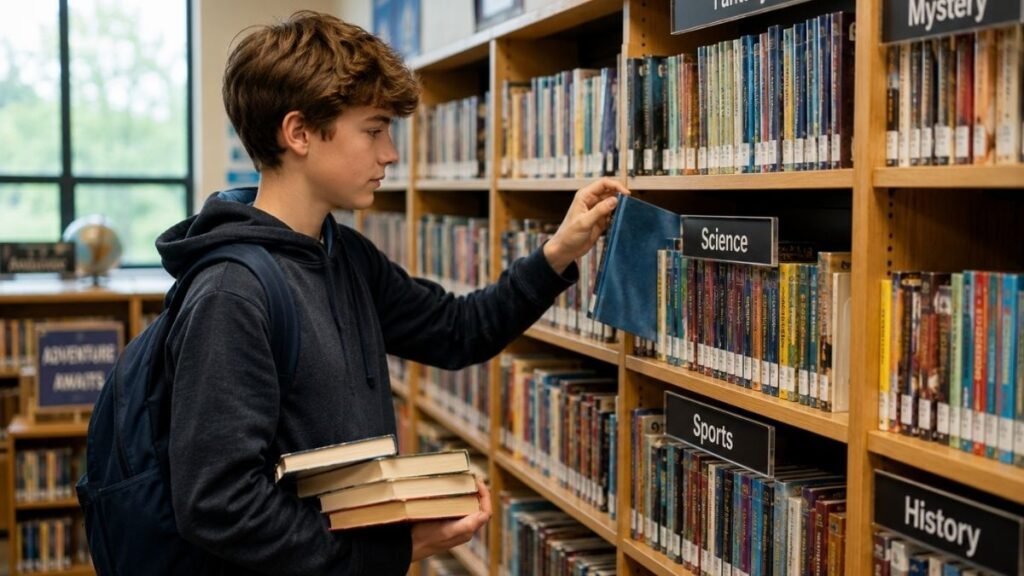
The easiest way to choose a book is to start with what your child already enjoys. Whether they’re into fantasy, mystery, sports, or real-life stories, picking the right genre makes it much easier to find a book they’ll actually finish.
Which Genre Fits Your Child?
- Fantasy lovers tend to enjoy imaginative world-building and clear good-vs-evil stakes.
- Mystery fans like piecing together clues and tend to enjoy books with a strong reveal.
- Survival readers are drawn to high physical stakes and resourceful main characters.
- Historical fiction readers connect best when history is told through a relatable character’s eyes, not textbook facts.
- Science fiction fans enjoy “what if” premises and futuristic or scientific concepts.
- Sports readers respond well to fast pacing and competitive stakes.
- Humor-driven readers need levity, especially if they’re currently reluctant.
- Graphic novel readers benefit from visual storytelling and often transition into traditional novels later.
- Narrative nonfiction fans enjoy true stories that read with the pacing of fiction.
Choosing Books That Match Personality
A quiet, reflective child may gravitate toward introspective realistic fiction, while a high-energy child often does better with survival or sports stories. Neither preference is “better” — matching format and pacing to personality tends to matter just as much as matching genre to interest.
Following your child’s existing interests, rather than steering them toward books that feel more “important,” is usually the faster path to genuine engagement. A child who loves basketball is far more likely to finish The Crossover than a classic they feel no connection to — and that early win often opens the door to trying other genres later. For visual learners specifically, it’s worth browsing Best Graphic Novels for Kids for more format-friendly options.
Best Nonfiction Books for 7th Graders
Narrative nonfiction tells true stories using the same pacing, tension, and character development as fiction — and it’s often a great fit for kids who say they “don’t like reading” but love facts, history, or true crime-style intrigue.
Bomb by Steve Sheinkin — The race to build the atomic bomb, told like a thriller. Best for history and science-curious readers.
Shipwreck at the Bottom of the World by Jennifer Armstrong — The true story of Ernest Shackleton’s Antarctic expedition. Best for adventure and survival fans.
Chasing Lincoln’s Killer by James L. Swanson — A fast-paced account of the manhunt for John Wilkes Booth. Best for kids who enjoy mystery and suspense.
Hidden Figures (Young Readers Edition) by Margot Lee Shetterly — The story of Black women mathematicians at NASA. Best for STEM-curious readers and school research projects.
The Boys Who Challenged Hitler by Phillip Hoose — A true story of teenage resistance fighters in WWII Denmark. Best for readers drawn to history and courage-driven stories.
History vs Science vs Biography
| Category | Best Book | Best For |
|---|---|---|
| History | Chasing Lincoln’s Killer | Mystery and suspense fans |
| Science | Bomb | STEM-curious readers |
| Biography | Hidden Figures | School research, STEM interest |
| Adventure/Survival | Shipwreck at the Bottom of the World | Adventure-driven readers |
| WWII History | The Boys Who Challenged Hitler | History-focused readers |
Many parents are surprised to find that a child who avoids textbooks will happily finish a nonfiction book about survival, history, or space. The best nonfiction books for 7th graders tell true stories in a way that feels every bit as engaging as fiction.
Short Books That Build Reading Confidence
Long books can feel intimidating, especially for kids who already struggle to stay interested. These shorter picks are easier to finish, helping seventh graders build confidence while enjoying the experience.
Shorter books work well for readers who:
- Get discouraged by thick books before even starting
- Need a quick win to rebuild reading confidence
- Do better with verse novels or graphic formats
- Respond well to audiobooks paired with print
The Crossover — A fast-reading verse novel with strong emotional payoff.
Long Way Down by Jason Reynolds — A tense, single-elevator-ride verse novel that reads in under an hour but stays with readers much longer.
New Kid — A graphic novel that offers a complete, satisfying story without a heavy page count.
Reluctant Reader Success Plan:
- Choose a book under 250 pages to start
- Try a verse novel or graphic novel first
- Pair the print book with its audiobook
- Set a short, low-pressure daily reading goal
- Celebrate finishing — regardless of the book’s length or difficulty
- Avoid comparing their pace to other readers
Finishing one shorter book often does more for a reluctant reader’s confidence than starting five longer ones they never complete. That sense of “I actually finished a book” tends to be the turning point many parents notice before their child willingly picks up a second one.
Books That Help Kids Navigate Growing Up
Middle school comes with new friendships, bigger challenges, and moments that can feel confusing. The right book won’t solve every problem, but it can help seventh graders see they’re not the only ones going through it.
| Life Challenge | Recommended Books |
|---|---|
| Friendship changes | Wonder, Restart |
| Bullying | Wonder, Ghost |
| Anxiety | Ghost, The Crossover |
| Self-confidence | Restart, Ghost |
| Identity | New Kid, Refugee |
| Family changes | A Long Walk to Water |
| Building empathy | Refugee, Wonder |
| Resilience | Hatchet, A Long Walk to Water |
Consider reaching for these books proactively — not just after a difficult moment has already happened. Reading about a character navigating friendship conflict, for example, can open up a conversation before a similar situation arises in real life, which tends to feel much less pointed than raising the topic directly.
Stories often make it easier for kids to process feelings they aren’t ready to discuss directly. A child who’s reluctant to talk about being excluded at school may talk openly about why a character in Wonder felt hurt — and that conversation frequently circles back to their own experience naturally, without feeling like an interrogation.
Books for Advanced Seventh Grade Readers
Some seventh graders are ready for longer books, richer vocabulary, and more challenging ideas. The goal isn’t to move into older teen books too quickly—it’s to choose stories that stretch their reading skills while staying age-appropriate.
The Hobbit by J.R.R. Tolkien — Rich world-building and higher vocabulary, with adventure pacing that keeps it accessible.
The Westing Game by Ellen Raskin — A clever mystery with a large cast and a puzzle-box structure that rewards careful readers.
Roll of Thunder, Hear My Cry by Mildred D. Taylor — A powerful, emotionally complex look at racism in the 1930s American South; excellent for discussion.
The Book Thief by Markus Zusak — Beautifully written but tonally heavy; best previewed by a parent first, as its themes around death and WWII can be intense for some readers.
The False Prince by Jennifer A. Nielsen — A twist-heavy political fantasy with more narrative complexity than typical Middle Grade fare.
Scythe by Neal Shusterman — A thought-provoking sci-fi premise with mature philosophical themes; worth previewing, as it’s closer to the YA line than most titles on this list.
Books to Avoid Rushing Into
Many early YA titles include mature romance, explicit language, or darker violence intended for older teen readers. Even a strong reader benefits from staying in well-written Upper Middle Grade a bit longer rather than jumping into content built around themes they’re not yet ready to navigate.
Advanced Reader Comparison
| Book | Vocabulary Level | Thematic Depth | Parent Guidance |
|---|---|---|---|
| The Hobbit | High | Moderate | Low |
| The Westing Game | Moderate-High | Moderate | Low |
| Roll of Thunder, Hear My Cry | High | High | Moderate |
| The Book Thief | Very High | Very High | Recommended preview |
| Scythe | High | High | Recommended preview |
A common misconception is that a strong vocabulary means a child is ready for older content — but vocabulary growth and emotional readiness don’t always develop on the same timeline. Choosing books with high thematic depth, rather than simply mature content, is usually the better way to challenge an advanced reader.
Middle Grade vs. YA: Which Is Right for a 7th Grader?
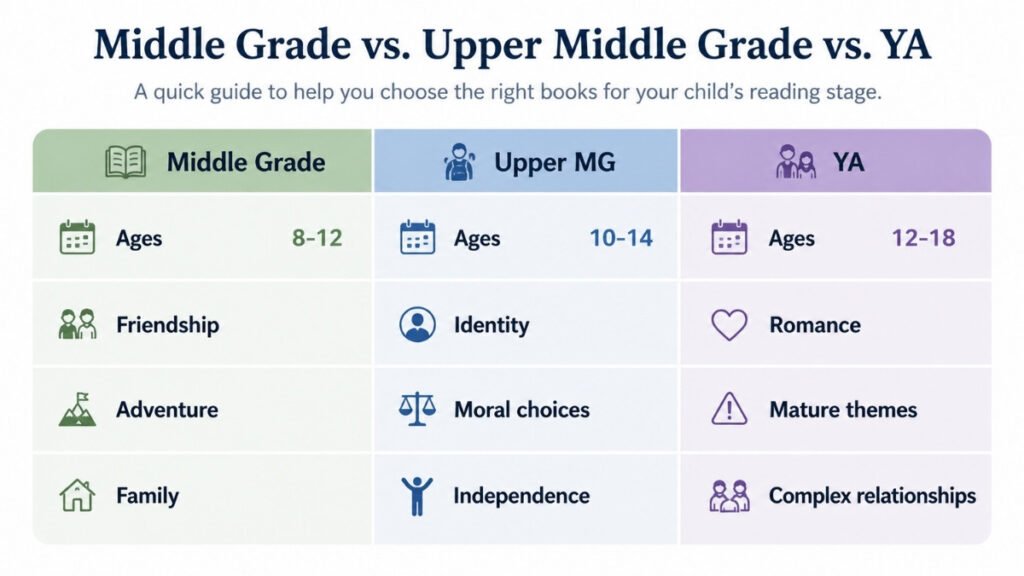
Direct answer: Middle Grade generally targets ages 8–12, Upper Middle Grade bridges ages 10–14 with more complexity while staying content-appropriate, and Young Adult targets ages 12–18 with more mature romantic, violent, or thematic content. Most seventh graders — even advanced ones — are best served by Upper Middle Grade rather than early YA.
MG vs Upper MG vs YA
| Middle Grade | Upper Middle Grade | Young Adult | |
|---|---|---|---|
| Typical Age | 8–12 | 10–14 | 12–18 |
| Complexity | Simple-Moderate | Moderate-High | High |
| Romance | Rare | Minimal, if any | Common |
| Violence | Mild | Moderate | Can be intense |
| Language | Clean | Mostly clean | May include strong language |
| Emotional Maturity Needed | Low | Moderate | Moderate-High |
Upper Middle Grade tends to be the sweet spot for most seventh graders: complex enough to feel genuinely engaging, without rushing into themes better suited to older teens. It’s worth pairing this with our guide on Books for 6th Graders if you’re comparing what shifts as your child moves up a grade.
A common misconception among parents is that a strong reader should automatically graduate into YA once Middle Grade starts feeling “too easy.” Reading ability and emotional readiness are separate tracks — a 13-year-old reading at a high school level isn’t necessarily ready for high-school-level themes.
Classic Books That Still Connect With Seventh Graders
Starting with engaging stories and age-appropriate themes can help seventh graders enjoy the experience instead of seeing classics as just another school assignment.
The Hobbit — Still resonates thanks to its adventure and world-building; a gentle entry point into fantasy classics.
To Kill a Mockingbird — Powerful and widely taught, though some scenes benefit from parent context and discussion.
The Call of the Wild — Shorter and fast-paced, making it more accessible than many classics its age.
Treasure Island — Adventure-driven with pirate-story appeal, though the language can feel dated for reluctant readers.
Anne of Green Gables — Character-driven and warm; works especially well as a buddy read.
The Secret Garden — A gentler classic, good for readers who prefer quieter, character-focused stories.
Modern Alternatives for Hesitant Readers
If a classic feels like too much of a leap, a modern book with a similar spirit can ease kids in first:
- Treasure Island → Peak
- Call of the Wild → Hatchet
- To Kill a Mockingbird → Refugee
Classic vs Modern Alternative
| Classic | Modern Alternative | Why It Works |
|---|---|---|
| Treasure Island | Peak | Similar adventure pacing, more accessible language |
| Call of the Wild | Hatchet | Survival themes, faster modern pacing |
| To Kill a Mockingbird | Refugee | Similar moral weight, more contemporary voice |
Slower classics are often far more enjoyable when read together rather than independently. Pausing to explain older language or historical context turns a potentially frustrating read into a genuinely rich conversation.
Simple Reading Habits That Work for Seventh Graders
Small habits—like talking about a book over dinner or letting them choose what to read—can make a bigger difference than setting strict reading rules.

Weekend Reading Routine
A simple, consistent block of time — even 15 to 20 minutes on a Saturday morning — tends to work better than trying to squeeze reading into busy weekday evenings.
Family Conversation Starters
- What would you have done differently than the main character?
- Did anything in the book surprise you?
- Who did you relate to most, and why?
- Was there a decision a character made that you disagreed with?
How to Keep Reading Fun
Avoid turning discussion into a quiz. Open-ended questions almost always generate richer conversation than “what happened next” comprehension checks — and they respect your child’s growing ability to form independent opinions.
Family Reading Discussion Guide:
- Set a consistent, low-pressure reading time each week
- Read a chapter, then pause to talk before continuing
- Ask open-ended questions, not yes/no ones
- Let your child share opinions you might disagree with
- Skip formal comprehension testing
A realistic weekend reading routine doesn’t need to be elaborate — many families find that pairing reading time with something already comfortable, like Saturday morning breakfast, is what actually makes the habit stick long-term.
How to Choose the Right Book for Your Seventh Grader
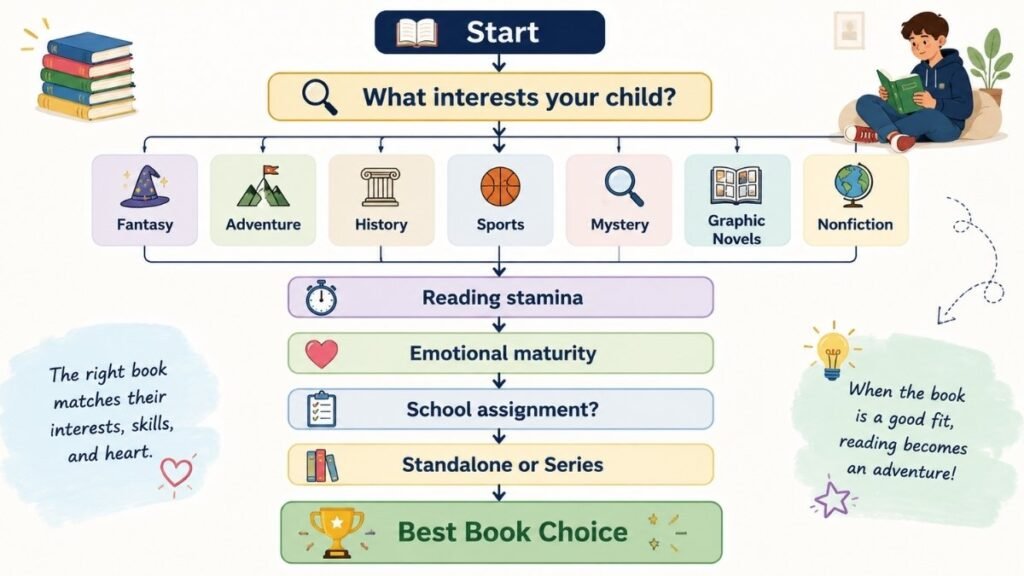
Direct answer: The right book balances your child’s interests, reading stamina, and emotional maturity, while still leaving room for your child’s own preferences.
Use this flow when narrowing down options: Interest → Reading Stamina → Emotional Readiness → School Needs → Standalone or Series → Final Choice
Before Buying a Book Checklist:
- Does it connect to something your child already enjoys?
- Is the length realistic for their current reading stamina?
- Are the themes emotionally appropriate for your child specifically?
- Does it meet a school assignment requirement, if needed?
- Have you previewed any potentially sensitive content?
- Is it standalone, or part of a series your child might want more of?
- Did your child have a say in the final choice?
Forcing a child through a mismatched book rarely builds reading skill, and it often does more harm to their motivation than simply switching to something else.
FAQ
What are the best fast-paced, instantly engaging books for 7th graders that hook them from page one?
Hatchet, Peak, and Ghost are excellent choices for immediate engagement. All three open with high stakes and minimal slow buildup, which works especially well for readers who lose interest quickly.
What are the most exciting non-fiction books for 7th graders that read like a novel?
Bomb and Chasing Lincoln’s Killer both use suspense and pacing similar to fiction while telling true stories. They’re great for kids who enjoy facts but find traditional textbooks dry.
What are some good short novellas or shorter novels for reluctant 7th-grade readers?
Long Way Down and The Crossover are both under 250 pages and use verse formatting, which reads faster than traditional prose while still delivering emotional depth.
Should a 7th grader read Middle Grade (MG) or Young Adult (YA) books?
Most seventh graders are best served by Upper Middle Grade — books written for the older end of the middle-grade range. They offer more complexity than standard MG without the mature romantic or violent content common in YA.
What are the best classic books for 7th graders that aren’t too boring or outdated?
The Hobbit and The Call of the Wild tend to hold up best for this age, thanks to strong pacing and adventure elements. Reading classics together as a family often makes them far more engaging than assigning them independently.
How can I help a 7th grader who hates reading find a book they actually enjoy?
Start with a fast-paced, high-interest book under 250 pages — Ghost or Peak are strong starting points. Pairing the print book with its audiobook can also help rebuild enthusiasm before returning to reading independently.
What are the top high-interest survival and adventure books for 12-to-13-year-olds?
Hatchet and Peak are the strongest picks for this category, both offering high physical stakes and fast pacing that appeal to readers who want constant forward momentum.
What are great read-aloud or class novel options for a 7th-grade English class or family buddy reading?
The Giver and Refugee both work well for group or family reading, since their themes naturally invite discussion after each chapter or section.
Final Thoughts
Choosing the right books for 7th graders isn’t about finding the longest reading list or the most challenging title. It’s about finding the book that makes your child want to turn one more page. Many lifelong readers can still remember the single book that changed how they felt about reading—and for your seventh grader, that book could be any one of the recommendations in this guide.
📚 Behind This Guide
Choosing books for 7th graders isn’t just about reading level. It’s about finding stories that match where kids are emotionally, academically, and personally during one of the biggest transitions of middle school.
This guide is organized around four key areas:
- 📖 Top Book Picks — Trusted favorites recommended by teachers, librarians, and families.
- 🚀 Books for Every Reader — Fast-paced, shorter, advanced, and nonfiction titles for different reading styles.
- 💬 Growing Through Reading — Books that explore friendship, identity, resilience, and other middle-school experiences.
- ✅ Choosing the Right Book — Practical tips to help parents match books with their child’s interests and reading confidence.
Because the goal isn’t to finish the longest book.
It’s to help your child discover one they’ll want to keep reading.
📚 Continue Building Your Child’s Reading Journey
Finding the right book is just the beginning. These related guides can help you discover more age-appropriate recommendations, award-winning titles, and reading resources for every stage of your child’s journey.
- Books for 6th Graders — Explore engaging books that help bridge the transition from elementary school to middle school.
- Best Books for 12-Year-Olds — Discover age-appropriate favorites for readers with different interests, reading levels, and personalities.
- Newbery Award Winners — Browse some of the most celebrated children’s books recognized for outstanding storytelling and lasting literary value.
- Graphic Novels for Kids — Find graphic novels that build reading confidence while keeping reluctant readers excited to turn the next page.
- Nonfiction Books for Kids — Explore fascinating true stories, history, science, and biographies that make learning as engaging as fiction.
- Classic Children’s Books Every Family Should Own — Discover timeless stories that families can enjoy together and revisit for years to come.
❤️ A Final Note
A lifelong love of reading doesn’t begin with the “perfect” book—it begins with feeling supported, encouraged, and curious.
At ZestRead, we’re here to help families discover books that fit every stage of childhood, while making shared reading a joyful part of everyday life. From picture books to middle-grade favorites, our goal is to help parents choose with confidence and nurture a lasting love of learning.
Growing readers starts with growing together.