
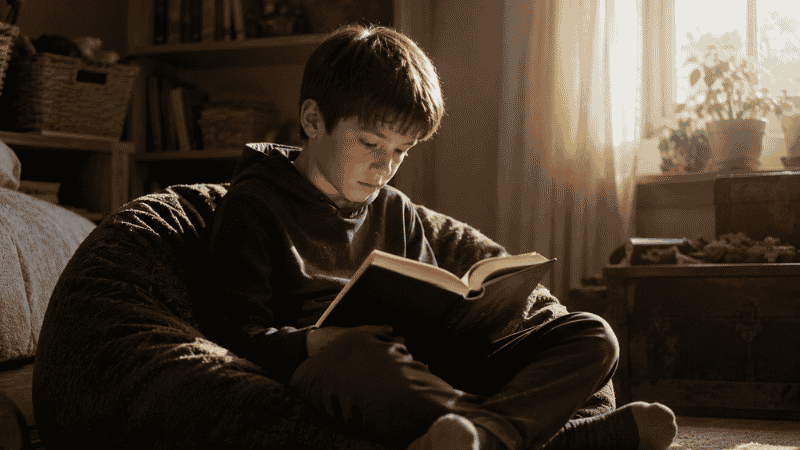
There’s a particular kind of quiet that settles over a house when a nine-year-old is reading.
It’s different from the quiet of a sleeping child, or the quiet of a child watching a screen. It’s a specific, inhabited silence — the kind that has a person in it. You walk past the bedroom door and there they are, completely elsewhere. Book open, the world closed out, fully gone into whatever is happening on page 247.
Nine is when that happens most completely. The mechanics of reading have disappeared — there’s no effort anymore, just absorption. Children this age read the way adults do: not to practice, but to live inside something else for a while.
And yet. Nine is also the age when children are quietly building something that will define the next decade of their lives — a sense of identity, a framework for understanding fairness and belonging and what they stand for. The best books for 9-year-olds aren’t just good stories. They’re part of that construction. They offer models of courage and friendship and moral complexity that children this age are actively looking for, whether they know it or not.
This guide is built for that work.
Key Takeaways
- Nine-year-olds who read for pleasure for 30 minutes a day encounter an estimated 2.7 million words per year — a vocabulary exposure that drives significant academic advantages across every subject (Anderson, Wilson & Fielding, 1988).
- Fourth grade marks the transition to “reading to learn” across the curriculum — children who are not reading fluently and independently by this point face compounding challenges in science, social studies, and mathematics (Chall, 1983).
- Books that feature characters navigating identity, justice, and belonging are developmentally matched to nine-year-olds, who are actively constructing their own sense of self and social world.
- Read-aloud remains valuable at nine: listening comprehension still exceeds reading level by two or more years, meaning shared reading continues to build vocabulary and comprehension beyond what independent reading provides.
- Series loyalty at this age is a feature, not a bug — children who read an entire series develop stronger narrative comprehension, character analysis, and sustained reading stamina than those who read standalone books exclusively.
What Nine-Year-Olds Need From Books That Eight-Year-Olds Didn’t
The shift from eight to nine is subtler than earlier transitions, but it’s real.
Eight-year-olds want to be entertained and to feel capable. Nine-year-olds want something more: they want to feel understood. They’re entering the early edge of preadolescence — not there yet, but sensing it. Social dynamics are more complex. Friendships feel more consequential. Questions about fairness, identity, and what kind of person they want to be are becoming genuinely urgent, even if they don’t arrive with that language attached.
The best books for 9-year-olds meet that urgency without being heavy-handed about it. They tell good stories — funny, exciting, adventurous — that happen to also be about something real. Characters who figure out who they are while also defeating a villain or solving a mystery or surviving something difficult. The entertainment and the meaning aren’t separate. They’re the same thing.
Nine is also the age when children start to notice craft. They’re old enough now to appreciate how a book is written — a perfect sentence, a plot twist that was hidden in plain sight, a character detail that pays off fifty pages later. This is the age when readers sometimes become writers, almost by accident, because they’ve started reading the way writers read: noticing how the magic is made.
Best Books for 9-Year-Olds: Series Worth Every Night
Fantasy and Adventure Series for 9-Year-Olds
Harry Potter series — Books 4 and 5 by J.K. Rowling
If your child read Books 1-3 at eight, nine is the right time to continue. Goblet of Fire and Order of the Phoenix are significantly longer and darker — real death, political manipulation, grief, the specific rage of feeling that adults in power are lying to you. Nine-year-olds are emotionally ready for this in a way that eight-year-olds often aren’t.
Why it works at 9: The themes of Goblet of Fire and beyond — injustice, loyalty under pressure, the difference between following rules and doing what’s right — are exactly what nine-year-olds are thinking about in their own social worlds. Harry’s anger in Order of the Phoenix, which frustrates some adult readers, is one of the most honest portrayals of being nine or ten that children’s literature has ever produced.
How to read it: If they’re reading independently, let them go completely. If you’re reading aloud, these books reward it — the emotional payoffs are bigger when they’re shared. Many families report that reading Goblet of Fire aloud was when the series became a family touchstone rather than just a child’s book.
📦 Series — continuing from Book 4: Goblet of Fire
⭐ Worth the Splurge — the illustrated Jim Kay editions for Books 1-4 are extraordinary
The Ranger’s Apprentice series by John Flanagan
Will is an orphan who hopes to become a knight but is instead apprenticed to Halt, a mysterious Ranger who protects the kingdom through stealth and skill rather than strength. The series is set in a medieval world with real tactical detail, genuine danger, and a mentor-apprentice relationship that is one of the most satisfying in children’s literature.
Why it works at 9: Nine-year-olds are at the age where competence is deeply appealing — not the effortless competence of a chosen hero, but the earned competence of someone who practiced until they were excellent. Will’s development across the series models exactly that, and children who follow it feel themselves growing alongside him.
How to read it: Two chapters per night. The tactical details — how a ranger moves through a forest, how a trap is set, how a bow is drawn correctly — are specific enough that children often go outside and try to replicate them. That embodied engagement is part of why the series creates such loyal readers.
📦 Series — 12 books; The Ruins of Gorlan is Book 1
💰 Budget Pick — paperback editions widely available
Redwall series by Brian Jacques
A medieval world populated entirely by animals — mice, badgers, otters, weasels, rats — who build abbeys, fight wars, and go on epic quests. The series is enormous (22 books) and each one is complete in itself, which means children can read them in any order after the first. The food descriptions alone have inspired devoted fan communities.
Why it works at 9: The Redwall books are fully immersive in a way that requires and rewards sustained attention. The villains are genuinely threatening, the heroes are genuinely tested, and the world has enough internal consistency that children build a mental map of it over multiple books. Nine-year-olds who find their way into this series often read the whole thing.
How to read it: Start with Redwall, then let them choose. The books are designed to be read in any order after the first, and letting a child choose their own path through a series is its own form of reading empowerment.
📦 Series — 22 books; Redwall is the entry point
💰 Budget Pick
Books for 9-Year-Olds About Identity and Belonging
These are the books that do the deeper work — the ones that help children figure out who they are and what they stand for.
Wonder by R.J. Palacio
Auggie Pullman has a facial difference. He is starting middle school for the first time. The story is told from multiple perspectives — Auggie’s, his sister’s, his friends’ — and it is, at its core, about what it costs to be kind when kindness is not convenient.
Why it works at 9: Nine-year-olds are navigating social hierarchies with a new intensity — who is popular, who is excluded, what it means to stand up for someone at a cost to yourself. Wonder doesn’t offer easy answers. It shows the full complexity of what kindness actually requires, which children this age are ready to engage with honestly.
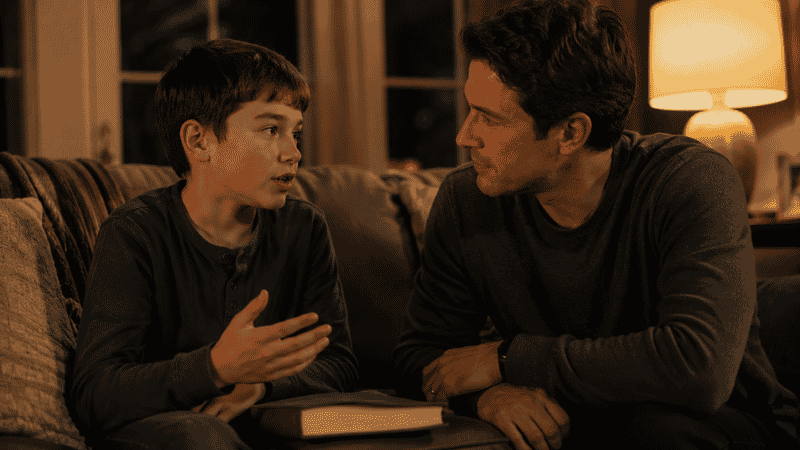
How to read it: Read it together if you can — the multiple perspectives reward discussion. After Via’s section, ask: “What’s it like to be the sibling of someone who needs a lot of attention?” The conversations this book opens are among the most valuable any family will have.
💰 Budget Pick — paperback widely available; leads into the companion Auggie & Me
Inside Out and Back Again by Thanhha Lai
Ten-year-old Hà flees Saigon with her family in 1975 and resettles in Alabama, where she must learn English, navigate a new culture, and hold onto her sense of self in a place that doesn’t yet know how to see her. Written entirely in verse — which sounds experimental but reads as completely accessible and deeply moving.
Why it works at 9: The verse format makes each entry short and punchy enough to hold attention, while the cumulative emotional weight builds to something genuinely affecting. Children who have ever felt like an outsider — in a new school, a new neighborhood, a new situation — will recognize Hà’s experience as their own in some fundamental way.
How to read it: Read it aloud. The verse is designed for the voice. Read slowly enough that each poem lands fully before moving to the next. It takes less than two hours to read aloud in its entirety — the kind of book that works as a single long reading session.
⭐ Worth the Splurge — National Book Award winner
Hatchet by Gary Paulsen
Brian Robeson’s plane crashes in the Canadian wilderness. He survives alone for 54 days with nothing but a hatchet. The novel is spare, precise, and completely gripping — a story about what a person actually needs to stay alive, both physically and psychologically.
Why it works at 9: Nine-year-olds are at the age where self-reliance becomes genuinely appealing — the fantasy of being competent enough to survive. Brian’s problem-solving is specific and real: how do you start a fire? how do you find food? how do you not give up? The answers feel earned because they are.
How to read it: Read it aloud if you can — Paulsen’s prose has a rhythm that rewards being heard. Pause at the moments where Brian fails and ask: “What would you do differently?” The problem-solving engagement deepens comprehension significantly.
📦 Series — leads into The River and Brian’s Return
💰 Budget Pick — Newbery Honor
Mystery and Thriller Books for 9-Year-Olds
Nine-year-olds are old enough for mysteries with genuine stakes and real complexity. These are the ones that deliver.
The London Eye Mystery by Siobhan Dowd
Ted and Kat’s cousin Salim gets into a pod on the London Eye and never comes out. Ted — who has a different kind of brain that processes the world in unusual ways — sets out to solve the mystery. The novel is partly a thriller and partly a portrait of a neurodivergent child whose way of thinking turns out to be exactly the kind of thinking the mystery requires.
Why it works at 9: The mystery is genuinely solvable — the clues are all there. But the book is really about Ted, and children who have ever felt that their mind works differently from everyone else’s find something quietly profound in watching Ted’s differences become his greatest asset.
How to read it: Keep a running list of suspects together. Commit to a theory before the reveal. When you’re wrong — and you probably will be — talk about which clue you missed and where it was hidden.
💰 Budget Pick
From the Mixed-Up Files of Mrs. Basil E. Frankweiler by E.L. Konigsburg
Still excellent at nine for children who haven’t read it yet — and richer on a second read at this age than it was at eight. The mystery deepens, the logistics become more interesting, and Claudia’s quest for something she can’t quite name resonates differently at nine than it did a year earlier.
💰 Budget Pick — Newbery Medal winner
Nonfiction Books for 9-Year-Olds Who Love Facts
The Wonders of Nature series by Ben Hoare (and similar DK Eyewitness titles)
Nine-year-olds who are curious about the natural world often need nonfiction that goes deep rather than wide — books that treat a subject with the same seriousness the child brings to it. DK Eyewitness and similar series provide the specificity and visual richness that this age group finds deeply satisfying.
How to use it: Don’t read cover to cover — browse. Let your child lead. Ask them to tell you something you don’t know from what they’ve read. The teaching-back process deepens retention and gives a child who loves facts an audience for their knowledge.
💰 Budget Pick — individual titles under $20; library editions often available
Hidden Figures Young Readers’ Edition by Margot Lee Shetterly
The true story of the Black women mathematicians who helped NASA win the Space Race — adapted for middle-grade readers. The Young Readers’ Edition preserves the essential story while making it accessible and immediate for nine-year-olds.
Why it works at 9: Nine-year-olds who are beginning to understand how systems work — and how some people are excluded from them — find this story genuinely galvanizing. It’s about brilliance, persistence, and the specific kind of courage required to be excellent in a room where you’re not supposed to be.
How to read it: Read it together. The conversations about what fairness means, about what these women were up against, about what changed and what didn’t — those conversations are among the most worthwhile you can have with a nine-year-old.
💰 Budget Pick
What to Skip at Age 9: The Honest Version
Young adult books that are technically readable but emotionally premature. Many nine-year-olds are fluent enough to decode YA novels, but fluency and readiness are different things. Books dealing with romantic relationships, sexual identity, substance use, or severe depression are better held until twelve or thirteen — not because children shouldn’t eventually encounter these themes, but because the developmental context for processing them meaningfully comes later. A book read before a child is ready is rarely damaged by waiting; a child’s relationship with reading sometimes is.
Fifty-book lists that recommend everything. A list of fifty books is a list of no books in particular. At nine, children benefit from depth over breadth — three books read slowly and discussed are worth more than fifteen books consumed and forgotten. Choose fewer, go deeper.
Books chosen to fill reading logs rather than fill imaginations. If the goal of reading time has become completing a school reading log, something has gone wrong with the framing. Reading logs and minutes-per-day goals can make reading feel like homework. At nine, reading for pleasure should be protected as pleasure.
When Reading Is Still a Struggle at 9: Real Strategies
For the child who reads well but has stopped reading for fun: Something has likely made reading feel like work. Remove all visible measurement from home reading — no logs, no timers, no questions after. Find the audiobook of whatever they’re currently obsessed with and make it available without comment. Rebuild the association between story and pleasure before reintroducing independent reading expectations.
For the child who is still reading below grade level: Audiobooks are not a consolation prize — they’re a legitimate and effective way to build vocabulary, comprehension, and love of story while decoding skills continue to develop. Let them listen to books that are above their independent reading level. The exposure matters more than the format.
For the child who only reads in one genre: This is not a problem. A nine-year-old who reads only fantasy, or only animal books, or only graphic novels, is building real skills and a real reading identity. Expand from inside their interests rather than redirecting away from them.
A Note on Reading and Screen Competition at Age 9
Nine is often the age when the competition between screens and books becomes most acute. Children this age have social media-adjacent apps, gaming, and streaming all competing for the same attention that reading needs.
The research is clear that children who read for pleasure at nine are significantly more likely to be readers at fourteen — and that the inverse is also true. The habits formed in these years are sticky.
This doesn’t mean eliminating screens. It means protecting reading time with the same intentionality you’d give anything else that matters. A specific reading time, a specific reading place, and a parent who is also reading nearby are the three most effective environmental factors in maintaining a reading habit through the middle years.
FAQ: What Parents of Nine-Year-Olds Actually Search For
What reading level should a 9-year-old be at? By the end of fourth grade, most children are reading at approximately DRA Level 44–50, or Guided Reading Level P–S. But this range is genuinely wide, and children on both ends are frequently typical. Growth over time matters more than a single benchmark. If your child is reading fluently and with comprehension — if stories are landing, if they’re laughing at the right moments and asking questions about what happens next — the level is less important than the engagement.
Is Harry Potter okay for 9-year-olds? Books 4 and 5 are well-matched to nine-year-olds who have read the earlier books. Goblet of Fire’s themes of death, injustice, and political manipulation land differently at nine than they would at seven — children this age have the emotional context to process them meaningfully. Books 6 and 7 are better held until ten or eleven; they’re darker and more complex in ways that benefit from slightly more emotional development.
How long should a 9-year-old read each day? Thirty minutes of independent reading per day is well-supported by research for this age. But the quality of engagement matters enormously — a thirty-minute session where the child is genuinely absorbed is worth significantly more than an hour of distracted page-turning. If your child is reading voluntarily beyond whatever time you’ve set, do not interrupt them under any circumstances. That voluntary extension is the habit itself.
What are the best series books for 9-year-olds? For independent reading: Harry Potter (continuing), Ranger’s Apprentice, Redwall, Hatchet and its sequels. For read-aloud: Wonder, Hatchet, Inside Out and Back Again. The best series is always the one your child will actually read — follow their enthusiasm wherever it leads.
What is a good book for a 9-year-old who loves animals? Hatchet (survival with animals), the Redwall series (animal characters), Shiloh by Phyllis Reynolds Naylor (a boy and a dog in rural West Virginia), and Mrs. Frisby and the Rats of NIMH by Robert C. O’Brien are all excellent. For nonfiction animal lovers, the DK Eyewitness series on specific animals, and The One and Only series by Katherine Applegate, are deeply satisfying.
How do I get my 9-year-old to read more when they say books are boring? “Books are boring” usually means “the books I’ve encountered so far haven’t been for me.” Find out what they love in other formats — games, shows, topics — and look for books in that territory. A child who loves Minecraft may not have encountered the survival-and-strategy genre in book form yet. A child who loves mystery shows hasn’t met the right mystery novel. The book they need exists; it just hasn’t found them yet.
Are Percy Jackson books okay for 9-year-olds? Completely — and nine-year-olds who read them at eight often get significantly more from them the second time. The themes of identity, belonging, and what it means to discover your own strength resonate more deeply at nine than at eight. The Heroes of Olympus series (the sequel series) is also very well-matched to this age.
One Last Thing
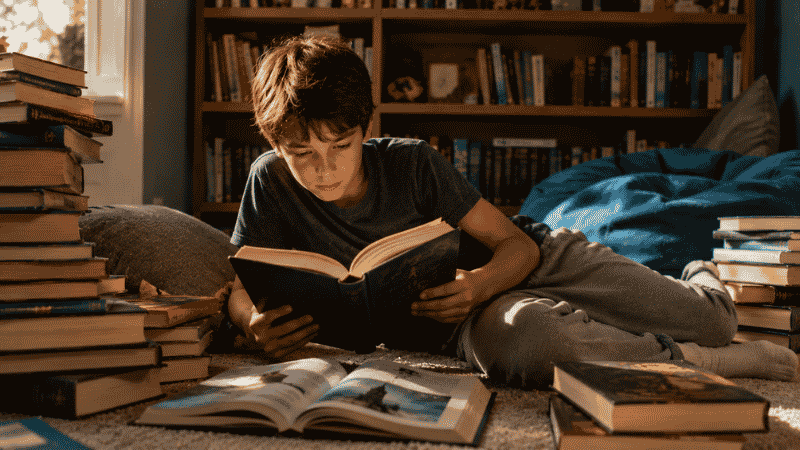
That inhabited quiet — the silence with a person in it — is one of the best things a house can hold.
At nine, you can’t make it happen. You can only create the conditions for it: good books available, time protected, screens put away, a reading life modeled by the adults they love most.
And then you walk past the door, and there they are. Completely elsewhere. Home and gone at the same time.
That’s the whole thing. That’s everything reading is supposed to do.
References
- Anderson, R.C., Wilson, P.T., & Fielding, L.G. (1988). “Growth in Reading and How Children Spend Their Time Outside of School.” Reading Research Quarterly, 23(3), 285–303.
- Chall, J.S. (1983). Stages of Reading Development. McGraw-Hill.
- Sullivan, A., & Brown, M. (2015). “Reading for Pleasure and Progress in Vocabulary and Mathematics.” British Educational Research Journal, 41(6), 971–991.
- Clark, C., & Rumbold, K. (2006). Reading for Pleasure: A Research Overview. National Literacy Trust. https://literacytrust.org.uk
Laura Bennett is the founder of ZestRead and a mom who has learned to recognize the quality of silence that means her daughter is on page 247 and should not be interrupted for anything short of a fire. She writes about children’s reading, family education, and the books that help children become more fully themselves. Reach her at info@zestread.com