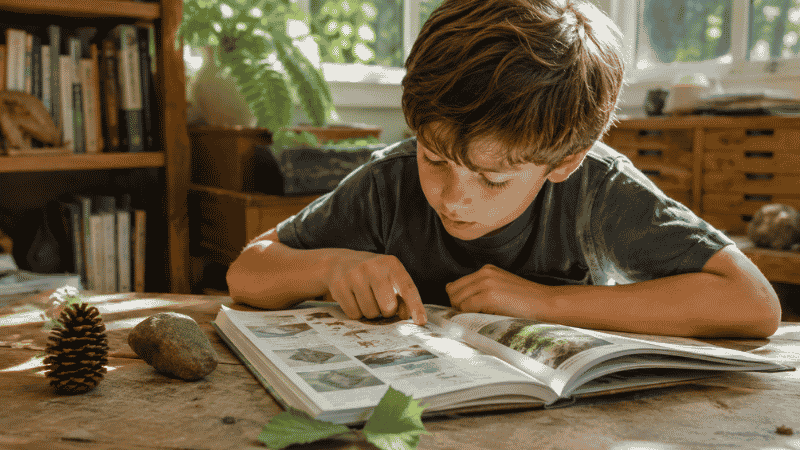
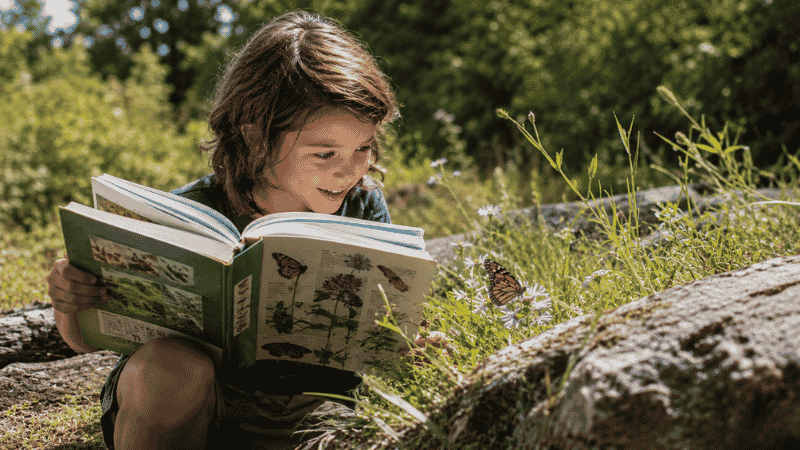
My daughter was four years old when she refused to let me read her a picture book about butterflies.
Not because she didn’t like butterflies. Because I’d gotten the metamorphosis wrong.
“That’s not how it works,” she said, with the patience of someone explaining something obvious to someone who should know better. “The caterpillar doesn’t just sleep. It turns into liquid inside the chrysalis and then rebuilds itself.”
She had, apparently, read this somewhere. In a book I didn’t know she’d found on the bottom shelf. A nonfiction book about insects that I’d bought somewhat hopefully, not expecting much.
That was the day I stopped treating nonfiction books for kids as the responsible vegetables on the literary plate — the things you offer alongside the fiction children actually want. Because the child who turns into liquid and rebuilds herself inside a chrysalis? She had found something in that nonfiction book that no story had given her: the shock of a true thing, more astonishing than anything invented.
This guide is for parents who want to find those books — the nonfiction books for kids that actually get read, actually get remembered, and actually change how children see the world.
Key Takeaways
- Nonfiction books build vocabulary at a faster rate than fiction for many children — they introduce domain-specific language in context, which research shows is the most effective form of vocabulary acquisition (Duke, 2000).
- Some children — particularly those who struggle with fiction — are natural nonfiction readers. These children are not “behind” in reading; they are reading in the format that suits their cognitive style.
- The best nonfiction books for kids read like good stories: they have narrative arc, emotional stakes, and characters (human or animal) that readers care about.
- Science books, history books, and nature books for kids are not separate categories — the best books often combine all three, and children who love one usually find their way to the others.
- Nonfiction read-alouds produce more conversation than fiction read-alouds, because every page offers something to discuss, question, or disagree with.
Why Nonfiction Books for Kids Deserve More Shelf Space
Most family bookshelves are heavily weighted toward fiction. This reflects the way adults were raised to think about children’s literature — stories are imagination, nonfiction is school. The fiction is for pleasure; the nonfiction is for learning.
This split is false, and it does children a disservice.
The best nonfiction books for kids are not textbooks. They are not dry summaries of facts organized by topic. They are books about specific, astonishing things — the life cycle of a star, the social organization of ants, the year a teenage girl convinced Napoleon to support her army — written by people who find those things so interesting they can’t stop themselves from sharing them.
Research on reading comprehension consistently shows that children need exposure to both fiction and nonfiction to develop the full range of literacy skills they’ll need in school. Reading nonfiction helps young children build a cache of knowledge they’ll draw on in school and throughout life. But more importantly for the purposes of this guide: nonfiction books give fact-hungry children permission to be exactly who they are. The child who knows the internal temperature of a chrysalis isn’t a difficult reader. She’s a reader who hasn’t found her genre yet.
How to Choose Nonfiction Books for Kids (The Three-Question Test)
Before the list, a framework for evaluating any nonfiction book at any age — three questions to ask before you buy:
Does it have a story underneath? The best nonfiction for children is narrative — it follows something across time, builds toward something, has stakes. A biography has a character who wants something. A nature book follows an animal through a season. A history book builds toward a moment that changed everything. If a book is organized as pure information without narrative structure, it works better as a reference book than a read.
Does it trust the child? The worst nonfiction books for kids are condescending — they simplify to the point of inaccuracy, or they constantly pause to remind the reader that this is hard. The best ones assume an intelligent reader who can handle complex ideas if they’re clearly explained. Look for books that explain things at the right level, not below it.
Does it make you want to know more? A great nonfiction book ends with a child who has more questions than they started with. If a book leaves a child feeling like they’ve covered the subject — checked it off — it has done the least interesting thing nonfiction can do. The best books open doors rather than closing them.
Best Nonfiction Books for Kids by Age
Best Nonfiction Books for Young Children (Ages 3–6)
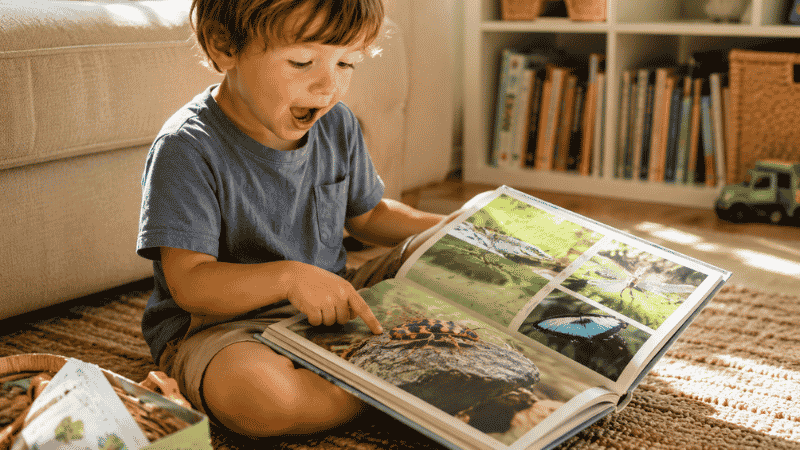
Young children are natural nonfiction readers — they just don’t know it yet. Every “why?” is a nonfiction question. Every “what’s that?” is a request for real information. The nonfiction books that work at this age are picture books that take real things seriously.
National Geographic Little Kids First Big Books series
National Geographic’s series for young children — covering animals, space, the ocean, bugs, and more — is the gold standard of nonfiction for this age. The photographs are extraordinary. The information is accurate and appropriate for preschoolers. Each book is organized around questions (“What does a lion eat?”) that mirror the way young children actually think.
Why it works: The question-answer format gives young children a structure they can follow independently. Children who can’t yet read will spend twenty minutes with these books looking at photographs and absorbing information.
How to read it: Don’t read straight through. Ask: “What do you think the answer is?” before revealing the page. Then ask: “Were you right?” The prediction-and-confirmation loop is deeply satisfying to children and builds scientific thinking simultaneously.
💰 Budget Pick — individual titles under $20, durable hardcover
Over and Under the Pond by Kate Messner, illustrated by Christopher Silas Neal
A mother and child canoe across a pond while the text describes everything happening above and below the water’s surface simultaneously — the heron and the fish, the dragonfly and the crayfish. The illustrations are split between above-water and below-water views on each spread. Scientifically accurate, visually extraordinary, and completely compelling as a read-aloud.
Why it works: The split-view illustration does something no photograph can do — it shows two worlds at once, making visible the invisible ecosystem beneath the surface. Children who read this book look at ponds differently for the rest of their lives.
How to read it: After each spread, ask: “What’s happening above the water? What’s happening below?” The parallel structure is something children can track and feel smart tracking.
⭐ Worth the Splurge — the illustration quality justifies the hardcover
📦 Series — Over and Under the Snow, Over and Under the Rainforest follow naturally
Ada Twist, Scientist by Andrea Beaty, illustrated by David Roberts
Ada is three years old and full of questions. When a terrible smell fills the house, she applies the scientific method to find the source. The book celebrates curiosity as a character trait — not just as a means to an end — and Ada’s relentless “why?” is presented as the best thing about her, not an annoyance.
Why it works at 3–6: For children who are already asking “why?” constantly, this book says: that impulse is exactly right. You are a scientist. Keep going.
How to read it: Ask “what do you think Ada will try next?” before each page turn. Let your child predict the experiment. The scientific thinking is embedded in the story structure.
💰 Budget Pick — leads into Iggy Peck Architect and Rosie Revere Engineer
Bugs! Bugs! Bugs! by Bob Barner
For the child who wants to know everything about insects right now. Bold illustrations, accurate information, strong rhythm. Covers ants, beetles, butterflies, fireflies, and more in a format that works for children as young as two. One of the best entry points to the natural world in picture book form.
💰 Budget Pick
Best Nonfiction Books for Early Readers (Ages 6–9)
At this age, children can follow longer nonfiction narratives and are ready for books that go deeper into subjects — biography, narrative science, and illustrated history.
Shaking Things Up: 14 Young Women Who Changed America edited by Susan Hood
Fourteen poems about fourteen young women who changed history — Malala Yousafzai, Ruby Bridges, Temple Grandin, and others — each illustrated by a different female artist. The format means each profile is complete in itself, making it easy to dip in and out. Each woman is introduced at the age when she did the thing she’s known for — which means the reader is always measuring against themselves.
Why it works at 6–9: The subjects are young — many were children when they acted. This makes the book immediately personal: “She was nine. I’m nine.” The leap from page to possibility is very short.
How to read it: Read one profile per sitting. After each, ask: “What would you have done?” Don’t rush to the next one.
💰 Budget Pick
The Brilliant Deep: Rebuilding the World’s Coral Reefs by Kate Messner, illustrated by Matthew Forsythe
The story of Ken Nedimyer, who discovered coral growing on a shipwreck in the Florida Keys and spent thirty years figuring out how to grow coral in ocean nurseries. A true story about one person doing something that seemed impossible. The illustrations are luminous; the science is accurate and accessible.
Why it works: It answers the question children most often ask about environmental problems: “But what can I do?” One person can do something. This book shows what.
How to read it: After finishing, ask: “What’s one impossible thing you could start?” The book is designed to produce exactly this conversation.
⭐ Worth the Splurge
Bomb: The Race to Build — and Steal — the World’s Most Dangerous Weapon by Steve Sheinkin
Already recommended in the 10-year-old and 12-year-old book lists, and worth repeating here for strong readers at 8–9. The true story of the Manhattan Project, told with thriller pacing — three parallel storylines (the scientists building the bomb, the Soviet spies trying to steal it, the Norwegian saboteurs trying to stop it) that converge in one of the most consequential moments of the twentieth century.
Why it works: Sheinkin proved that nonfiction can be as unputdownable as any novel. Children who read Bomb often say it was the first nonfiction book they read voluntarily past their bedtime.
How to read it: Read aloud together for the first three chapters to establish the parallel storylines. After that, many children will take over independently.
💰 Budget Pick — National Book Award finalist
Nic Bishop Spiders by Nic Bishop
Bishop’s macro photography of spiders is among the most extraordinary in children’s nonfiction. The photographs — taken over years, with extreme patience — show spider anatomy, behavior, and hunting in detail that no illustration can replicate. The text is accurate, engaging, and pitched perfectly for this age.
Why it works: Children who are afraid of spiders and children who are fascinated by spiders both find this book transformative. The scale of the photography makes the familiar alien and the alien familiar.
💰 Budget Pick — part of the Nic Bishop series covering frogs, butterflies, snakes, and more
Best Science Books for Kids (Ages 7–10)
The Way Things Work Now by David Macaulay
How does a zipper work? A nuclear reactor? A touchscreen? Macaulay’s illustrated explanations of machines, technology, and physics have been in print since 1988 because they are genuinely the clearest explanations of how things work that have ever been written for children. Every spread is a complete lesson; the book works as both a cover-to-cover read and a reference.
Why it works: Children who need to understand how things work — not just what they do, but the actual mechanism — find this book revelatory. It’s the book that creates engineers.
How to read it: Don’t read it cover to cover. Browse. Follow curiosity. Start with whatever your child most wants to understand right now.
⭐ Worth the Splurge — the updated edition includes digital and modern technology
Mesmerized: How Ben Franklin Solved a Mystery that Baffled All of France by Mara Rockliff, illustrated by Iacopo Bruno
Benjamin Franklin, commissioned by King Louis XVI, investigates a celebrated French physician who claims to have discovered “animal magnetism” — an invisible force that can cure disease. Franklin designs experiments to test the claim and finds… nothing. A book about the scientific method disguised as a historical mystery.
Why it works: The story teaches the difference between a compelling story and a testable claim — one of the most important scientific thinking skills there is — through one of the most entertaining historical episodes imaginable.
💰 Budget Pick
An Inconvenient Truth (Young Adult Adaptation) by Al Gore
The young readers adaptation of Gore’s landmark book on climate change — updated, accessible, and visually compelling. For children who are already asking questions about the environment and want real information rather than reassurance.
How to read it: Read together and discuss one chapter at a time. The book is designed to prompt questions; make space for them.
💰 Budget Pick
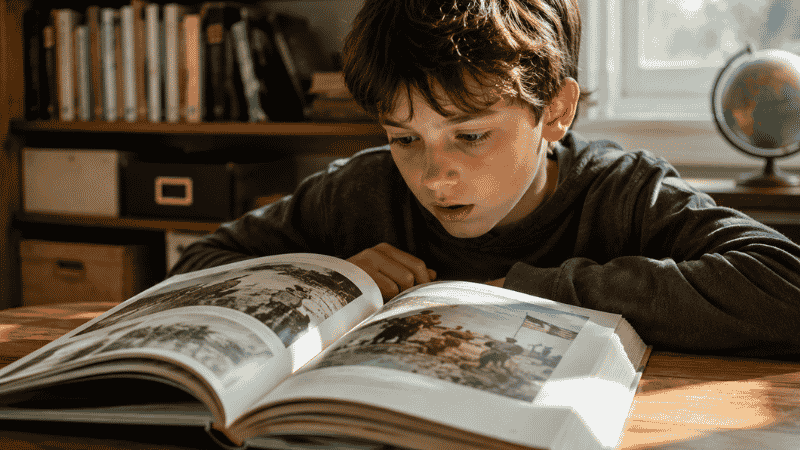
Best History Books for Kids (Ages 8–12)
Hidden Figures Young Readers’ Edition by Margot Lee Shetterly
The true story of the Black women mathematicians — Katherine Johnson, Dorothy Vaughan, Mary Jackson — who calculated the trajectories that sent American astronauts to space. Already recommended in the nine-year-old book list; essential here.
Why it works: It’s a story about brilliance, about systems designed to exclude, and about what happens when brilliant people refuse to be excluded. Children who read this book understand both the history of space exploration and the history of civil rights more completely.
💰 Budget Pick
The Boy Who Harnessed the Wind by William Kamkwamba and Bryan Mealer (Young Readers Edition)
William Kamkwamba was fourteen years old in Malawi when a famine threatened his family. He taught himself physics from a library book and built a windmill from scrap metal that generated electricity. A true story about resourcefulness, curiosity, and what one person can do with limited materials and unlimited determination.
Why it works at 8–12: Children at this age are beginning to ask what they’re capable of. This book answers the question more powerfully than any motivational speech.
How to read it: Find Malawi on a map before you begin. The geography grounds the story and makes the accomplishment more concrete.
💰 Budget Pick
Sapiens: A Brief History of Humankind (Young Adult Adaptation) by Yuval Noah Harari
How did Homo sapiens come to dominate the planet? What made us different from other animals? Young readers will discover how humans evolved into a dominant species, took over the world, fought wars, and established countries. The YA adaptation is genuinely accessible for strong ten-to-twelve-year-old readers without sacrificing the intellectual ambition of the original.
Why it works: It takes seriously a question that children find genuinely fascinating — why are humans the way they are? — and answers it with evidence rather than assumption.
💰 Budget Pick
I Am Malala (Young Readers Edition) by Malala Yousafzai
Malala was fifteen when she was shot by the Taliban for the crime of going to school. The Young Readers Edition tells her story at a level accessible for children from age ten, and it is — at its core — a book about believing you have the right to exist as you are, and acting on that belief in the face of real danger.
Why it works: Malala is not brave because she is fearless. She is brave because she is afraid and goes anyway. This distinction — which adults rarely make explicit — is one that children need to encounter in a real story.
💰 Budget Pick
Best Nature Books for Kids (All Ages)
The Hike by Alison Farrell
A group of friends goes on a day hike and notices everything — mushrooms, birds, rocks, insects — recording what they see in their field notebooks. The illustrations are detailed and warm; the back matter includes identification guides for what the characters observed. This is a book that sends children outside.
Best at: Ages 4–8 How to use it: Take it on an actual hike. The field guide format becomes a real tool.
💰 Budget Pick
The Forest in the Clouds by Sneed B. Collard III, illustrated by Michael Rothman
Set in the cloud forests of Costa Rica, this narrative nonfiction book follows scientists studying the extraordinary biodiversity of one of the most fragile ecosystems on earth. The illustrations are detailed and atmospheric; the science is presented through the experience of real researchers doing real work.
Best at: Ages 7–10
💰 Budget Pick
Tracking Trash: Flotsam, Jetsam, and the Science of Ocean Motion by Loree Griffin Burns
Scientists track plastic garbage floating in the ocean to understand ocean current patterns — and what they find reveals both the scale of ocean pollution and the remarkable predictability of ocean motion. A book about a genuinely fascinating scientific puzzle that happens to also be about an urgent environmental problem.
Best at: Ages 8–12
💰 Budget Pick
When Your Child Says “I Don’t Like Nonfiction”
This almost always means they haven’t found their subject yet.
The child who says they don’t like nonfiction has usually only encountered nonfiction in school — as assigned reading, often on subjects chosen by someone else, often with comprehension questions afterward. This is nonfiction as obligation. It produces nothing except the conviction that nonfiction is boring.
The fix is simple: find the subject they find irresistible. Every child has one. Dinosaurs. Deep-sea creatures. World War II. Ancient Egypt. The physics of sport. The biology of food. Whatever they can’t stop asking about — find the best nonfiction book on that exact subject and put it in their hands without comment.
The subject creates the reader. Let the subject lead.
FAQ: What Parents Actually Search About Nonfiction Books for Kids
What are the best nonfiction books for kids? The best nonfiction books for kids combine accurate information with narrative structure — they tell a story, have characters (human or animal) that readers care about, and leave children wanting to know more. The best starting points by age: National Geographic series for ages 3–6; Shaking Things Up and Bomb for ages 6–10; Hidden Figures and I Am Malala for ages 10–12.
What are the best science books for kids? The Way Things Work Now (mechanics and physics), Mesmerized (scientific method through history), the Nic Bishop photography series (natural science), and An Inconvenient Truth Young Adult Edition (environmental science) are the most consistently engaging science books across ages 7–12.
What are good history books for kids? Bomb by Steve Sheinkin (Manhattan Project), Hidden Figures Young Readers’ Edition (space race and civil rights), The Boy Who Harnessed the Wind (modern Africa and resourcefulness), and I Am Malala (education and human rights) are the history books most likely to produce genuine engagement rather than obligatory reading.
Are nonfiction books good for reluctant readers? Often, yes. Many reluctant readers are reluctant fiction readers who haven’t been offered nonfiction on subjects they actually care about. The shorter chapters, the real stakes, and the absence of fictional world-building they may find exhausting can make nonfiction more accessible. Dog Man creator Dav Pilkey himself struggled with reading — and found his way through comics and visual storytelling. Format flexibility matters enormously for reluctant readers.
How do I get my child interested in nonfiction? Follow their existing obsessions completely. If they love Minecraft, find nonfiction about game design or computer programming. If they love soccer, find nonfiction about the physics of sport or the history of the World Cup. If they love animals, start with Nic Bishop’s photography books. Interest is the engine; everything else follows.
At what age should kids start reading nonfiction? From birth — board books that show real photographs of real objects are nonfiction. The question isn’t age but format: picture book nonfiction from age 2, narrative nonfiction from age 6, and longer nonfiction chapter books from age 9 or 10. The progression is less about age than about reading level and subject interest.
One Last Thing
My daughter is nine now. She still reads nonfiction with the same intensity she brought to that insect book at four — but the subjects have expanded. She went from insects to ocean biology to the history of pandemics to a recent, consuming interest in the mathematics of music.
The chrysalis fact is still in there. She mentioned it last month, correctly and in context, five years after she first read it.
That’s what the best nonfiction books for kids do. They don’t just inform — they install. The right fact, encountered at the right age, in the right book, becomes part of how a child understands the world.
The books on this list are the ones most likely to do that. Start wherever your child’s curiosity is brightest. Let the subject lead.
Keep exploring on ZestRead:
- Best Books for 6-Year-Olds: The Year They Start Reading Themselves
- Best Books for 7-Year-Olds: When Reading Really Takes Off
- Best Books for 8-Year-Olds: Readers Finding Their Own Path
- Best Books for 9-Year-Olds: The Independent Reader Who Still Needs You
- Best Books for 10-Year-Olds: The Last Year Before Everything Changes
- Classic Children’s Books Every Family Should Own: A Real Mom’s Guide by Age
- Caldecott Medal Books: The Best Award-Winning Picture Books and How to Read Them
References
- Duke, N.K. (2000). “3.6 Minutes per Day: The Scarcity of Informational Texts in First Grade.” Reading Research Quarterly, 35(2), 202–224.
- Pappas, C.C. (1993). “Is Narrative ‘Primary’? Some Insights from Kindergartners’ Pretend Readings of Stories and Information Books.” Journal of Reading Behavior, 25(1), 97–129.
- American Library Association. (2023). “Sibert Medal and Honor Books.” https://www.ala.org/alsc/awardsgrants/bookmedia/sibertmedal
- National Council of Teachers of English. (2017). “Nonfiction in the Classroom: Best Practices.” https://ncte.org
Laura Bennett is the founder of ZestRead and a mom whose daughter corrected her butterfly facts at age four and has not stopped reading nonfiction since. She writes about children’s reading, book recommendations, and the specific joy of a child who has found their subject. Reach her at info@zestread.com