
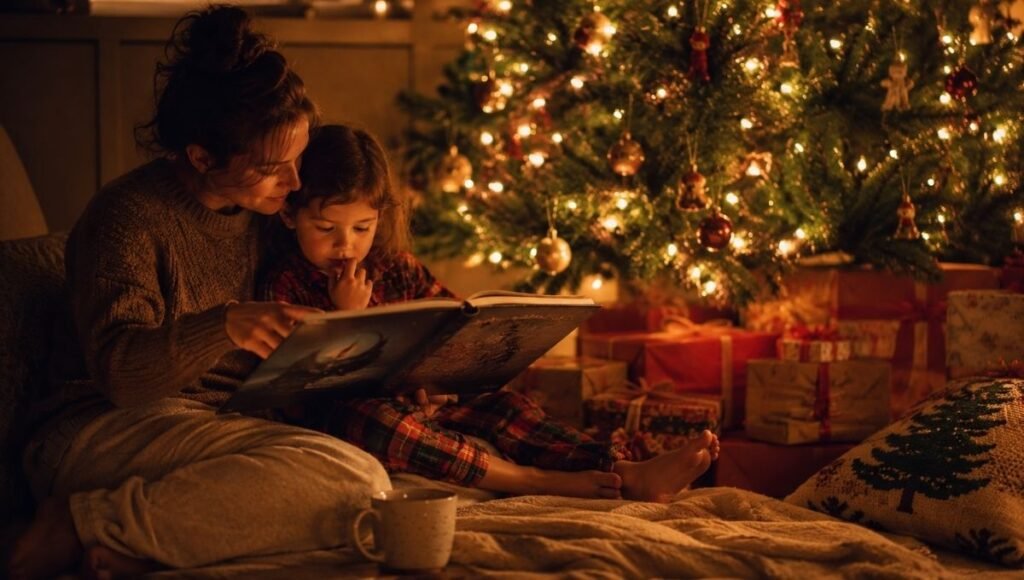
It started with an Advent calendar made of paper bags.
Each bag had a number, and inside each bag was a small gift — sometimes candy, sometimes a little toy. And in a few of the bags, a Christmas book. My daughter was three, and the night she pulled out The Polar Express was the night I understood what Christmas books could actually do.
We read it twice that night. She made me read it twice. And then she asked to sleep with it beside her pillow, which seemed slightly impractical for a large hardcover but felt too important to argue about.
That was eight years ago. We still have that copy. The spine is soft. Some of the pages have finger-shaped wrinkles in the corners. And every December, when I pull out the Christmas books, The Polar Express comes out first — not because I decide that, but because she does. At eleven years old, she still reaches for it before anything else. Not out of nostalgia, exactly. More like checking in with something true.
That’s what the best Christmas books for kids do. They don’t just entertain. They become part of how a family understands the season.
Key Takeaways
- Christmas books work best as part of a seasonal ritual — a dedicated collection that only appears in December creates anticipation and memory that builds across years.
- The best Christmas books for young children don’t explain the holiday; they embody its feeling — warmth, generosity, wonder, and the specific magic of something happening that can’t quite be explained.
- Children who have consistent seasonal reading rituals show stronger long-term reading engagement than those who read only on demand, because the ritual creates positive emotional associations with books (Mar & Oatley, 2008).
- A Christmas book collection should include at least one book per year since a child’s birth — the accumulated collection becomes a tangible record of childhood that many families treasure beyond any other holiday decoration.
- Christmas books cross generations uniquely well — the books that moved parents in childhood often move their children for the same reasons, which makes them among the most successful intergenerational gifts available.
How to Build a Christmas Book Collection That Lasts Decades
Before the picks, a thought about how to use them.
The families I know who have the richest Christmas book traditions share one habit: they started small and added consistently. One or two books per year, carefully chosen, for ten or twelve years, becomes a collection of twenty to twenty-five books — enough to read one every two nights through December without repetition. Enough to see a child’s favorites shift as they grow. Enough to pull out on Christmas Eve and look at the dates written inside the covers and feel something that isn’t quite sadness and isn’t quite joy but is very specifically December.
A few things that make the tradition stick:
Write the year and a brief note inside every Christmas book. “December 2019. You asked for this one every night for two weeks.” In ten years, that inscription will be worth more than the book itself.
Let the collection be multigenerational. The battered copy of How the Grinch Stole Christmas! that you read as a child deserves to come out in December alongside the books you’ve bought for your own children. The wear on the pages is part of the story.
Don’t put them away too early. December is short. Keep the Christmas books accessible through the whole month and don’t rush their departure.
Best Christmas Books for Kids by Age
Christmas Books for Babies and Toddlers (Ages 0–3)
The Snowman by Raymond Briggs
Almost wordless — and for very young children, this is a feature rather than a limitation. A boy builds a snowman on Christmas Eve. The snowman comes to life. They fly through the night together. In the morning, the snowman is gone. The story moves entirely through Briggs’ soft watercolor panels, which means a baby can absorb it through the images while a parent supplies whatever words feel right.
Why it works at this age: The visual storytelling is complete without text. An eighteen-month-old can follow the snowman’s journey through pure image. The wonder is accessible at every reading level.
How to read it: On the pages where they fly, turn the book slowly and let your child’s eyes move across the spread. Don’t rush the flight.
⭐ Worth the Splurge — this is a keeper
Dream Snow by Eric Carle
A farmer dreams of snow covering his animals in the night. The die-cut pages let you lift white “snow” to reveal each animal underneath. Simple, sensory, completely satisfying for very young children encountering the visual language of Christmas for the first time.
How to read it: Let your child lift each flap. Slow down. Let them put it back before you move on. The physical interaction is the whole experience at this age.
💰 Budget Pick
Merry Christmas, Big Hungry Bear! by Don and Audrey Wood
Little Mouse is going to eat his strawberry all by himself — but then realizes he should share it. The gentle Christmas message about generosity is entirely embedded in character and action, never stated directly. The illustrations are warm and funny.
💰 Budget Pick
Best Christmas Picture Books (Ages 3–7)
This is the golden age for Christmas books. Children this age are fully inside the magic — they believe completely, they feel everything, and a well-chosen Christmas book can produce the specific happiness that is one of the best things childhood has to offer.
The Polar Express by Chris Van Allsburg
A boy is taken by train to the North Pole on Christmas Eve. He receives a bell from Santa’s sleigh. As he grows older, the bell goes silent for everyone around him — but he can still hear it ring. Van Allsburg’s illustrations are unlike anything else in children’s literature — dense, painterly, lit from within by something that feels genuinely magical.
Why it’s essential: This is the Christmas book that crosses from childhood into something you carry with you. The message — that the magic stays with those who believe — is one that adults feel as sharply as children. I have never read this book aloud without my voice doing something it wasn’t expecting to do in the final pages.
How to read it: Slowly. Van Allsburg’s sentences need time. The illustrations need even more. This is not a book to rush through.
⭐ Worth the Splurge — the oversized hardcover is the definitive edition
How the Grinch Stole Christmas! by Dr. Seuss
The Grinch hates Christmas and tries to steal it from Whoville. It doesn’t work. The ending is one of the great moments in children’s literature — not because the Grinch gives back what he stole, but because he understands why it didn’t matter that he had. Seuss understood that Christmas is something that can’t be taken because it isn’t located where you think it is.
Why it’s essential: Fifty years and still in continuous print, read by multiple generations, never tired. That’s the test.
How to read it: Do the voices. The Grinch deserves a proper grumble. The Whos deserve warmth. The contrast is everything.
💰 Budget Pick — original illustrated edition is the only version worth owning
The Night Before Christmas by Clement C. Moore, illustrated by various artists
The poem itself needs no introduction. The question is which illustrated edition to choose — and the answer is whatever edition you grew up with, or whatever edition makes your child’s eyes go wide. Every generation of illustrators has taken a pass at this poem. Find the one that feels like Christmas to you.
Editorial note: The Jan Brett edition and the Tasha Tudor edition are both extraordinary for different reasons. Jan Brett’s border illustrations are intricate and warm; Tudor’s are pastoral and nostalgic. Either is a worthy anchor for a Christmas collection.
💰 Budget Pick — multiple editions available at every price point
Bear Stays Up for Christmas by Karma Wilson, illustrated by Jane Chapman
Bear’s friends work very hard to keep him awake through Christmas — which is, for a hibernating bear, somewhat against his nature. The cumulative rhyming text is warm and musical, and the illustrations of Bear and his friends are among the coziest in picture book literature.
How to read it: Read the refrain (“But Bear stays up!”) with emphasis. By the third page, your child will be saying it with you. Let them take it over entirely if they want to.
💰 Budget Pick
Father Christmas by Raymond Briggs
Briggs’ take on Father Christmas is deliberately ordinary — a grumpy, overworked man who does his job on Christmas Eve with the resigned professionalism of someone who has been doing this for a very long time. The humor is gentle and dry. The illustrations are specific and domestic. It’s completely unlike any other Christmas book.
Why it works: For children who have moved past pure magical thinking and want something that acknowledges the complexity of grown-up perspectives, this is a perfect bridge. Father Christmas is still doing the thing. He’s just doing it with slightly less reverence than the poem suggests.
💰 Budget Pick — part of a Briggs series
Christmas Books for Older Children (Ages 7–12)
A Christmas Carol by Charles Dickens (adapted editions)
Ebenezer Scrooge is visited by three ghosts. He is changed. The story is one of the most structurally perfect things Dickens ever wrote — the transformation arc is completely earned, the ghosts are genuinely frightening (particularly the Ghost of Christmas Yet to Come), and the ending is one of the most joyful in all of English literature.
Which edition: For ages 7–9, look for illustrated abridged editions that preserve Dickens’ essential language while making the Victorian prose accessible. For ages 10 and up, the original Dickens is entirely readable and worth the encounter with his actual sentences.
How to read it: Together, always. A Christmas Carol is a family reading experience. Read it every December for a decade and watch how what your child understands about Scrooge changes as they grow.
⭐ Worth the Splurge — the illustrated Quentin Blake edition for younger readers; the original for older
The Christmas Miracle of Jonathan Toomey by Susan Wojciechowski, illustrated by P.J. Lynch
A widow and her son commission a carving from Jonathan Toomey, the best woodcarver in the valley — a man who has become hardened and isolated by grief. As the boy watches him work, something slowly opens. This is a quiet, serious, genuinely moving book for children who are ready for a Christmas story that contains real sadness and real healing.
Why it works at this age: Children ages 8–12 who have encountered loss or who are beginning to understand that adults carry things they don’t always show find this book deeply resonant. It’s a Christmas story that makes room for grief — and that makes the warmth at the end feel earned rather than given.
⭐ Worth the Splurge — Lynch’s illustrations are among the finest in the genre
The Best Christmas Pageant Ever by Barbara Robinson
The six Herdman children — widely considered the worst kids in the history of their town — bully their way into every role in the church Christmas pageant. What follows is the funniest and most unexpectedly moving Christmas story in middle-grade literature. Robinson understands that sometimes the people who encounter a story without preconceptions see it most clearly.
Why it works at this age: It’s funny, it’s honest about how children actually behave, and the ending arrives with a warmth that sneaks up on you. Children ages 8–12 who have been through many Christmas pageants themselves will find the Herdmans’ perspective genuinely illuminating.
How to read it: Aloud, together. This is a read-aloud book — Robinson’s comic timing is best heard, not just read.
💰 Budget Pick — a genuine classic, widely available in paperback
The Christmas Books That Work for the Whole Family
Some books transcend age. These are the ones that work equally well for a five-year-old and a forty-five-year-old.
The Polar Express — Van Allsburg writes directly to the adult who is reading aloud as much as to the child listening.
How the Grinch Stole Christmas! — The message lands differently at five, fifteen, and forty-five. It’s always true.
A Christmas Carol — This one is for the adults as much as the children. Dickens knew that.
The Snowman — Wordless stories have no age.
These four, read together every December, are the core of a multigenerational Christmas reading tradition. Everything else is wonderful addition.
Making Christmas Books a Tradition: What Actually Works

Most families don’t need more ideas about Christmas. They need permission to do less, and do it well.
One Christmas book per night, from December 1. Not a stack, not a pile. One book, chosen by the child (or by rotating selection), read slowly. Twenty-four nights gets you through an Advent’s worth without repetition.
Keep a Christmas book journal. A simple notebook where you record which book was read when, who chose it, and one line about the reaction. In five years, this journal will be more precious than most of what’s under the tree.
Give a Christmas book every year as part of the holiday gifts. Wrapped, under the tree, to be opened on Christmas Eve for reading before bed. The book becomes part of the ritual of Christmas Eve itself — anticipated, chosen with care, connected to the specific magic of that night.
Don’t retire books too early. A twelve-year-old who still wants to read The Polar Express is not being sentimental. She is being wise.
FAQ: What Parents Actually Search About Christmas Books for Kids
What is the best Christmas book for kids? If you’re choosing one: The Polar Express for ages 4 and up. It’s the Christmas book that crosses generations, that parents feel as deeply as children, and that holds up to decades of annual reading. For very young children, The Snowman is the equivalent — wordless, warm, and completely magical.
What Christmas books are appropriate for toddlers? Dream Snow, The Snowman, and Merry Christmas, Big Hungry Bear! are all excellent for ages 1–3. Look for books with simple text, strong illustrations, and sensory elements like flaps or textures. The content matters less than the reading experience at this age — warmth, closeness, and repetition are the whole point.
What is a good Christmas book for an 8-year-old? The Best Christmas Pageant Ever is the obvious choice — it’s funny, warm, and perfectly calibrated for this age. A Christmas Carol in an illustrated abridged edition works beautifully as a read-aloud. The Christmas Miracle of Jonathan Toomey is the right choice for a child who is ready for something quieter and more moving.
When should I start reading Christmas books? December 1 is the natural start — it creates a clear seasonal boundary and gives you the whole month. But there’s no wrong answer. Some families start Thanksgiving weekend. Some wait until the tree goes up. The ritual matters more than the start date.
Are Christmas books appropriate for non-Christian families? Many Christmas books — The Polar Express, The Snowman, How the Grinch Stole Christmas! — are entirely secular, centering on themes of wonder, generosity, and the magic of winter rather than on religious content. A Christmas Carol is nominally Christian but culturally universal in its themes of redemption and generosity. Families of any background who want to participate in the cultural tradition of Christmas books without the religious content have many excellent options.
What makes a Christmas book a classic? The same thing that makes any book a classic — it speaks to something true about human experience that doesn’t age. The best Christmas books speak to the specific emotional truth of the season: that something important is happening, that generosity matters, that wonder is possible, that even in winter there is warmth. These things remain true across generations.
One Last Thing
My daughter is eleven now, which means she is old enough to know that Santa Claus is a story. She is also old enough to understand why the story matters. When she reaches for The Polar Express on the first night of December, she isn’t pretending to believe what she believed at three. She’s doing something more sophisticated than that — she’s choosing to inhabit the feeling that the book creates, because the feeling is true even when the story is a story.
That’s what the best Christmas books for kids ultimately offer. Not magic, exactly. But the experience of a feeling that magic would feel like, if there were such a thing.
Pull out the books this December. Start with the one that meant the most to you as a child. Read it to your child with your actual voice, at your actual pace, without rushing to the next thing.
That’s the tradition. The rest is just decoration.
Keep exploring on ZestRead:
- Halloween Books for Kids: From Cozy to Spooky, Sorted by Bravery Level
- Best Books for 3-Year-Olds: What Actually Works at Storytime
- Best Books for 4-Year-Olds: When Stories Start Getting Really Good
- Classic Children’s Books Every Family Should Own: A Real Mom’s Guide by Age
- Caldecott Medal Books: The Best Award-Winning Picture Books and How to Read Them
References
- Mar, R.A., & Oatley, K. (2008). “The Function of Fiction is the Abstraction and Simulation of Social Experience.” Perspectives on Psychological Science, 3(3), 173–192.
- Cristia, A., & Seidl, A. (2015). “Parental Reports on Touch Screen Use in Children Younger Than 2 Years.” JAMA Pediatrics, 169(10), 1002–1003. (On the importance of physical book experiences for very young children.)
- American Library Association. (2023). “Building a Family Reading Tradition.” https://www.ala.org
- Mol, S.E., & Bus, A.G. (2011). “To Read or Not to Read: A Meta-Analysis of Print Exposure From Infancy to Early Adulthood.” Psychological Bulletin, 137(2), 267–296.
Laura Bennett is the founder of ZestRead and a mom whose daughter still sleeps with The Polar Express beside her pillow on Christmas Eve, at eleven years old, for reasons that feel exactly right. She writes about children’s reading, seasonal book traditions, and the specific magic of December evenings with the right book. Reach her at info@zestread.com