
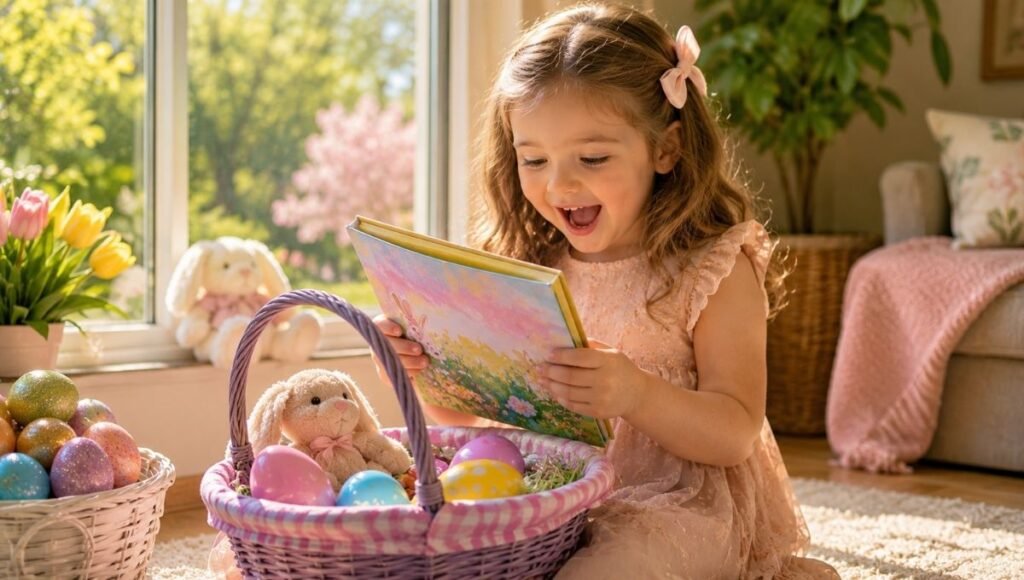
Easter is one of those holidays that means genuinely different things to different families.
For some, it’s the most sacred day of the Christian calendar — a celebration of resurrection, of hope, of something that happened two thousand years ago and still feels immediate. For others, it’s entirely secular: baskets and eggs and the specific pleasure of a spring morning when the world is turning green again. And for many families — probably most, if we’re honest — it’s some layered combination of the two that shifts from year to year depending on who’s at the table and how old the children are.
The best Easter books for kids honor that range. They don’t require you to choose between bunny and resurrection, between chocolate and meaning, between the fun of the egg hunt and the bigger story underneath it. The right Easter book meets your family exactly where you are.
This guide is organized by what you’re looking for — not by age alone, but by what you want the book to do. Because an Easter book for a toddler who mostly cares about bunnies is doing completely different work than an Easter book for a seven-year-old whose family observes Holy Week. Both are valuable. Both deserve the right book.
Key Takeaways
- Easter books for kids span a wider range than any other holiday — from completely secular spring celebrations to deeply religious accounts of the Passion and Resurrection. Knowing what you’re looking for before you shop saves time and surprises.
- Spring books and Easter books significantly overlap in content and searchability — books about new life, animals being born, seeds growing, and the natural world awakening are meaningful Easter reading even when they don’t mention Easter directly.
- Children ages 2–5 benefit most from Easter books that are sensory and playful — bunnies, eggs, chicks, springtime colors. The theological content is best introduced gradually, closer to ages 5–7, when children can hold more narrative complexity.
- Research on children and seasonal rituals shows that repeated annual traditions — specific books read at the same time each year — create stronger positive memories and family identity than one-off celebrations (Fiese et al., 2002).
- Easter basket books — one or two carefully chosen books tucked into an Easter basket — are among the highest-retention gifts parents can give. Books received as gifts are reread significantly more often than books purchased routine.
Easter Board Books for Babies and Young Toddlers (Ages 0–2)

At this age, Easter is purely sensory. The basket. The colors. The texture of plastic eggs. The specific excitement of being carried outside in the morning when everything is different. Books for this age group need to match that energy — bright, tactile, simple, warm.
Peter Rabbit’s Happy Easter by Beatrix Potter (board book edition)
The board book adaptation of Potter’s classic brings Peter Rabbit — already one of the great characters in children’s literature — into a gentle Easter context. The illustrations are the originals: soft watercolors of the English countryside in spring. The text is simplified for the youngest readers without losing the essential Beatrix Potter quality.
Why it works at this age: Potter’s illustrations are among the most beautiful in children’s book history. Even a one-year-old responds to the quality of the art. And Peter’s adventurous spirit is immediately recognizable to any toddler who has ever done something they probably shouldn’t.
💰 Budget Pick — board book editions widely available
Easter Bunny’s on His Way by Jan Thomas
Jan Thomas’s characteristic bold illustrations and simple, energetic text follow the Easter Bunny’s preparations. Completely secular, completely cheerful, completely appropriate for children who mostly want to know about the bunny and the eggs.
How to read it: Read it with maximum energy. Thomas writes books that are meant to be performed — the exclamation points are instructions.
💰 Budget Pick
That’s Not My Bunny by Fiona Watt (Usborne Touchy-Feely series)
Part of the beloved Touchy-Feely series, this board book lets babies and young toddlers touch different textures as they search for the right bunny. The sensory engagement is developmentally appropriate and deeply satisfying at this age.
Why it works: Physical engagement with a book deepens attention and memory. A baby who touches the fuzzy bunny ear is more engaged with the book than one who only looks at it.
💰 Budget Pick
Best Easter Books for Toddlers and Preschoolers (Ages 2–5)

Secular Easter Books for Toddlers and Preschoolers
The Easter Egg by Jan Brett
An Easter egg decorating contest in the forest — but Hoppi the rabbit is so busy taking care of a robin’s nest that he never finishes his egg. What he discovers at the end is one of the warmest surprise endings in picture book literature. Brett’s signature illustrations — intricate, detailed, with border panels that preview what’s coming — are extraordinary.
Why it works: The egg-decorating contest gives toddlers and preschoolers a framework they immediately understand. The ending teaches something about what really matters without ever stating it directly.
How to read it: Spend time on the illustrations. Brett hides story details in the border panels that the text doesn’t mention. Ask: “What do you see in the borders on this page?”
⭐ Worth the Splurge — Brett’s illustrations justify the hardcover
Rechenka’s Eggs by Patricia Polacco
An injured goose named Rechenka is taken in by Babushka, an old woman known for her beautiful painted eggs. When Rechenka accidentally breaks all the eggs before the Easter festival, something miraculous happens. Set in Russia, with illustrations that are as elaborate and beautiful as the pysanky eggs they depict.
Why it works: The book is both a folktale and an Easter story — it works for religious and secular families alike because the “miracle” can be held lightly or reverently depending on what a family brings to it.
Editorial note: Polacco is one of the finest picture book illustrators working today. This is one of her best books, and it’s criminally undersold in Easter reading lists.
⭐ Worth the Splurge
Bluey: The Easter Bunny by Ludo Studio
For the child who is currently living entirely inside the Bluey universe — which describes a significant percentage of preschoolers — the Bluey Easter special adaptation is exactly the right entry point. Familiar characters, familiar warmth, Easter context.
Editorial note: Bluey books are not great literature. They are, however, reliably effective at getting children who love Bluey to sit down and read. That is not nothing.
💰 Budget Pick
Here Comes Peter Cottontail by Steve Nelson and Jack Rollins, illustrated by various artists
The classic song in picture book form. Children who know the song will love having the words to follow; children who don’t will quickly learn it. The repetitive structure is deeply satisfying for preschoolers.
💰 Budget Pick
Religious Easter Books for Toddlers and Preschoolers
The Story of Easter by Patricia Pingry, illustrated by Stacy Venturi-Pickett
A simple, gentle introduction to the Easter story for very young children — the events of Holy Week presented in language and illustrations appropriate for ages 2–5. Not simplified to the point of inaccuracy, but accessible to children who are encountering the story for the first time.
When to read it: The week before Easter, as part of a daily pre-Easter reading. One page per day across Holy Week gives young children a gentle structure without overwhelming them.
💰 Budget Pick
He Is Risen by Cheryl Hawkinson
A board book focused specifically on the Resurrection — simple text, warm illustrations, the central message of Easter for Christian families presented in language young children can hold. For families who want to introduce the Resurrection before the Easter Bunny, this is the right starting point.
💰 Budget Pick
Best Easter Books for Kids Ages 5–8
This is the age range where Easter books can carry more weight — narrative complexity, historical context, and theological depth all become accessible in ways they weren’t before.
Secular Easter Picture Books (Ages 5–8)
The Country Bunny and the Little Gold Shoes by Du Bose Heyward, illustrated by Marjorie Flack
First published in 1939 and somehow still exactly right. A little brown country bunny wants to be one of the five Easter Bunnies. She’s told she can’t — she’s a country bunny, not grand enough. She proves them wrong, not through force but through persistence, ingenuity, and the specific kind of resourcefulness that comes from having raised twenty-one children. The ending involves a pair of magic gold shoes and a sick child on a mountaintop and — this surprises people every time — genuine tears.
Why it’s essential: This book was written in 1939, and its message — that a mother’s strength is underestimated and extraordinary — hasn’t aged a day. Children find it beautiful and moving. Adults find it devastating in the best way.
Editorial note: This is one of my personal favorites on this entire list. If you buy one Easter book that isn’t explicitly religious and isn’t explicitly about eggs and bunnies, make it this one.
⭐ Worth the Splurge — this is a keeper across generations
Chicken Sunday by Patricia Polacco
Three children — two Black brothers and their white friend — want to buy Miss Eula an Easter hat. They’re accused of vandalizing a shop. They must figure out how to prove their innocence and earn the money for the hat at the same time. A story about friendship, community, cross-cultural connection, and the specific love between children and an elderly neighbor.
Why it works at this age: Children 6–8 are old enough to follow the injustice of the accusation and feel the satisfaction of its resolution. The friendship at the center of the book is warm and completely real.
💰 Budget Pick
Religious Easter Books (Ages 5–8)
The Garden, the Curtain, and the Cross by Carl Laferton, illustrated by Catalina Echeverri
This book does something most children’s Easter books don’t: it places the Resurrection in the context of the whole biblical story — the Garden of Eden, the temple curtain, the Cross, the empty tomb — so that Easter isn’t just a single event but the culmination of a long narrative. For Christian families who want to give their children theological depth alongside the story, this is the right book.
How to read it: One section per day across the week before Easter, with brief conversation about each section. “Why do you think the curtain tore?” is a question this book opens naturally.
💰 Budget Pick
The Sparkle Box by Jill Hardie, illustrated by Christine Kornacki
A child is disappointed that his Christmas present is an empty box. Through the year, the family fills it with cards representing acts of service — kindness given as gifts. The book is technically Christmas-framed but the message is central to Easter values for Christian families: giving, service, the orientation away from self.
For: Families who want to build an Easter tradition around giving rather than receiving.
💰 Budget Pick
Easter Is for Jesus by Mary Manz Simon
Simple, clear, focused specifically on the meaning of Easter for Christian children ages 4–8. No bunnies, no eggs — just the story of Holy Week told with warmth and clarity appropriate for this age range.
💰 Budget Pick
Best Spring Books for Kids (Easter Adjacent, Any Family)
spring books for kids is one of the most searched related terms at Easter — and it makes sense. Spring is its own celebration regardless of religious tradition: new life, longer days, the specific miracle of something coming back after winter.
And Then It’s Spring by Julie Fogliano, illustrated by Erin E. Stead
A boy plants seeds and waits. The waiting is the whole story. Stead’s illustrations — pencil and gouache in soft, muted spring tones — are among the most beautiful in recent picture book art. This is a book about patience and hope that works equally well as an Easter book, a spring book, or simply a book about what it means to wait for something good.
How to read it: Slowly. This book is not meant to be rushed. It breathes.
⭐ Worth the Splurge — Caldecott Honor
Bloom by Nicola Skinner
For middle-grade readers — a girl discovers that flowers bloom wherever she goes, with increasingly complicated results. Part magical realism, part coming-of-age, entirely about the irrepressible nature of growth and spring.
For: Ages 8–11 who are ready for a longer, more complex spring story.
💰 Budget Pick
Over in the Meadow by John Langstaff, illustrated by Feodor Rojankovsky
The classic counting song, illustrated with warmth and precision. Ten different meadow mothers and their babies — turtles, fish, crows, lizards — counting from one to ten in a spring meadow. Rhythmic, beautiful, completely appropriate from babyhood through early elementary.
💰 Budget Pick
Up in the Garden and Down in the Dirt by Kate Messner, illustrated by Christopher Silas Neal
A grandmother and granddaughter tend a garden across the seasons. The illustrations show what happens both above and below the soil simultaneously — the same split-view technique Messner used in Over and Under the Pond. Scientifically accurate, visually extraordinary, completely compelling.
For: Ages 4–8. Perfect for combining with an Easter egg hunt — plant something the same day.
💰 Budget Pick
Easter Basket Books: What to Put in the Basket Instead of (or Alongside) Candy
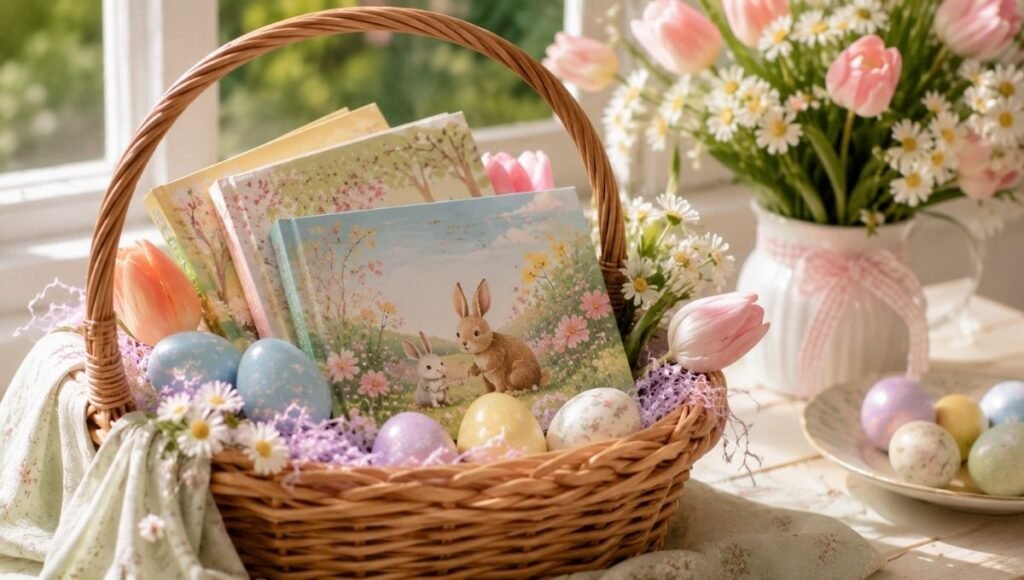
Easter baskets are one of the best delivery mechanisms for children’s books. A book in an Easter basket feels like a gift — which means it gets more attention and more re-reads than a book simply added to the shelf.
The sweet spot: One board book for very young children; one picture book for preschoolers; one chapter book or special edition for older readers. Wrapped, in the basket, alongside whatever else the Easter Bunny brings.
What works well as an Easter basket book:
- A new book in a beloved series (Frog and Toad, Mo Willems, Elephant and Piggie)
- A spring-themed book with beautiful illustrations they can look at independently
- A new Newbery or Caldecott winner they haven’t read yet
- A book about something they’re currently obsessed with — animals, space, history
What doesn’t work: Books chosen as “Easter books” that don’t actually connect to the child’s interests. The basket context doesn’t overcome a bad fit.
FAQ: What Parents Actually Search About Easter Books for Kids
What are the best Easter books for kids? For secular families: The Country Bunny and the Little Gold Shoes, The Easter Egg, Rechenka’s Eggs. For religious families: The Garden, the Curtain, and the Cross, Easter Is for Jesus, He Is Risen. For spring reading any family can enjoy: And Then It’s Spring, Over in the Meadow, Up in the Garden and Down in the Dirt.
What are good Easter books for toddlers? Peter Rabbit’s Happy Easter, That’s Not My Bunny, Easter Bunny’s on His Way, and The Story of Easter (for religious families) are all well-calibrated for ages 1–3. At this age, focus on books with simple text, strong illustrations, and sensory elements. The theological content can wait.
Are there Easter books for non-religious families? Many excellent Easter books are entirely secular — The Easter Egg, The Country Bunny and the Little Gold Shoes, Rechenka’s Eggs, and the spring books listed above all celebrate Easter or spring without religious content. Non-religious families have plenty of excellent options.
What are good Christian Easter books for kids? The Garden, the Curtain, and the Cross for ages 5–8; He Is Risen board book for very young children; Easter Is for Jesus for ages 4–8; The Story of Easter for toddlers. For older children ready for more theological depth, the Passion narrative in an illustrated children’s Bible is also appropriate.
What books should I put in an Easter basket? One great picture book is the right call for most ages. For toddlers: a board book with textures or flaps. For preschoolers: a new picture book in a beloved series or a beautiful spring book. For ages 6–10: a new chapter book by a favorite author or the first book in a series they haven’t started yet.
What are good spring books for kids? And Then It’s Spring, Over in the Meadow, Up in the Garden and Down in the Dirt, The Tiny Seed by Eric Carle, and Flower Garden by Eve Bunting are all excellent spring books that work for any family regardless of how they observe Easter.
One Last Thing
Easter morning at our house involves baskets before breakfast, an egg hunt in the backyard, and — this part took a few years to establish — a book read at the table before we go outside. Just one. Not long. But the book before the eggs has become the ritual inside the ritual.
Last year it was The Country Bunny and the Little Gold Shoes. My daughter, who is eleven and would normally claim to be too old for picture books, cried a little at the ending. She claimed it was allergies. I didn’t argue.
That’s what the right Easter book does. It makes the morning mean something beyond the basket.
Keep exploring on ZestRead:
- Thanksgiving Books for Kids: The Ones That Actually Start Conversations at the Table
- Christmas Books for Kids: Building a Holiday Reading Tradition That Lasts
- Halloween Books for Kids: From Cozy to Spooky, Sorted by Bravery Level
- Classic Children’s Books Every Family Should Own: A Real Mom’s Guide by Age
- Best Books for 3-Year-Olds: What Actually Works at Storytime
References
- Fiese, B.H., Tomcho, T.J., Douglas, M., Josephs, K., Poltrock, S., & Baker, T. (2002). “A Review of 50 Years of Research on Naturally Occurring Family Routines and Rituals.” Journal of Family Psychology, 16(4), 381–390.
- Mar, R.A., & Oatley, K. (2008). “The Function of Fiction is the Abstraction and Simulation of Social Experience.” Perspectives on Psychological Science, 3(3), 173–192.
- American Library Association. (2023). “Caldecott Medal and Honor Books.” https://www.ala.org/alsc/awardsgrants/bookmedia/caldecottmedal
- Zero to Three. (2021). “Reading Together: Tips for Every Age.” https://www.zerotothree.org
Laura Bennett is the founder of ZestRead and a mom whose eleven-year-old cried at The Country Bunny and the Little Gold Shoes on Easter morning and claimed it was allergies. She writes about children’s reading, seasonal books, and the rituals that make holidays mean more than the basket. Reach her at info@zestread.com