
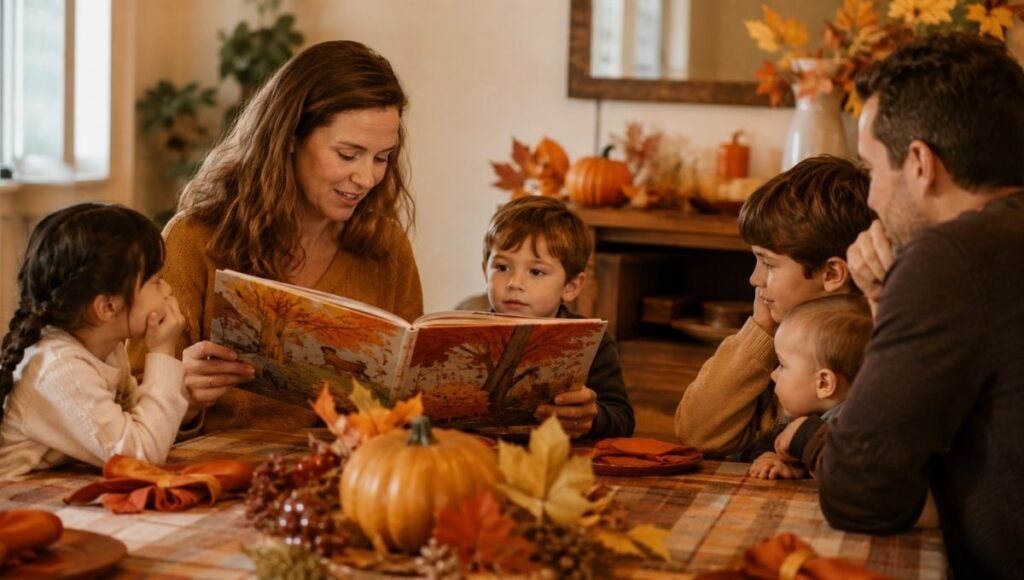
There’s a moment every November that I think a lot of parents recognize.
You’re sitting at the Thanksgiving table, and someone — usually a child, because children have no filter — asks a question you weren’t ready for. “Why did the Pilgrims come here?” or “Who already lived here?” or “What happened to the Native Americans after that?” And you realize that you don’t quite know how to answer it in a way that is both true and appropriate for a five-year-old. Or an eight-year-old. Or, honestly, for yourself.
Thanksgiving is one of the most complicated holidays to navigate honestly with children. The simplified version — Pilgrims and Native Americans had a feast together and were friends — is not the whole story, and most parents instinctively know it. But the complete version contains history that is genuinely difficult and developmentally challenging to process.
The best Thanksgiving books for kids sit somewhere in that space. They don’t oversimplify, but they don’t overwhelm. They give children — and parents — a vocabulary for the holiday that is warmer, more honest, and more complete than what a single classroom lesson can provide.
This guide is organized by age and purpose. Because what a toddler needs from a Thanksgiving book is entirely different from what an eight-year-old needs, and both are entirely different from what helps a parent navigate that question at the table.
Key Takeaways
- Thanksgiving is the American holiday most likely to generate genuine questions about history, identity, and fairness from children — books that address these questions honestly, at an age-appropriate level, give families a starting point for conversations that matter.
- Research on children and gratitude consistently shows that children who practice naming specific things they’re grateful for — not generically, but concretely — show measurable increases in wellbeing (Emmons & McCullough, 2003). The best Thanksgiving books model exactly this specificity.
- Thanksgiving books for toddlers and preschoolers should focus on warmth, family, and the sensory experience of the holiday — not history. History becomes accessible and meaningful closer to ages 6–8.
- Indigenous perspectives in Thanksgiving books are not a “difficult addition” to the holiday — they are part of the holiday’s actual history, and children who encounter them are better prepared to understand both the past and the present.
- A Thanksgiving book read aloud at the table — or in the days before — is one of the most effective conversation-starters available to families who want to make the holiday feel meaningful rather than just logistical.
Thanksgiving Books for Toddlers and Babies (Ages 0–3)
At this age, Thanksgiving is purely sensory and social — it’s about family, food, warmth, and the specific energy of a house full of people who love each other. Books for this age don’t need to explain the holiday. They just need to feel like it.
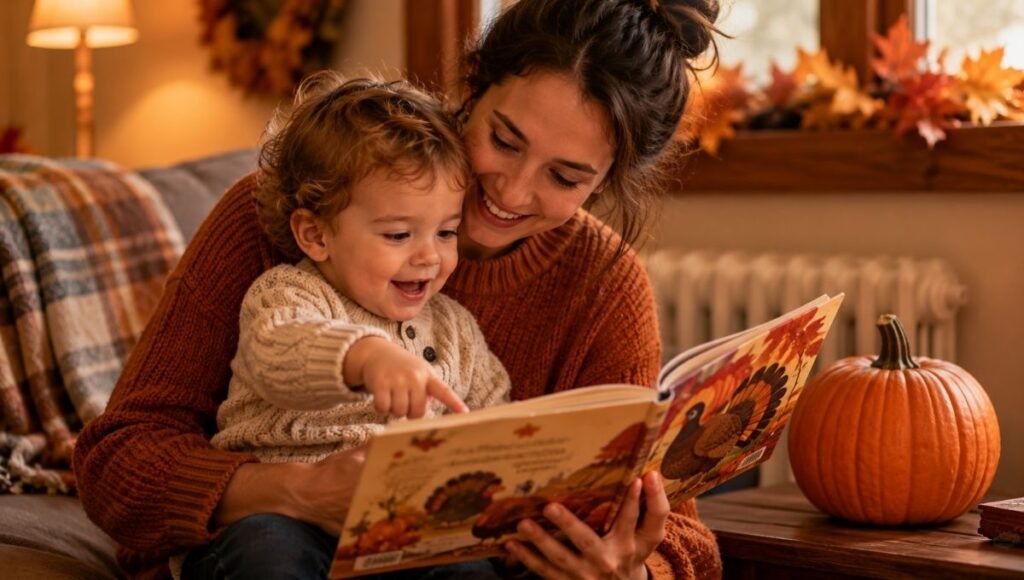
Turkey Trouble by Wendi Silvano, illustrated by Lee Harper
Turkey is in serious trouble — it’s almost Thanksgiving, and he doesn’t want to be dinner. So he disguises himself as other farm animals, one after another, with increasingly absurd results. The humor is perfectly calibrated for toddlers, the illustrations are warm and funny, and the ending is cheerful without being sentimental.
Why it works at this age: The disguise premise gives toddlers exactly the kind of predictable surprise they love — each page brings a new animal, a new ridiculous costume, and the satisfaction of knowing what’s coming before it arrives.
How to read it: Ask before each page turn: “Do you think Turkey will fool the farmer this time?” Let them answer with complete confidence. Let them be right.
💰 Budget Pick
We Gather Together by Wendy Pfeffer, illustrated by Linda Bleck
A gentle, sensory exploration of autumn and harvest — squirrels gathering nuts, farmers harvesting crops, families coming together. The text is lyrical and warm, the illustrations are rich with autumn color, and the book is entirely about the feeling of the season rather than the history of the holiday.
For toddlers who need Thanksgiving to simply feel like home.
💰 Budget Pick
Bear Says Thanks by Karma Wilson, illustrated by Jane Chapman
Bear wants to share a meal with his friends but realizes he has no food — only stories. His friends bring the food; he brings himself. The book is a warm, rhyming celebration of what gratitude actually looks like: showing up, sharing what you have, being present.
Why it works: The message about gratitude is completely embedded in the story — never stated, always felt. For children who are too young for explicit gratitude lessons, this is the right approach.
How to read it: After reading, ask: “What do you think Bear brought to the feast?” Let your child decide. There’s no wrong answer.
💰 Budget Pick — part of the beloved Bear series
Thanksgiving Picture Books for Preschoolers (Ages 3–5)
At three, four, and five, children can hold a simple narrative about Thanksgiving — family gathering, food, something to be thankful for — without needing the historical complexity. These books build the emotional vocabulary of the holiday before the historical one.
Thanksgiving Is Here! by Diane Goode
A family gathers at Grandma’s house for Thanksgiving. The house fills up. The cooking happens. The meal is eaten. Everyone goes home. The illustrations are warm and detailed and completely domestic — this is Thanksgiving as most children experience it, not as history.
Why it works: For children whose Thanksgiving experience is fundamentally about family arriving and filling a house with noise and warmth, this book is a direct mirror. Recognition, at this age, is everything.
How to read it: “What happens at your Thanksgiving that’s the same as this family’s?” Let the comparison become its own conversation.
💰 Budget Pick
Balloons Over Broadway by Melissa Sweet
The true story of Tony Sarg, the puppeteer who invented the giant balloon animals of the Macy’s Thanksgiving Day Parade. Told through Sweet’s extraordinary collage illustrations, this is a book about creativity and problem-solving as much as about Thanksgiving — and it gives children a new way to see a holiday they may already know through television.
Why it works at this age: The balloon parade is something many children have seen but never understood the origin of. Learning that a real person invented it — and how — is the kind of specific knowledge that makes children feel smart and curious simultaneously.
Editorial note: This is one of my favorite picture books of the last decade, Thanksgiving or otherwise. The Caldecott Honor is completely deserved.
⭐ Worth the Splurge — Caldecott Honor winner
The Thankful Book by Todd Parr
Todd Parr’s characteristic bold illustrations and matter-of-fact text applied to gratitude: “I am thankful for music because it makes me want to dance.” “I am thankful for my pet because it loves me no matter what.” Specific, concrete, cheerful, and completely non-preachy.
Why it works: Gratitude research consistently shows that generic gratitude (“I’m thankful for my family”) is less effective than specific gratitude (“I’m thankful that Dad makes pancakes on Saturdays”). Todd Parr models specificity naturally.
How to read it: After each page, pause and ask: “What’s something specific you’re thankful for? Not just ‘food’ — what food, specifically?” Let the specificity build.
💰 Budget Pick
Best Thanksgiving Books for Kindergarten and Early Elementary (Ages 5–8)
This is the age range where the history of Thanksgiving begins to be accessible — and where books that offer more complete, more honest perspectives become not just appropriate but important.
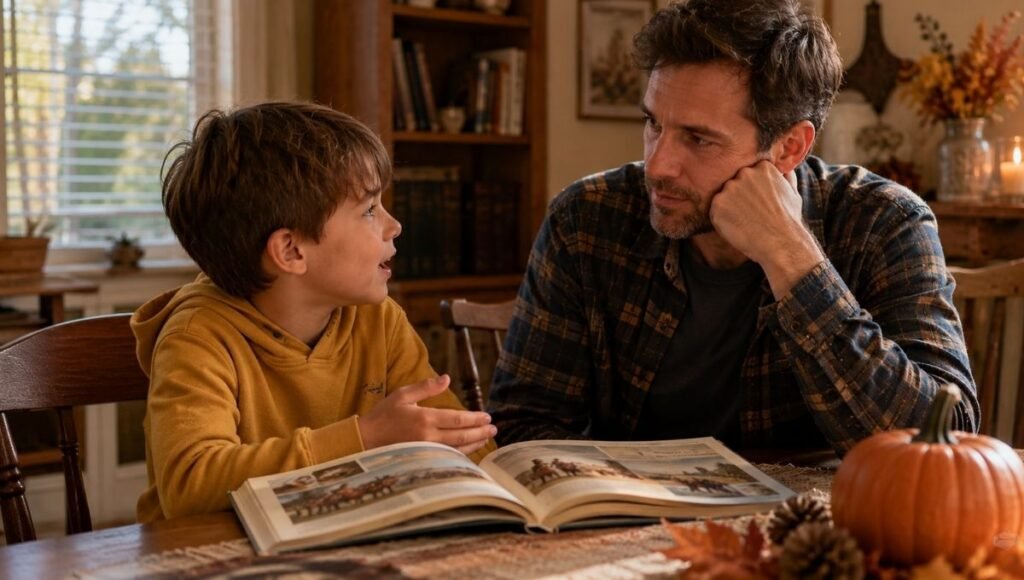
1621: A New Look at Thanksgiving by Catherine O’Neill Grace and Margaret M. Bruchac, photographs by Sisse Brimberg and Cotton Coulson
A National Geographic book that presents the 1621 harvest celebration from both Pilgrim and Wampanoag perspectives. The photographs, taken at Plimoth Patuxent (the living history museum), are extraordinary. The text is careful and accurate without being overwhelming for children in this age range.
Why it matters: This is the book I wish I’d had when my daughter started asking the hard questions. It doesn’t villainize the Pilgrims or romanticize the Wampanoag — it presents both groups as real people in a complicated historical moment, which is the most honest thing you can do for a seven-year-old.
How to read it: Read it in sections rather than cover to cover. Let questions arise naturally. “What do you think the Wampanoag people thought when the ships arrived?” is not too hard a question for a seven-year-old who has the book in their hands.
⭐ Worth the Splurge — essential for this age range
Squanto’s Journey: The Story of the First Thanksgiving by Joseph Bruchac, illustrated by Greg Shed
Told from Squanto’s perspective — a Wampanoag man who had been enslaved and taken to Europe before returning to find his people devastated by disease, then acting as interpreter between the remaining Wampanoag and the Plymouth colonists. This is the Thanksgiving story told from inside a perspective that most children have never encountered.
Why it works at this age: Squanto is a fully realized human being in this book — not a helper character in someone else’s story. Children who read this see the 1621 harvest as something that happened to Squanto as much as something that happened with him.
Editorial note: Joseph Bruchac is Abenaki, and this matters. This story told by a Native author carries a weight and authenticity that versions told by non-Native authors cannot replicate.
💰 Budget Pick
Giving Thanks: A Native American Good Morning Message by Chief Jake Swamp, illustrated by Erwin Printup Jr.
Based on the Haudenosaunee (Iroquois) Thanksgiving Address — a prayer of gratitude that has been offered at the beginning of important gatherings for centuries. The text gives thanks to the earth, the waters, the fish, the plants, the animals, the trees, the birds, the four winds, the thunder, the sun, the moon, the stars, and the Creator. Reading this alongside traditional Thanksgiving stories gives children a completely different framework for what gratitude and giving thanks can look like.
How to read it: Slowly. One page per day in November, as a morning practice, is one way families have used this book. Or read it in one sitting and ask: “What would you add to this list of things to be thankful for?”
💰 Budget Pick
The Wampanoag by Laurie Weinstein-Farson (part of the First Americans series)
Nonfiction, accurate, written for ages 7–10. If your child is the kind who wants to know more after a story book, this gives the historical and cultural context. Supplement with current information about the Wampanoag Nation, which is very much still present today.
💰 Budget Pick
Funny Thanksgiving Books for Kids (Because the Holiday Needs Some Lightness)
Not every Thanksgiving book needs to be historically serious. The holiday also involves the specific chaos of a household full of relatives, a turkey that takes longer than expected, and children who would rather play than sit at the table.
Thanksgiving Rules by Lauren Myracle, illustrated by Roz Chast
A child narrates the rules for Thanksgiving — don’t say you hate the food, don’t pull the dog’s tail, don’t argue about football. The rules are specific and funny and completely recognizable to any family that has navigated a Thanksgiving gathering with children. Roz Chast’s illustrations are chaotic and warm.
How to read it: Ask your child afterward: “What rules would YOU add for our Thanksgiving?” The conversation that follows is usually more revealing than you expect.
💰 Budget Pick
How to Catch a Turkey by Adam Wallace, illustrated by Andy Elkerton
The STEM Turkeys are escaping from Pilgrim Elementary’s Thanksgiving play — and the children have to catch them using Rube Goldberg-style contraptions. Funny, energetic, and great for children who need movement before they can sit through a meal.
💰 Budget Pick — part of the How to Catch series
How to Use Thanksgiving Books to Start the Hard Conversations
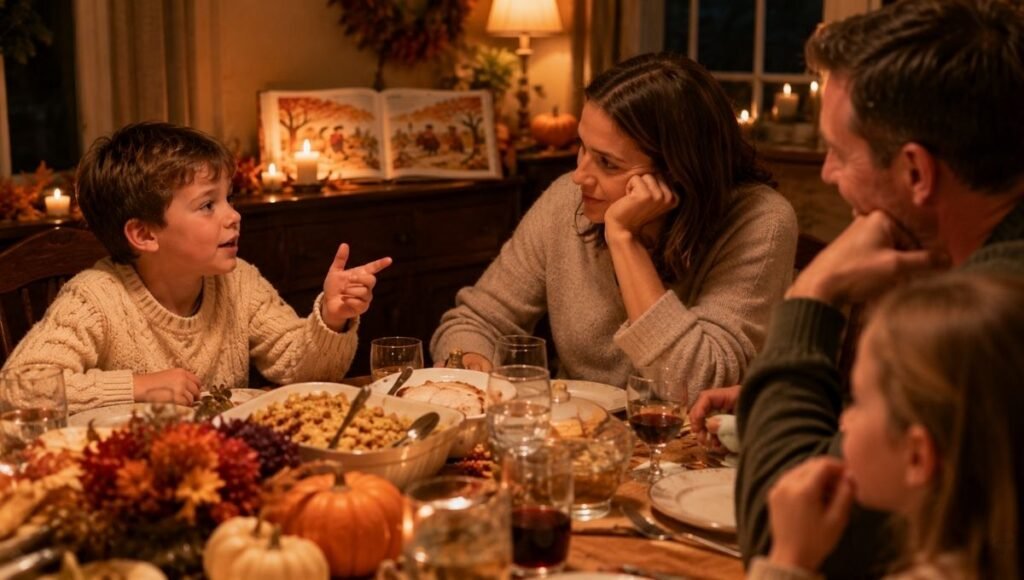
This is the section most book lists skip. Because knowing which books to read is only half the work — the other half is knowing how to open the conversation without making it feel like a history lesson.
Start with what your child already knows. Before reading, ask: “What do you know about Thanksgiving?” Let them tell you the version they’ve absorbed. Don’t correct it yet. Just listen.
Let the book do the introducing. Read a book like Squanto’s Journey or 1621 and let the questions come naturally. “Why did Squanto go to Europe?” and “What happened to the other Wampanoag?” are questions the book invites. You don’t have to engineer them.
Acknowledge the complexity without resolving it. You don’t need to arrive at a tidy conclusion. “This part of history is complicated, and I’m still learning about it too” is a completely honest and appropriate thing to say to a child. It models intellectual humility, which is its own kind of teaching.
Return to it next year, with a different book. Thanksgiving is annual. The conversation doesn’t need to be complete in one sitting. A child who encounters Squanto’s perspective at seven and the full history of colonialism at twelve is going to understand both better for having had the earlier encounter.
FAQ: What Parents Actually Search About Thanksgiving Books for Kids
What are the best Thanksgiving books for kids? For toddlers: Turkey Trouble, Bear Says Thanks. For preschoolers: Balloons Over Broadway, The Thankful Book. For ages 5–8: 1621, Squanto’s Journey, Giving Thanks. For humor at any age: Thanksgiving Rules. The best choice depends on what you want the book to do — warmth, history, gratitude, or laughter.
What are good Thanksgiving books for preschoolers? Turkey Trouble, Thanksgiving Is Here!, The Thankful Book, and Bear Says Thanks are all excellent for ages 3–5. At this age, focus on books that capture the feeling of the holiday rather than the history — warmth, family, food, and the specific magic of a house full of people who love each other.
What are good Thanksgiving books for kindergarten? Balloons Over Broadway is perfect for kindergarten — the story of the Macy’s parade inventor combines creativity and holiday context beautifully. Squanto’s Journey can work for confident kindergarten readers with parental support. 1621 is better for first or second grade.
Are there Thanksgiving books that include Native American perspectives? Yes — and they’re essential. Squanto’s Journey by Joseph Bruchac, Giving Thanks by Chief Jake Swamp, and 1621 by Catherine O’Neill Grace and Margaret M. Bruchac all center Indigenous perspectives. These books don’t just add “another point of view” — they tell the story more completely.
How do I talk to my child about the complicated history of Thanksgiving? Start with a book that introduces the complexity gently — 1621 or Squanto’s Journey — and let the questions come naturally. Acknowledge what you don’t know. Return to the conversation each year with slightly more complexity as your child grows. The goal is not one definitive conversation but a series of honest ones.
What Thanksgiving books are appropriate for toddlers? Turkey Trouble, Bear Says Thanks, and We Gather Together are all excellent for ages 1–3. Board book editions of Turkey Trouble and similar titles work for children under two. At this age, the book’s job is simply to feel festive and warm — no history required.
One Last Thing
The question my daughter asked at the Thanksgiving table — “What happened to the Native Americans after that?” — came after we’d read Squanto’s Journey together the week before. The book hadn’t answered the question. It had just opened enough space for her to ask it.
I didn’t have a perfect answer. I said something true and incomplete: that what happened was very hard and unfair, and that the Wampanoag and other Native nations are still here today, and that this is something our family is still learning about. She nodded. We passed the sweet potatoes.
It wasn’t a resolution. It was the beginning of a longer conversation that we’re still having, in installments, every November.
That’s what the best Thanksgiving books for kids do. They don’t close things down. They open them up.
Keep exploring on ZestRead:
- Christmas Books for Kids: Building a Holiday Reading Tradition That Lasts
- Halloween Books for Kids: From Cozy to Spooky, Sorted by Bravery Level
- Children’s Books About Feelings: The Right Book for Every Big Emotion
- Classic Children’s Books Every Family Should Own: A Real Mom’s Guide by Age
- Dialogic Reading: The Simple Technique That Makes Every Storytime Count
References
- Emmons, R.A., & McCullough, M.E. (2003). “Counting Blessings Versus Burdens: An Experimental Investigation of Gratitude and Subjective Well-Being in Daily Life.” Journal of Personality and Social Psychology, 84(2), 377–389.
- Bruchac, J. (2000). Squanto’s Journey: The Story of the First Thanksgiving. Harcourt. (Author’s note on Indigenous authorship and historical accuracy.)
- Plimoth Patuxent. (2023). “Wampanoag History and Culture.” https://www.plimoth.org
- National Museum of the American Indian. (2023). “Thanksgiving: A Native American Perspective.” https://americanindian.si.edu
Laura Bennett is the founder of ZestRead and a mom who was asked at the Thanksgiving table what happened to the Native Americans, gave an incomplete but honest answer, and has been reading more carefully every November since. She writes about children’s reading, seasonal books, and the conversations that books make possible. Reach her at info@zestread.com