
I used to think reading to my daughter meant reading to her.
I’d sit down with a book, open it, and read. Start to finish. The words, the pictures, the end. She’d listen, sometimes point at things, sometimes not. I’d close the book feeling like I’d done something good for her brain. Checked the box. Moved on.
It wasn’t until she was about two and a half that I stumbled across something that changed how I thought about the whole thing. A researcher named Grover Whitehurst had spent years studying what actually happens in children’s brains during shared reading — and what he found was both simple and kind of stunning. The reading itself wasn’t the most powerful part. The conversation around the reading was.
He called it dialogic reading. And when I started doing it — really doing it, not just skimming the concept — the difference was immediate and completely obvious. My daughter started talking more. She started asking more questions. She started finishing sentences before I got to them. Storytime went from something I did to something we made together.
This is what dialogic reading actually is, how it works at every age, and exactly how to start tonight.
Key Takeaways
- Dialogic reading is a research-backed shared reading technique in which the adult becomes the listener and the child becomes the storyteller — reversing the traditional read-aloud dynamic.
- Children who are read to dialogically show language development gains equivalent to several months of additional development after just a few weeks of practice (Whitehurst et al., 1988).
- The technique is most powerful for children ages 2–6, but adapted versions benefit children through age 12.
- Dialogic reading requires no special materials, no training, and no extra time — just a different way of using the time you’re already spending with books.
- The American Academy of Pediatrics endorses interactive shared reading as a core component of early childhood development, citing its impact on language, literacy, and parent-child bonding.
What Is Dialogic Reading (And Why It’s Different From Regular Read-Aloud)
Most parents read to their children the way they were read to: the adult reads, the child listens. The book is a performance. The child is the audience.
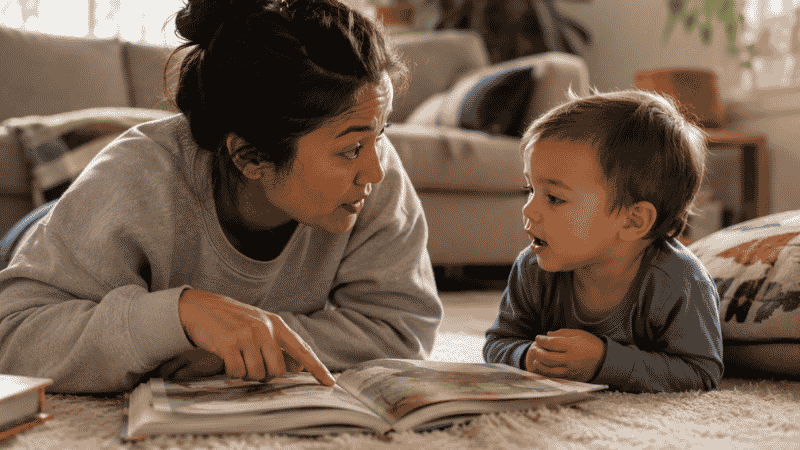
Dialogic reading flips that. The adult still holds the book, still moves through the pages — but the goal shifts. Instead of delivering the story, the adult is drawing the child into making the story. Asking. Listening. Expanding. The child becomes the narrator, the commentator, the expert. The adult becomes the audience.
This sounds like a small change. It isn’t.
When a child is passively listening to a story, they’re absorbing language at one rate. When a child is actively producing language — answering questions, completing sentences, predicting what comes next, explaining what they see — they’re processing at a fundamentally different depth. The words go in differently. They stick differently. They connect to more things.
Whitehurst’s original research found that children in dialogic reading programs showed language gains significantly above children in standard read-aloud programs — gains that showed up on standardized assessments, that were visible to parents and teachers, and that persisted over time. The research has been replicated consistently across different populations, languages, and settings. It works.
The PEER Sequence: How Dialogic Reading Actually Works
Whitehurst developed a simple framework for remembering how to do dialogic reading in practice. He called it the PEER sequence — four steps that can happen multiple times across a single book.
P — Prompt. Ask the child something about the book. Not a yes/no question — an open question that requires them to produce language. “What’s happening here?” “What do you think this animal is going to do?” “Can you tell me about this picture?”
E — Evaluate. Listen to what they say. Don’t immediately correct or redirect — genuinely receive the answer. A child who says “the dog is happy” when the dog in the picture is clearly scared is not wrong in a way that needs immediate fixing. They’re engaging. That’s the goal.
E — Expand. Add something to what they said. If they said “dog,” you might say “Yes, a big fluffy dog. He looks a little nervous, doesn’t he?” You’re modeling richer language without correcting — just expanding.
R — Repeat. Invite them to try again with the expansion. “Can you say ‘big fluffy dog’?” For toddlers, this repetition consolidates vocabulary. For older children, it’s less about repetition and more about the expansion itself landing.
The whole sequence takes about thirty seconds per page. It doesn’t add time to storytime — it replaces the silence with something more valuable.
The CROWD Prompts: Five Ways to Ask Better Questions During Dialogic Reading
Within the PEER sequence, the Prompt step is where most parents get stuck. What do you actually ask? Whitehurst identified five types of prompts — remembered with the acronym CROWD — that cover the full range of dialogic engagement.
C — Completion prompts. Leave a gap in a sentence for the child to fill. “The very hungry caterpillar ate through one ___.” Works especially well with books that have repetitive text. Children as young as eighteen months will start filling in gaps they’ve heard before.
R — Recall prompts. Ask about something that happened earlier in the book. “Do you remember what happened when he knocked on the door?” This builds narrative comprehension — the ability to hold a story in memory across time.
O — Open-ended prompts. Ask a genuinely open question about the picture or the story. “What do you see on this page?” “What’s happening here?” These prompts produce the most language and are the most flexible across ages.
W — Wh- prompts. Questions that begin with what, where, when, who, why, or how. “Where is the rabbit going?” “Why do you think she looks scared?” These build specific vocabulary and causal reasoning simultaneously.
D — Distancing prompts. Connect the book to the child’s real life. “Has anything like this ever happened to you?” “Do you know someone who feels like that sometimes?” This is the most powerful prompt for older children — it’s where books become tools for processing real experience.
How to Do Dialogic Reading at Every Age
The technique adapts across the full span of childhood. Here’s what it looks like at each stage.
Dialogic Reading With Toddlers (Ages 1–3)
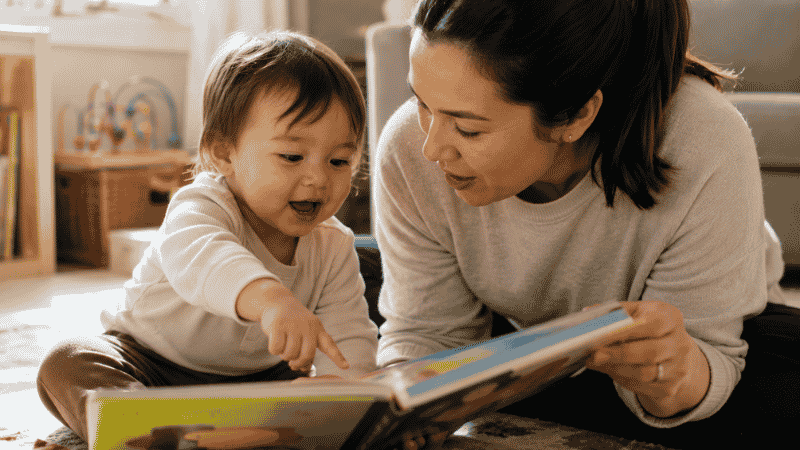
At this age, the primary tool is the completion prompt and the open-ended question. Toddlers can’t yet hold a narrative in memory, so recall prompts don’t work well — but they can fill in a word, point to a picture, name an animal, or say what color something is.
What to do:
- Point at pictures and name them together, then ask: “Can you find the duck?” or “What sound does the duck make?”
- Use completion prompts with any repetitive book: “Brown bear, brown bear, what do you ___?”
- Expand single words into phrases: if they say “dog,” you say “Yes, a big spotted dog.”
- Follow their finger, not the text. If they point at the mouse hiding in the corner of the page, talk about the mouse. The story can wait.
What not to do: Don’t correct pronunciations during dialogic reading. The goal is confident production, not accuracy. Accuracy comes with time and exposure; shutting down a wrong word shuts down the willingness to try.
Books that work especially well at this age: Brown Bear Brown Bear, The Very Hungry Caterpillar, Goodnight Moon, We’re Going on a Bear Hunt — any book with repetition, strong visuals, and predictable structure.
Dialogic Reading With Preschoolers (Ages 3–5)
At three, four, and five, children can hold a narrative in memory and begin to understand cause and effect in stories. Recall and Wh- prompts become more powerful. This is also the age when distancing prompts start working — children can begin connecting what happens in a book to what happens in their own life.
What to do:
- Before opening the book: “What do you think this book is going to be about?” Prediction activates engagement before the first word.
- During the book: “Why did she do that?” “What do you think will happen next?”
- After the book: “Has anything like that ever happened to you?” “How did that character feel at the end?”
- Let them hold the book and control the page turns. Agency matters at this age.
What to do when they don’t answer: Wait longer than feels comfortable. The research on “wait time” consistently shows that children produce significantly more language when adults wait 5–7 seconds after a question rather than filling the silence. The silence feels awkward. It’s working.
Books that work especially well at this age: The Feelings Book, Enemy Pie, Corduroy, The Story of Ferdinand — books with clear character emotion and identifiable cause-and-effect structure.
Dialogic Reading With Early Readers (Ages 5–8)
Once children begin reading independently, many parents stop reading aloud — which is exactly the wrong moment to stop. Children’s listening comprehension exceeds their reading level by years at this stage, which means the books you can read together are far richer than what they can access alone.
Dialogic reading at this age shifts from vocabulary-building toward comprehension and critical thinking. The distancing prompts become the most valuable tool.
What to do:
- Stop mid-chapter: “What do you think she should do?” Let them argue with the character’s choices.
- Ask about character motivation: “Why do you think he lied? What was he afraid of?”
- Make predictions explicit and then return to them: “You said the wolf was going to come back. Were you right?”
- Let them disagree with you. “I think she should have told the truth.” “I don’t — I think she was protecting her friend.” This kind of discussion is exactly what the research supports.
Books that work especially well at this age: Charlotte’s Web, The BFG, Matilda, Frog and Toad Are Friends — books with morally clear but emotionally complex characters.
Dialogic Reading With Older Children (Ages 8–12)
The research on dialogic reading focuses primarily on early childhood, but the underlying principle — that active engagement with text produces better outcomes than passive reception — holds across every age.
With older children, the technique looks less like structured prompts and more like conversation. The goal is to position the parent as a fellow reader, not an examiner.
What to do:
- Read independently in parallel and compare responses. “I thought the ending was sad. Did you?”
- Ask what they would have done differently than the character — not what they should have done, but what they would have done.
- Let them teach you. “Explain that part to me. I’m not sure I understood what happened.” Children who explain text to an adult are consolidating comprehension at the deepest possible level.
- Follow their lead on pace and discussion. Some nights they’ll want to process everything; some nights they’ll want to read quietly and share nothing. Both are fine.
Books that work especially well at this age: The Giver, Wonder, Hatchet, The Hunger Games — books with genuine moral complexity and clear opportunities for “what would you have done?”
What If My Child Won’t Engage With Dialogic Reading?
This is the most common question, and the most reassuring answer: resistance usually means the prompts are wrong for where the child is, not that the child is unwilling.
If they keep saying “I don’t know”: The question is probably too abstract. Ground it in the picture. “Look at this page — what do you notice?” is more answerable than “How do you think she feels?”
If they want you to just read: Honor that. Some nights children need passive absorption, not active engagement. Read straight through. Come back to dialogic prompts the next session. The habit builds across many readings, not within each one.
If they’re younger than two: Completion prompts and naming games are appropriate; open questions are not yet developmentally accessible. Start small. Name objects, make sounds, follow their gaze.
If they’re older and feel like you’re quizzing them: Change the frame. Stop asking questions entirely. Instead, share your own reactions: “I didn’t expect that to happen. Did you?” or “That part made me feel sad.” Modeling response invites response — without the interrogation dynamic.
The Biggest Mistakes Parents Make During Shared Reading
Even parents who know about dialogic reading often undermine it with habits that are easy to fall into.
Reading straight through without pausing. The pause is where the learning happens. A book read cover-to-cover in ten minutes with no engagement produces far less language development than the same book read in fifteen minutes with six conversational moments.
Correcting rather than expanding. When a child says something wrong or incomplete, the instinct to correct is strong. Resist it. Expand instead. Correction shuts down production; expansion models the right language without making the child feel wrong.
Asking only questions you already know the answer to. “What color is the cat?” is a quiz. “What do you think the cat is thinking?” is a conversation. The genuine open question — the one where the adult actually doesn’t know what the child will say — is the most powerful prompt in dialogic reading.
Stopping too soon. Many parents stop reading aloud when children start reading independently. This is the single most common and most consequential mistake in family reading. Keep reading aloud. Keep doing it at every age. The research supports it at every age.
When to Talk to Someone
Dialogic reading is not a clinical intervention — it’s a parenting practice. But it can reveal things worth paying attention to.
If your child consistently produces very little language in response to open prompts — fewer than ten to fifteen words per session by age two, significantly less than peers by age three — it may be worth raising with your pediatrician. This isn’t cause for alarm; it’s information. Many children who are later diagnosed with language delays or processing differences show early signs in exactly this kind of interactive context, and early support consistently produces better outcomes than waiting.
If your child seems not to hear or respond to your voice during reading — not distraction, but genuine non-response — a hearing assessment is worth requesting.
Neither of these concerns means anything is definitively wrong. They mean something is worth knowing more about.
FAQ: What Parents Actually Ask About Dialogic Reading
What is dialogic reading? Dialogic reading is a shared reading technique developed by researcher Grover Whitehurst in which the adult actively engages the child in conversation during the book — asking questions, expanding responses, and inviting the child to become the storyteller — rather than simply reading aloud while the child listens.
Does dialogic reading really work? Yes — the research base is strong and consistent. The original Whitehurst studies found language development gains equivalent to several months of additional development after just a few weeks of dialogic reading practice. These findings have been replicated across many populations and settings. The American Academy of Pediatrics cites interactive shared reading as a core component of healthy early development.
What age is dialogic reading for? Dialogic reading was originally developed for children ages 2–5, and the research is strongest for this age range. But the underlying principles — active engagement, open questioning, connecting text to life — are valuable at every age. Adapted versions work for infants (naming and pointing), school-age children (comprehension and prediction), and even preteens (discussion and debate).
How is dialogic reading different from just asking questions about a book? The structure of dialogic reading — specifically the PEER sequence and CROWD prompts — ensures that questioning serves language production rather than comprehension testing. Most parents who “ask questions during reading” default to questions with known answers: “What color is that?” Dialogic reading prioritizes open questions that require the child to produce original language: “What do you think is going to happen?”
How long does dialogic reading take? It takes no additional time. Dialogic reading happens within the same storytime session — the difference is how the time is used, not how much of it there is. A ten-minute storytime with dialogic reading is more effective than a thirty-minute passive read-aloud.
Do I need special books for dialogic reading? No. Any book works. That said, books with strong illustrations, clear character emotion, and repetitive or predictable text tend to generate more natural dialogic engagement — especially with younger children. The books recommended throughout ZestRead’s By Age series are all well-suited to dialogic reading.
Can I do dialogic reading with an older child who can already read? Yes — and you should. The technique adapts naturally into discussion-based reading for school-age children and older. The goal shifts from vocabulary-building toward comprehension and critical thinking, but the core principle — the child actively engaging with text rather than passively receiving it — remains exactly as valuable.
One Last Thing
The night I first really tried dialogic reading, we were reading The Very Hungry Caterpillar for what I estimated was the eighty-seventh time.
Normally I just read it. Same words, same pace, same ending. But that night I stopped on the page with all the food and asked: “Which one would you eat first?”
My daughter — who was two and a half, and had recently become opinionated about food in the way that two-year-olds are opinionated about everything — pointed at the chocolate cake and said, with complete conviction, “That one. And also that one. And also that one.”
We spent twelve minutes on that page. She told me everything she would eat and everything she wouldn’t and why. She used words I didn’t know she had. She made me laugh three times.
We never finished the book that night. It didn’t matter.
That conversation was the book.
Keep exploring on ZestRead:
- Best Books for 2-Year-Olds: What They’ll Actually Sit Still For
- Best Books for 3-Year-Olds: What Actually Works at Storytime
- Best Books for 4-Year-Olds: When Stories Start Getting Really Good
- Best Books for 5-Year-Olds: Bridging Preschool and the Big Wide World
References
- Whitehurst, G.J., Falco, F.L., Lonigan, C.J., Fischel, J.E., DeBaryshe, B.D., Valdez-Menchaca, M.C., & Caulfield, M. (1988). “Accelerating Language Development Through Picture Book Reading.” Developmental Psychology, 24(4), 552–559.
- American Academy of Pediatrics. (2014, updated 2023). “Literacy Promotion: An Essential Component of Primary Care Pediatric Practice.” Pediatrics. https://publications.aap.org
- Lonigan, C.J., & Whitehurst, G.J. (1998). “Relative Efficacy of Parent and Teacher Involvement in a Shared-Reading Intervention for Preschool Children from Low-Income Backgrounds.” Early Childhood Research Quarterly, 13(2), 263–290.
- Mol, S.E., Bus, A.G., & de Jong, M.T. (2009). “Interactive Book Reading in Early Education: A Tool to Stimulate Print Knowledge as Well as Oral Language.” Review of Educational Research, 79(2), 979–1007.
Laura Bennett is the founder of ZestRead and a mom who spent twelve minutes on one page of The Very Hungry Caterpillar and has never regretted it. She writes about children’s reading, family education, and the techniques that make storytime worth more than the sum of its pages. Reach her at info@zestread.com