
My neighbor’s daughter was reading chapter books at four. My daughter, at the same age, was still working out that letters made sounds.
I remember the specific discomfort of those playground conversations. Everyone seemed to know exactly where their child was supposed to be, and the unspoken math was constant: her child reading, my child not. What did that mean? Was I doing something wrong? Was she doing something wrong? Were neither of us?
The honest answer — the one that took me longer than it should have to fully believe — is that almost nothing I was observing actually meant what I thought it meant. The age at which kids learn to read varies enormously and normally. A child reading fluently at four is not ahead in a way that will matter at fourteen. A child who doesn’t crack the code until seven is not behind in a way that predicts anything about who they’ll become as a reader.
What matters is the foundation being built underneath the reading — and understanding what that foundation looks like at each age.
This guide walks through exactly that.
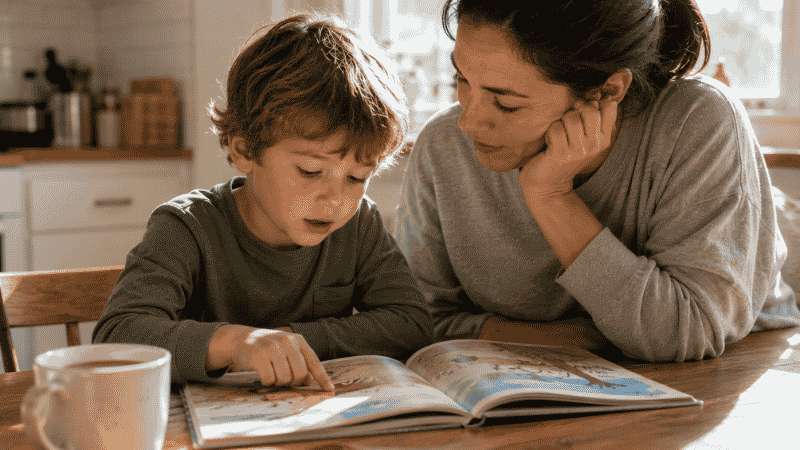
Key Takeaways
- Most children learn to read independently between ages 5 and 7, with a normal range extending to age 8 — all within typical development (National Reading Panel, 2000).
- Reading is not a natural skill like speaking. It must be explicitly taught, and the timeline for learning it varies widely and normally between children.
- Pre-reading skills — phonological awareness, print awareness, alphabet knowledge — begin developing from birth and are the true foundation of reading success.
- The single most effective thing parents can do to support reading development at every age is read aloud daily, with conversation (dialogic reading).
- Early reading does not reliably predict long-term reading success. Children who begin reading later but with strong oral language foundations often become stronger readers by third grade than early readers with thinner language bases.
When Do Kids Start Learning to Read? The Real Answer
The question “when do kids learn to read?” has a short answer and a true answer, and they’re different.
The short answer: most children begin reading simple words between ages 4 and 6, and most are reading independently with reasonable fluency by ages 6 to 7.
The true answer: reading development begins at birth and never really stops. Long before a child sounds out their first word, they are building the cognitive and linguistic architecture that makes reading possible — through being spoken to, sung to, read to, and exposed to print in their environment. The visible moment of reading — the first decoded word — is not the beginning. It’s the surface breaking on years of invisible work underneath.
This distinction matters enormously for parents, because it shifts the question from “why isn’t my child reading yet?” to “what is my child building right now?” — which is almost always something real and valuable, even when it doesn’t look like reading yet.
Reading Milestones by Age: What to Expect at Each Stage
These are guidelines, not checklists. Children develop along a wide and normal range. The purpose of understanding milestones is to know what direction development is moving — not to compare your child against a fixed schedule.
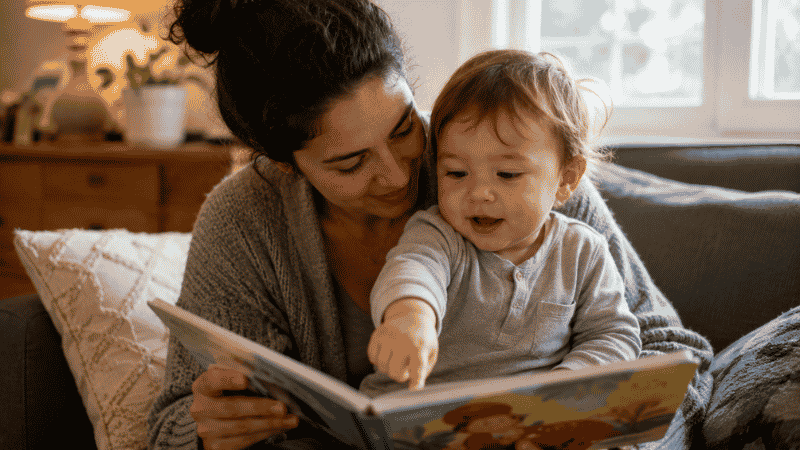
Reading Development in Babies (Birth to 12 Months)
Reading development begins here, which surprises most parents. Babies are not learning letters or sounds — they’re learning something more fundamental: that books are objects that exist in the world, that the sounds a parent makes while holding one are different from other sounds, and that this activity is associated with closeness and warmth.
What you’ll see:
- Interest in high-contrast images and faces in books
- Reaching for and mouthing board books
- Calming response to the rhythm of read-aloud voices
- Beginning to track moving objects with eyes — the same skill used later to track text
What to do: Read aloud anything, in any language, in any order. The content matters far less than the experience of a warm voice and a held book. Board books with simple, bold images work well, but so does reading a recipe aloud while your baby watches your face.
Reading Development in Toddlers (Ages 1–2)
This is when the first visible pre-reading skills emerge. Toddlers begin to understand that books are read in a specific direction, that the marks on the page are meaningful, and that the same story happens the same way every time — which is why they want it again and again.
What you’ll see:
- Pointing at pictures and naming objects
- Bringing books to adults to be read
- Beginning to fill in words in familiar books (“the very hungry ___”)
- Pretend reading — holding a book and babbling as if reading aloud
What to do: Follow their point. When a toddler points at something on the page, name it, extend it, make it a conversation. This is dialogic reading in its most natural form, and it’s building vocabulary and print awareness simultaneously.
Books that support this stage: Brown Bear Brown Bear What Do You See, The Very Hungry Caterpillar, Goodnight Moon, Peek-a-Who.
Reading Development in Preschoolers (Ages 3–4)
Three and four are the years when phonological awareness — the ability to hear and manipulate sounds in language — develops rapidly. This is one of the strongest predictors of later reading success, and it develops almost entirely through oral language: songs, rhymes, wordplay, and conversation.
What you’ll see:
- Recognizing that words rhyme
- Clapping out syllables in words
- Beginning to recognize some letters, especially in their own name
- Understanding that print goes left to right and top to bottom
- Recognizing environmental print (the McDonald’s “M,” the stop sign)
What to do: Sing. Rhyme. Play with words. “Bat, cat, hat, fat — what rhymes with bat?” costs nothing and builds phonological awareness more effectively than most structured curricula at this age. Read books with strong rhyme and repetition. Let children “read” familiar books from memory — this is real reading behavior, not pretending.
What not to worry about: Most three and four-year-olds cannot read. Some can — and that’s fine. But inability to read at four is not a warning sign. It’s normal.
Books that support this stage: Llama Llama Red Pajama, Dr. Seuss titles (The Cat in the Hat, Green Eggs and Ham), Chicka Chicka Boom Boom, Each Peach Pear Plum.
When Do Kids Start Reading: Ages 4–6
This is the window when most children begin to decode — to connect letters to sounds and blend them into words. For most children, this happens between four and six, with five being the most common starting point.
What you’ll see:
- Recognizing most or all letters of the alphabet
- Beginning to sound out simple three-letter words (cat, dog, sit)
- Reading simple sight words (the, and, is, it)
- Pointing to words while reading familiar books
- Increasing interest in environmental print
What drives it: Phonics instruction — the explicit teaching of letter-sound relationships — is the single most evidence-based approach to teaching decoding. The National Reading Panel’s landmark 2000 report established this clearly: systematic phonics instruction significantly improves reading outcomes compared to other approaches.
What to do: If your child is in kindergarten or first grade, trust their classroom instruction. At home, keep reading aloud (this builds vocabulary and comprehension that decoding alone doesn’t), play with letters and sounds, and make the experience of books as positive as possible. Pressure at this stage frequently backfires — children who associate early reading with anxiety become reluctant readers later.
What not to worry about: A child who is not reading at five is almost certainly within the normal range. A child who is not reading at six should be monitored but is still often within range. A child who is significantly behind peers at seven warrants a conversation with their teacher.
Books that support this stage: Elephant and Piggie series (Mo Willems), Fly Guy series (Tedd Arnold), Bob Books (for independent decoding practice), Frog and Toad Are Friends (read aloud).
What Age Do Kids Read Independently: Ages 6–8
Most children achieve independent reading — the ability to read simple texts without assistance — between ages 6 and 7. By age 8, most children are reading with enough fluency that reading becomes the vehicle for learning rather than the subject of learning.
This is the transition researchers call “learning to read” becoming “reading to learn” — and it’s one of the most significant cognitive shifts of childhood.
What you’ll see:
- Reading simple chapter books independently
- Increasing reading speed and fluency
- Beginning to read silently rather than aloud
- Choosing to read voluntarily (when reading is working)
- Comprehension improving alongside decoding
What to do: Keep reading aloud, even to children who can read independently. Their listening comprehension still significantly exceeds their reading level — the books you can read together are richer, more complex, and more vocabulary-building than what they can access alone. Don’t retire the read-aloud because they’ve started reading. It’s doing different and equally valuable work.
Books that support this stage: Magic Tree House series, Mercy Watson series, Nate the Great series (independent reading); Charlotte’s Web, The BFG, Matilda (read aloud).
Reading Development at Ages 8–12
By eight, most children who have had adequate instruction and exposure are reading independently. The developmental work at this stage shifts from decoding to comprehension, vocabulary, fluency, and stamina.
What you’ll see:
- Reading longer, more complex texts
- Beginning to read for pleasure independently
- Engaging with nonfiction and information texts
- Developing genre preferences and reading identity
- Reading speed increasing significantly
What to do: Follow their interests completely. A child who will only read graphic novels or fact books about dinosaurs is building real reading skills. Broaden from inside their interests, not against them. And keep reading aloud — research supports it through adolescence.
The risk at this stage: Reading rates drop sharply between ages 9 and 13 as screen competition intensifies. Children who maintain daily reading habits through this window are significantly more likely to be readers at 17 and 25.
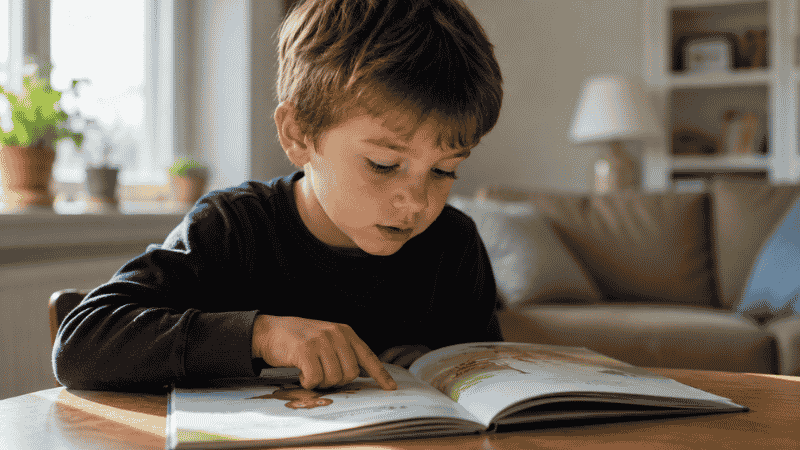
What Age Do Kids Learn to Read: The Factors That Influence the Timeline
Understanding why some children learn to read earlier or later than others helps parents contextualize what they’re seeing — and respond more usefully than simply worrying.
Oral language development. Children with rich oral language foundations — large vocabularies, exposure to complex sentence structures, lots of conversation — generally learn to read more easily. This is why talking to children, from birth, is one of the most important reading interventions available.
Phonological awareness. Children who can hear and manipulate sounds in language — who can rhyme, identify beginning sounds, segment syllables — decode more easily and earlier. This skill is built through songs, rhymes, read-alouds, and wordplay.
Print exposure. Children who have been surrounded by books, who have been read to regularly, who have seen adults reading and writing — these children arrive at reading instruction with a significant head start.
Instruction quality. The method and quality of phonics instruction matters. Explicit, systematic phonics instruction produces consistently better outcomes than implicit or whole-language approaches.
Individual neurological variation. Some children’s brains are simply wired to decode earlier or later, and this variation is normal. A child who reads at four and a child who reads at seven may both be completely typical — they’re just on different points of a wide normal range.
Learning differences. Dyslexia affects approximately 15-20% of the population and is characterized by difficulty with phonological processing that makes decoding harder. It is not related to intelligence, vision, or effort — it’s a neurological difference that responds well to appropriate instruction when identified early.
When Should You Be Concerned About Reading Development?
Most reading variation is normal. But some patterns are worth raising with a pediatrician or reading specialist.
Talk to someone if your child:
- Shows no interest in books or print by age 3
- Cannot recognize any letters by age 5
- Cannot connect letters to sounds by age 6
- Is significantly behind peers in reading fluency by age 7, despite adequate instruction
- Shows persistent difficulty with rhyming, sound blending, or phonological tasks
- Reverses letters (b/d, p/q) frequently beyond age 7 — note that some reversal is normal before this age
- Has a family history of dyslexia or reading difficulty
What to do: Start with your child’s teacher — they have the most direct observation of your child’s reading development in comparison to peers. From there, a school-based reading specialist or educational psychologist can conduct more formal assessment. Early identification of reading differences consistently produces better outcomes than waiting.
Early intervention, when it’s needed, is not a verdict. It’s a gift.
If Your Child Seems Behind: What Actually Helps
Read aloud more, not less. When children are struggling with reading, parents often pull back on read-alouds because it feels like they should be focused on decoding practice. This is exactly backwards. Read-aloud builds the vocabulary, comprehension, and love of story that make the effort of learning to decode worthwhile.
Make reading feel safe. Children who experience reading as a performance — who feel tested, corrected, watched — develop anxiety around reading that compounds difficulty. Home reading should be pressure-free. Let them choose. Let them put books down. Let them read the same easy book forty times.
Trust the school’s approach, and ask questions. If your child’s school is using a reading curriculum, ask what it is and how it works. Evidence-based phonics instruction is the gold standard. If you’re not seeing progress, ask for a reading assessment.
Consider audiobooks. Children who struggle with decoding can still access rich, complex stories through audiobooks — which build exactly the vocabulary and comprehension that support eventual reading fluency. Audiobooks are not a consolation prize. They’re a bridge.
FAQ: What Parents Actually Search About When Kids Learn to Read
What age do kids learn to read? Most children begin reading simple words between ages 4 and 6, with most achieving independent reading fluency between ages 6 and 7. The normal range extends to age 8 without any cause for concern. Children who read earlier are not reliably ahead long-term; children who read later are not reliably behind.
When do kids start reading on their own? Most children begin reading independently — choosing to read without prompting, for pleasure — somewhere between ages 5 and 8. This varies widely depending on instruction, exposure, and individual development. Children who have been read to extensively and who associate books with pleasure are more likely to choose independent reading earlier.
Is it normal for a 5-year-old to not be reading? Completely normal. The range for reading acquisition is wide, and a five-year-old who is not yet reading is almost certainly within typical development. Kindergarten is when most children begin formal reading instruction. If your five-year-old is engaged with books, recognizes some letters, and enjoys being read to, they are doing exactly what they should be.
Is it normal for a 6-year-old to not be reading? Yes, though by the end of first grade most children are reading simple texts. A six-year-old who is receiving good instruction and making visible progress is on track. A six-year-old who seems to be making very little progress despite adequate instruction is worth discussing with their teacher.
What are signs that a child is ready to read? Readiness signs include: recognizing most letters of the alphabet, showing awareness that print carries meaning, enjoying being read to, beginning to sound out letters in familiar words, and showing interest in writing letters. These signs can appear as early as three or four, or as late as six or seven — both are normal.
Does reading aloud to kids help them learn to read? Yes — significantly. Research consistently shows that children who are read to regularly develop stronger vocabulary, phonological awareness, print awareness, and comprehension — all of which support reading acquisition. Reading aloud is not a substitute for phonics instruction, but it is one of the most powerful supports for reading development available to parents.
What is the average reading level for a 7-year-old? By the end of second grade (age 7-8), most children are reading at approximately DRA Level 18-28, or Guided Reading Level J-M. But this range is wide, and children on both sides of it are frequently typical. Reading level at seven matters less than the direction of growth — is your child reading more fluently today than six months ago?
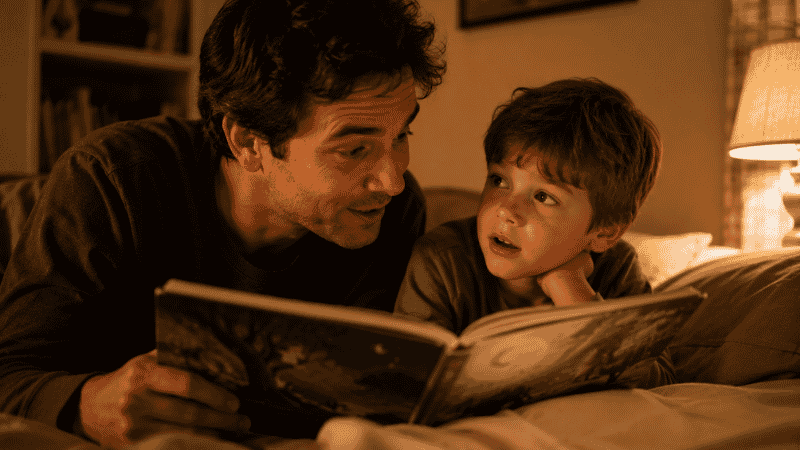
One Last Thing
The playground math never goes away entirely. Even now, I notice when other children seem ahead or behind where I’d expect, and I feel the old pull of comparison.
But I’ve learned to redirect it. Because what I’m actually watching — when I see a child sounding out a word, or a parent and child laughing over a picture book, or a kid carrying a novel that’s clearly too heavy for their backpack — is not a race. It’s a journey that starts at birth and doesn’t have a finish line.
Your job, at every stage, is the same: make books feel like something worth loving. Read aloud. Follow their interests. Trust the process. And when something feels genuinely off, ask for help early.
The rest takes care of itself.
Keep exploring on ZestRead:
- Best Books for 2-Year-Olds: What They’ll Actually Sit Still For
- Best Books for 3-Year-Olds: What Actually Works at Storytime
- Best Books for 4-Year-Olds: When Stories Start Getting Really Good
- Dialogic Reading: The Simple Technique That Makes Every Storytime Count
References
- National Reading Panel. (2000). Teaching Children to Read: An Evidence-Based Assessment of the Scientific Research Literature on Reading and Its Implications for Reading Instruction. National Institute of Child Health and Human Development. https://www.nichd.nih.gov
- American Academy of Pediatrics. (2014, updated 2023). “Literacy Promotion: An Essential Component of Primary Care Pediatric Practice.” Pediatrics. https://publications.aap.org
- Chall, J.S. (1983). Stages of Reading Development. McGraw-Hill.
- International Dyslexia Association. (2020). “Dyslexia Basics.” https://dyslexiaida.org
- Whitehurst, G.J., & Lonigan, C.J. (1998). “Child Development and Emergent Literacy.” Child Development, 69(3), 848–872.
Laura Bennett is the founder of ZestRead and a mom who spent too long comparing her daughter’s reading timeline to the wrong things. She writes about children’s reading, family education, and the research that actually matters for the families who are doing their best. Reach her at info@zestread.com