There is a specific kind of misery that comes from reading a “funny” children’s book that isn’t funny.
You know the type. The puns that require a seven-year-old to have a working knowledge of wordplay they don’t possess yet. The slapstick that works on the page but falls completely flat when read aloud. The jokes that your child laughs at politely because they can tell you expect them to, and you laugh back for the same reason, and everyone in the room is performing amusement for an audience of one.
And then there are the other books.
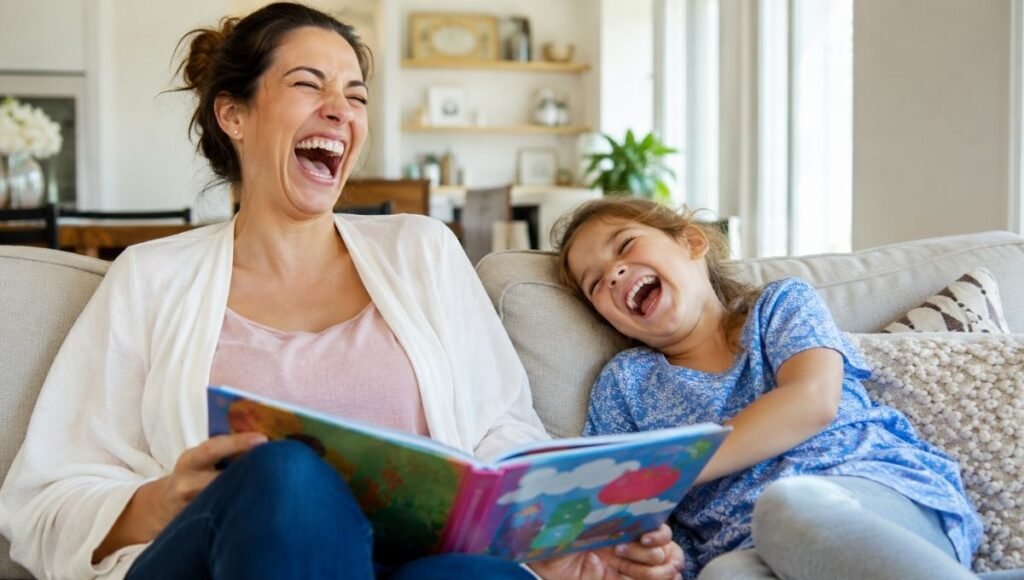
The books where your child laughs so hard they can’t breathe. The books you’ve read forty times and still find yourself grinning at. The books where you’re reading aloud and you’re the one who loses it first — in the middle of a sentence, undone by something you’ve read fifteen times before. Where your child looks at you with that specific expression that means they’ve watched a grown-up become completely helpless and they find this extraordinary.
Those books exist. There are more of them than most people realize. And they are not all the same kind of funny — which is why this guide is organized not by age alone, but by what kind of funny your child actually is.
Key Takeaways
- Children’s humor develops in stages: toddlers respond to physical comedy and surprise; preschoolers to rule-breaking and absurdity; school-age children to wordplay, irony, and social situations; tweens to dry wit and self-aware comedy (McGhee, 1979).
- Funny books are among the most effective reading interventions for reluctant readers — the reward of the next laugh keeps children reading past the point where they’d normally put a book down.
- The best funny books for kids work on two levels simultaneously — there is humor that lands for children and humor that lands for the adult reading aloud, and the books that have both create the most genuinely memorable shared reading experiences.
- Reading funny books aloud produces measurable increases in children’s sense of humor sophistication — children who are regularly exposed to sophisticated comedic structures begin producing them in their own storytelling (Bergen, 2009).
- Humor in children’s books is not a lesser form of literary value. The craft required to write something genuinely funny for children — to time a joke in a picture book, to build a comedic structure that lands across age groups — is as significant as any other literary skill.
What Kind of Funny Is Your Child?
Before the list, a framework that actually helps.
Children’s humor is not generic. A five-year-old who loves absurdity (“a bear wearing a hat?!”) may find wordplay completely opaque. A nine-year-old who loves irony may find gross-out humor exhausting. A seven-year-old who thinks bodily functions are the pinnacle of comedy may never appreciate the dry wit of a well-timed deadpan.
The five main types of children’s humor — and which books deliver each:
Surprise humor: The setup leads somewhere completely unexpected. Works for ages 2 and up. Books: I Want My Hat Back, anything by Jon Klassen.
Absurdist humor: The premise is so ridiculous that the ridiculousness is the joke. Works for ages 3 and up. Books: Dragons Love Tacos, Don’t Let the Pigeon Drive the Bus!
Rule-breaking humor: Characters doing things they shouldn’t, getting away with it, or suffering consequences that are funnier than punitive. Works for ages 4 and up. Books: Captain Underpants, Diary of a Wimpy Kid.
Wordplay and irony: Jokes that require understanding two meanings simultaneously, or a gap between what’s said and what’s meant. Works for ages 7 and up. Books: A Series of Unfortunate Events, The Book with No Pictures.
Dry wit and deadpan: The humor comes from understatement, from someone being completely serious about something absurd. Works for ages 8 and up, and is the type adults most reliably share. Books: The Phantom Tollbooth, Jon Klassen’s hat trilogy.
Funny Picture Books That Make Everyone Laugh (Ages 2–6)
Don’t Let the Pigeon Drive the Bus! by Mo Willems
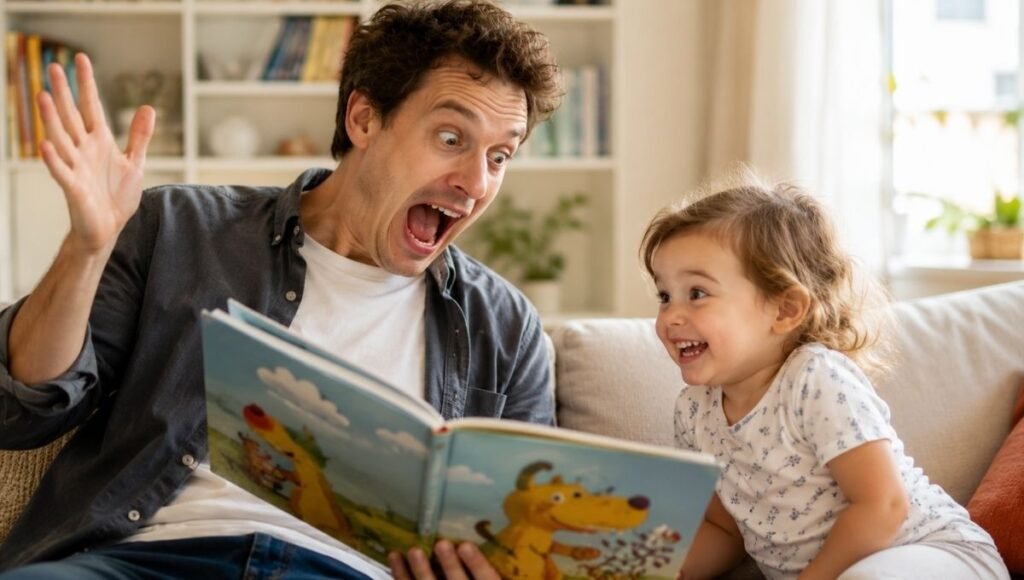
The bus driver leaves. The Pigeon wants to drive the bus. You, the reader, are in charge of saying no. The Pigeon argues. The Pigeon pleads. The Pigeon tries every manipulation available to a creature with no thumbs and enormous ambition. Children love saying no to the Pigeon; they also recognize every tactic the Pigeon uses, because they have used them all.
Why it makes adults laugh too: The Pigeon’s escalating negotiation strategies — including “I’ll be your best friend” and an abrupt attempt to change the subject — are recognizable to any parent who has ever bargained with a toddler. Reading this book aloud, you are simultaneously performing the Pigeon and watching yourself from the outside. That double vision is where the adult laugh lives.
How to read it: Give the Pigeon everything. The wheedling, the wounded dignity, the sudden outrage. The more committed the performance, the harder everyone laughs.
📦 Series — the entire Pigeon universe, plus Elephant and Piggie
💰 Budget Pick
The Book with No Pictures by B.J. Novak
The author informs the reader upfront that a book with no pictures might seem boring — but then explains that everything written in a book must be said aloud by the person reading it. And then writes things like “BLORK” and “I am a monkey who taught myself to read” and “My best friend is a ROBOT MONSTER who eats BLUEBERRY PIE.”
Why it makes adults laugh too: The book is a trap. It is designed to make the adult reading it do increasingly undignified things in front of their child, who finds this hilarious. There is a specific pleasure in watching a grown-up submit to a book’s instructions — especially when the instructions involve making the noise “Ba-Dooongy Face” at full volume.
How to read it: Read everything with total conviction, as if completely fine with the situation. The dignity with which you maintain your composure in the face of the text is exactly where the comedy lives.
💰 Budget Pick
I Want My Hat Back by Jon Klassen
A bear wants his hat back. He asks everyone. No one has seen it. Then he sees it. The ending is dark in the specific way that children find absolutely hilarious and adults find genuinely surprising for a picture book.
Why it makes adults laugh too: Klassen’s comedy is entirely deadpan — the expressions, the timing, the pause before the reveal. The humor operates through withholding, through what isn’t said, through the specific quality of a character who processes information very slowly and then acts on it with complete conviction. This is sophisticated comedic structure in a picture book that children absorb completely through feeling even if they can’t name what they’re responding to.
📦 Series — This Is Not My Hat, We Found a Hat
⭐ Worth the Splurge — Caldecott Medal winner
Dragons Love Tacos by Adam Rubin, illustrated by Daniel Salmieri
Dragons love tacos. They love all kinds of tacos. They love chicken tacos and beef tacos and all the tacos in the world. But they cannot eat spicy salsa. What happens when they eat spicy salsa at a party is the entire premise of the book, and it lands completely every time.
Why it works at this age: The premise is absurd in exactly the way that three-to-six-year-olds find delicious — the confident assertion of an impossible thing delivered as simple fact. Dragons love tacos. This is just how it is.
📦 Series — Dragons Love Tacos 2: The Sequel
💰 Budget Pick
Interrupting Chicken by David Ezra Stein
Papa reads bedtime stories. Chicken interrupts each one. Each interruption is a completely different character from a completely different story barging into the action to save the day in the wrong story. The cumulative structure builds perfectly, and the ending reverses the entire dynamic in a way children recognize immediately.
How to read it: Use completely different voices for the interrupting characters. The contrast between Papa’s measured reading-aloud voice and the chicken’s sudden intrusions is where the comedy lives.
💰 Budget Pick — Caldecott Honor
Click Clack Moo: Cows That Type by Doreen Cronin, illustrated by Betsy Lewin
The cows find a typewriter and start leaving notes. They have demands. The farmer has demands. The duck mediates. The labor negotiation at the heart of this picture book is written with complete straight-faced sincerity, which is exactly what makes it funny.
Why it makes adults laugh too: The political allegory is so perfectly constructed that it works simultaneously as a silly animal story for children and as a satire of collective bargaining for adults. Most picture books don’t do this. This one does it flawlessly.
💰 Budget Pick
Funny Books for Early Readers (Ages 5–8)
Elephant and Piggie series by Mo Willems
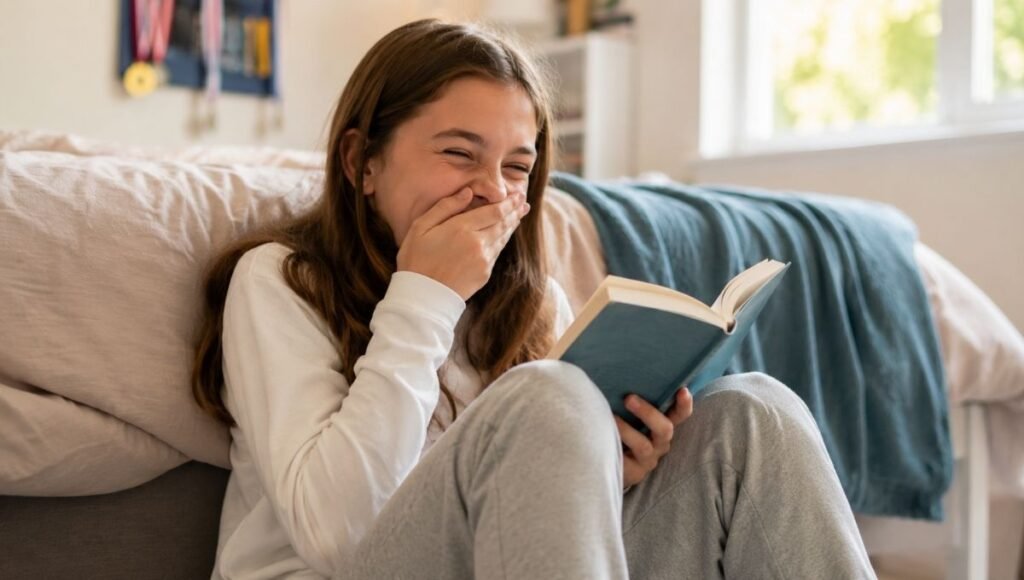
Gerald the elephant is anxious about everything. Piggie is enthusiastic about everything. Together they navigate friendship, misunderstanding, and the specific social complexity of being very different from your best friend. The books are short, the panels are simple, and the emotional comedy is sophisticated.
The specific funny: Willems understands that children’s humor is frequently about social dynamics — about what happens when two people with completely different temperaments try to do something together. The comedy of Elephant and Piggie is not situational; it’s relational. That’s what makes it so rereadable.
📦 Series — 25 books
💰 Budget Pick
Sideways Stories from Wayside School by Louis Sachar
Wayside School was built thirty stories tall by accident, one room on top of another. Mrs. Jewls teaches on the thirtieth floor. Each chapter is a different student with a different very strange problem. The humor is absurdist in a specifically logical way — everything that happens follows its own internal rules, which makes it funnier rather than more confusing.
Why it makes adults laugh too: Sachar is writing nonsense with total internal consistency, which is the hardest kind of comedy to produce. The chapter about the student who is counted absent every day because she turns into a dead rat is genuinely funny — and genuinely coherent within the book’s logic.
Bonus: Parents who read this aloud report laughing hard enough to have to stop reading. Multiple times. Per chapter.
📦 Series — Wayside School Is Falling Down, Wayside School Gets a Little Stranger
💰 Budget Pick
Wimpy Kid series by Jeff Kinney
Greg Heffley is not a good person, exactly. He’s self-absorbed, frequently conniving, and often responsible for his own problems. He is also completely honest about all of this in his journal, which is the source of most of the comedy. Children love Greg because he says the true things about being a kid that adults usually pretend aren’t true.
The specific funny: The humor of Diary of a Wimpy Kid is confessional — it works because Greg’s internal monologue is so recognizably real. Kids read it and feel understood. Adults read it and remember feeling exactly like Greg at that age.
📦 Series — 18+ books
💰 Budget Pick
The Bad Guys series by Aaron Blabey
A wolf, a shark, a piranha, and a snake want to be heroes. They are not good at it. Each book is a new adventure in which they try very hard and mostly cause chaos while accidentally saving the day. The books are written and drawn like a graphic novel, move very fast, and are genuinely, consistently funny.
For reluctant readers especially: The format — short chapters, comic-style panels, constant action — has converted more reluctant readers than almost any other series currently in print. This is the series to hand a child who says they hate reading.
📦 Series — 20 books
💰 Budget Pick
Funny Books for Middle Grade Readers (Ages 8–12)
A Series of Unfortunate Events by Lemony Snicket
Three orphans are placed with their terrible guardian Count Olaf after their parents perish in a fire. Every adult in the series is either evil or incompetent. Every child’s attempt to get help is thwarted by bureaucratic indifference. The narrator periodically reminds the reader that the book has an unhappy ending and suggests they stop reading.
Why it’s funny: The comedy is entirely in the narration — Snicket’s deadpan, his asides, his definitions, his performative sympathy. The situation is genuinely grim; the narration treats it with elaborate, precise, almost academic wit. Children who respond to this kind of humor — the gap between tone and content — find this series revelatory.
Editorial note: The first book is often the hardest sell, because the reader doesn’t yet trust the narrator. Push through. By book two, most children are committed.
📦 Series — 13 books
💰 Budget Pick
Hilo series by Judd Winick
Hilo is a robot who falls from space and has no memory of where he came from. He makes friends with two human children and they try to figure out his origin while fighting alien enemies. The humor is broad and physical in the graphic novel tradition, the heart is genuine, and the series escalates beautifully across its volumes.
For: Children who love graphic novels and want something that moves fast and is genuinely funny without being gross.
📦 Series — 9 books
💰 Budget Pick
The Hitchhiker’s Guide to the Galaxy by Douglas Adams (for advanced readers, ages 11–12)
Technically adult science fiction. In practice, perfectly accessible to bright eleven and twelve-year-olds, and one of the funniest books ever written in the English language. The Earth is demolished to make way for a hyperspace bypass. Arthur Dent survives because his friend turns out to be an alien researcher for the Hitchhiker’s Guide. Everything that follows is absurdist comedy of the highest order.
Editorial note: This is the book I recommend more than any other for children who have graduated from children’s humor and are ready for adult comedy but haven’t found it yet. The moment this book lands with a child is the moment they understand what writing can do when it’s really trying. I’ve seen it happen, and it is something to watch.
💰 Budget Pick
Funny Read-Alouds: Books That Work Best When Performed
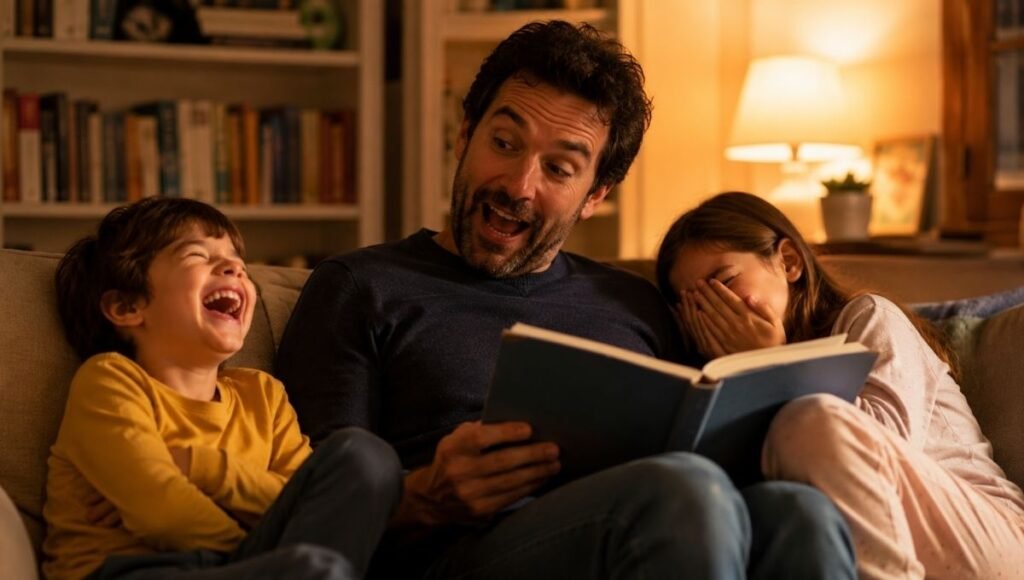
Some funny books are funny. These funny books are funnier when read aloud — because the comedy is in the voice, in the timing, in the gap between how the reader performs the text and what the child knows is true.
The Book with No Pictures — The whole book is a performance trap. Already covered above.
Interrupting Chicken — The interrupted stories require at least two voices and maximum commitment.
Anything by Mo Willems — Willems writes comedy that is entirely about character voice. Gerald’s anxiety and Piggie’s enthusiasm only fully exist when someone performs them.
Shel Silverstein’s collected poems (Where the Sidewalk Ends, A Light in the Attic) — These poems exist to be read aloud with expression. “Boa Constrictor” builds. “Sarah Cynthia Sylvia Stout Would Not Take the Garbage Out” escalates. “Sick” turns. They work on the page, but they work better as performance.
Sideways Stories from Wayside School — The chapter structure means you can start and stop anywhere. Read one chapter at dinner. Read two before bed. The episodic format is perfect for read-aloud.
The Joke Books Question
Parents often ask whether joke books count — whether the child who wants to read The Biggest Joke Book in the World is building real reading skills or just avoiding real books.
They count. Completely.
A child who reads joke books is learning: setup and punchline structure, the mechanics of surprise, how timing works in written form, the difference between a good joke and a bad one, and — perhaps most importantly — the specific pleasure of making someone else laugh.
The joke book reader is not avoiding reading. They are building a sophisticated understanding of comedic structure that will inform everything they read and write for the rest of their lives.
Best joke books for kids: National Geographic Kids Just Joking series, The World’s Best (and Worst) Jokes by Matt Rissinger and Philip Yates, and Shel Silverstein’s collected poetry (which is, at its best, the highest form of children’s joke writing).
💰 All Budget Picks
FAQ: What Parents Actually Search About Funny Books for Kids
What are the funniest children’s books of all time? The books most consistently cited across parent communities: Don’t Let the Pigeon Drive the Bus! (toddlers), The Book with No Pictures (ages 4–8), Sideways Stories from Wayside School (ages 7–10), A Series of Unfortunate Events (ages 9–12), and The Hitchhiker’s Guide to the Galaxy (ages 11+). These span very different types of humor and different ages, but all consistently produce genuine laughter in the children who encounter them at the right moment.
What are the best funny books for 8-year-olds? Sideways Stories from Wayside School, Diary of a Wimpy Kid, The Bad Guys series, Hilo, and A Series of Unfortunate Events. Eight is the age when children begin to appreciate irony and narrative unreliability — the gap between what a narrator says and what is actually happening — which opens up a whole category of comedy that wasn’t available before.
What are funny books that parents enjoy too? I Want My Hat Back (deadpan visual humor), Click Clack Moo (political satire in picture book form), The Book with No Pictures (traps the adult into performing indignity), A Series of Unfortunate Events (narrator wit), The Phantom Tollbooth (wordplay), and anything by Mo Willems (relational comedy that mirrors adult dynamics). These books work because they operate on two levels simultaneously.
Are joke books good for kids? Yes — joke books build understanding of comedic structure, setup and punchline mechanics, and the pleasure of making someone else laugh. A child who reads joke books is developing real literary skills in a format they find genuinely engaging. There is no category of reading that is too low for the reading habit to grow.
What are funny books for reluctant readers? Dog Man, The Bad Guys, Wimpy Kid, Big Nate, and the Hilo graphic novel series are the most consistently effective funny books for reluctant readers. The format matters as much as the humor — graphic novels and illustrated chapter books with short chapters have lower activation energy, which makes it easier to start and harder to stop.
What are funny middle grade books? A Series of Unfortunate Events, Sideways Stories from Wayside School, The Best Christmas Pageant Ever (funny in a very specific, warm way), How to Train Your Dragon, and The Phantom Tollbooth. These books work for ages 9–12 and represent different types of humor — from broad absurdism to dry wit to linguistic comedy.
One Last Thing
The night my daughter laughed so hard she fell off the couch, we were reading Sideways Stories from Wayside School.
The chapter about Mrs. Gorf, who turns students into apples when they misbehave, and what happens to her when they misbehave back — my daughter had been following the logic of the joke for several pages, and then the punchline arrived and she fell sideways. Literally. Off the couch. Still laughing while she hit the floor.
She was eight. The book was published in 1978. The joke worked exactly as it had always worked, across forty-six years and however many children, and it worked on my daughter on a Tuesday night in the exact same way.
That is what the best funny books do. They don’t expire. They find the children they’re meant for, and they do the thing they always do, and the children fall off the couch.
Find the right kind of funny for your child. Start there. Let the laughter happen.
Keep exploring on ZestRead:
- Graphic Novels for Kids: The Best Picks That Turn Reluctant Readers Into Devoted Ones
- Best Books for 8-Year-Olds: Readers Finding Their Own Path
- Best Books for 9-Year-Olds: The Independent Reader Who Still Needs You
- Best Books for 10-Year-Olds: The Last Year Before Everything Changes
- Classic Children’s Books Every Family Should Own: A Real Mom’s Guide by Age
References
- McGhee, P.E. (1979). Humor: Its Origin and Development. W.H. Freeman and Company.
- Bergen, D. (2009). “Gifted Children’s Humor Preferences, Sense of Humor, and Comprehension of Riddles.” Humor: International Journal of Humor Research, 22(4), 419–436.
- New York Public Library. (2018). “Make Me Laugh: The Epic Librarian List of Funny Books for Kids.” https://www.nypl.org
- American Library Association. (2023). “Theodor Seuss Geisel Award.” https://www.ala.org
Laura Bennett is the founder of ZestRead and a mom whose daughter fell off the couch laughing at a 1978 joke about a teacher who turns into an apple. She writes about children’s reading, humor in literature, and the books that produce the specific laughter that a family carries for years. Reach her at info@zestread.com