
Nobody warns you about the toddler bookshelf problem.
You hear about sleep regressions and picky eating and the specific chaos of a two-year-old who has decided that today they will not wear pants under any circumstances. But the bookshelf problem catches parents off guard.
It goes like this: you buy beautiful picture books, carefully chosen, age-appropriate, all the right things. And your toddler wants the same three. Every night. For six months. And when you gently suggest a different book, they look at you with the particular expression that means you have misunderstood everything and I will now explain it to you by crying.
Meanwhile, you are trying to figure out how to actually raise a toddler — a person who is simultaneously the most irrational and most earnest creature you have ever encountered — and the parenting books you read while pregnant suddenly feel very theoretical and not very useful.
This guide is for both problems. The best books for toddlers to read together, organized by what your child is actually like right now. And the best books for parents of toddlers — the ones that help you understand what’s happening inside that small, loud, deeply feeling person, so you can respond to it with something better than bewilderment.
Key Takeaways
- Toddlerhood spans ages 1–3, with a wide developmental range: a 13-month-old and a 35-month-old are in very different places, and books that work for one won’t necessarily work for the other.
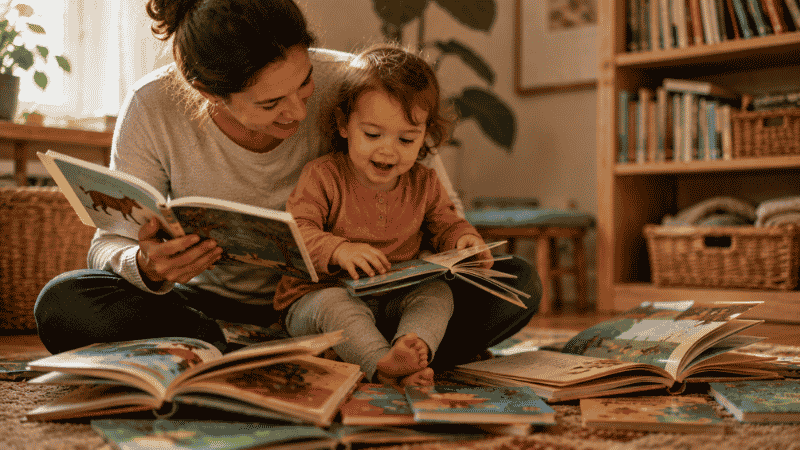
- The best picture books for toddlers share three qualities: repetition, strong visual storytelling, and a single clear emotional beat. Books that have all three tend to become the ones your toddler requests repeatedly — which is developmental success, not a problem.
- Shared reading with toddlers produces measurable vocabulary gains when done interactively — pausing to name, point, ask, and expand — rather than reading straight through (Whitehurst et al., 1988).
- The most useful parenting books for toddler parents are the ones that explain why toddlers behave the way they do neurologically, not just what to do about specific behaviors.
- You don’t need fifty books on the toddler shelf. You need eight to ten great ones, owned and read until they’re soft at the corners.
Part One: Best Picture Books for Toddlers
The picture books that work for toddlers are doing something specific: they’re built for a brain that is absorbing language at five to ten new words per day, that needs repetition to consolidate learning, that can hold one emotional thread at a time, and that has approximately twelve minutes of sustained attention before something more interesting happens.
The books below clear that bar. Every one of them.
Best Books for Young Toddlers (Ages 12–24 Months)
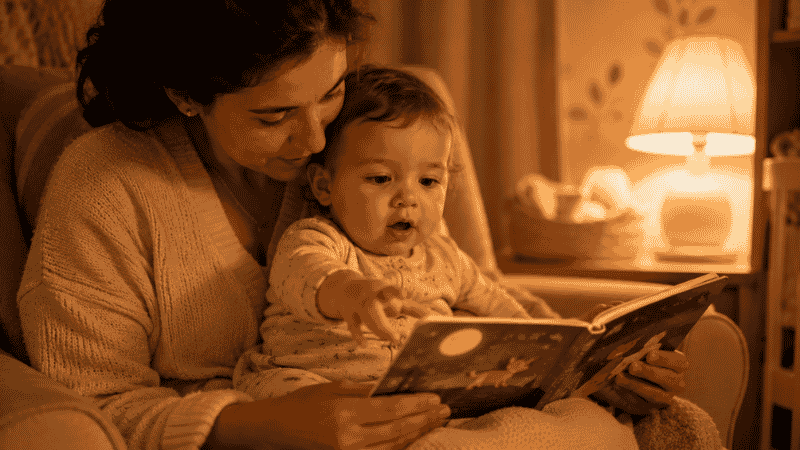
At this age, the book is almost secondary to the experience of sitting together with it. Your toddler is learning that books are objects that produce warmth and language and closeness — that is the whole lesson, and it’s more important than any specific title.
That said, some books work better than others for this age.
Goodnight Moon by Margaret Wise Brown, illustrated by Clement Hurd
The gold standard for a reason. The rhythm slows deliberately across the pages, the room grows darker, and children’s nervous systems follow the pace of the book into sleep. Published in 1947. Still unreplicated.
Why it works: Predictability is the point. Your toddler’s brain is learning what comes next — and the satisfaction of knowing what comes next is one of the earliest and most important cognitive pleasures.
How to use it: Lower your voice with each page. By the last spread, whisper. Watch what happens to your child’s body.
💰 Budget Pick — board book under $8
Pat the Bunny by Dorothy Kunhardt
The original touch-and-feel book, published in 1940. Paul and Judy do things — pat the bunny, smell the flowers, look in the mirror — and so does the child holding the book. No narrative. No lesson. Just the pure pleasure of a book that asks a baby to do something and then lets them do it.
Why it works: Physical engagement at this age deepens attention and memory. A toddler who touches the bunny is more engaged with the book than one who only looks at it.
💰 Budget Pick
Brown Bear, Brown Bear, What Do You See? by Bill Martin Jr., illustrated by Eric Carle
The repetitive question-and-answer structure is so predictable that most toddlers start filling in the answers before the page turns. Colors, animals, the pattern of call-and-response — it teaches three things simultaneously without feeling like teaching.
How to use it: After the third page, stop reading the answer and just look at your child. Wait. The pause is where the learning happens. You’ll be surprised how quickly they start completing the sentences.
💰 Budget Pick
The Very Hungry Caterpillar by Eric Carle
Counting, days of the week, food names, transformation — all through die-cut pages that toddlers find physically irresistible. The satisfying arc from hungry caterpillar to beautiful butterfly is one that children return to across years.
How to use it: Point to each food as you name it. After several reads, pause and let your child name it first. The moment they say “strawberry” before you do is the moment the vocabulary has landed.
💰 Budget Pick — board book edition handles enthusiastic handling
Where’s Spot? by Eric Hill
The original lift-the-flap book. Spot’s mother looks for him behind doors, under rugs, in boxes. Each flap reveals an animal that isn’t Spot. Simple, repetitive, interactive — and the flap mechanism gives toddlers something to do with their hands while their brain absorbs the language.
How to use it: Ask “Is Spot under the rug?” before lifting each flap. Let your child lift it. The anticipation is half the pleasure.
💰 Budget Pick
Best Books for Older Toddlers (Ages 2–3)
By two, children can hold a narrative in memory, follow cause and effect in a simple story, and begin to connect what happens in a book to what happens in their own life. The books that work at this age have more story — but still the rhythm, repetition, and emotional clarity that toddlers need.
Llama Llama Red Pajama by Anna Dewdney
Bedtime resistance and separation anxiety wrapped in rhyming text that is genuinely satisfying to read aloud. Llama Baby calls for his mama, feels scared, and — crucially — learns he’s okay. The book validates the feeling without reinforcing the behavior.
How to use it: After Mama says “Mama’s always close, don’t you know,” pause and make eye contact with your child. Let that land. Then keep reading.
⭐ Worth the Splurge — hardcover holds up to nightly reads
The Feelings Book by Todd Parr
Bold, bright, wonderfully non-judgmental. “Sometimes I feel like dancing in my underwear.” “Sometimes I feel mean.” Two-year-olds love that a book says the true things — that no feeling is positioned as better than another.
How to use it: Stop after each page and ask “have you ever felt like that?” Don’t redirect toward positive feelings. Let them name the real ones.
📦 Series Starter — Todd Parr has 30+ books in this style
💰 Budget Pick
Grumpy Monkey by Suzanne Lang
Jim the chimpanzee is grumpy for no particular reason. Everyone suggests he do things to feel better. None of it works. And then something shifts. This book is quietly revolutionary because it doesn’t insist on resolution — it just lets Jim be grumpy until he isn’t.
Why it works: Most toddler books about feelings try to teach emotional regulation. This one validates the experience of a bad day for no particular reason. Children recognize themselves immediately.
How to use it: Ask “has that ever happened to you? When you’re just grumpy?” Don’t rush them toward a lesson.
📦 Series Starter
💰 Budget Pick
We’re Going on a Bear Hunt by Michael Rosen, illustrated by Helen Oxenbury
The repeated refrain — “we can’t go over it, we can’t go under it, we’ve got to go through it” — gives toddlers the predictability they crave while the story builds, climaxes, and resolves. A narrative arc disguised as a chant.
How to use it: Stand up. Act it out. Stomp through the grass, splash through the river. For wired toddlers who need movement before settling, this book is a physical outlet and a story simultaneously.
💰 Budget Pick
Don’t Let the Pigeon Drive the Bus! by Mo Willems
The Pigeon argues, pleads, and melts down — and the child reading gets to say no. The power dynamic is delicious at this age. Already a modern classic.
How to use it: Give your child explicit permission to yell “NO!” at the pigeon. Lean into the call-and-response. It teaches narrative expectation and humor simultaneously.
📦 Series — the entire Pigeon universe
💰 Budget Pick
The Rabbit Listened by Cori Doerrfeld
Taylor’s block tower falls down. Every animal comes with advice. The rabbit just sits and listens. The quietest, most profound book on this list — and one that models something most adults struggle with: that presence without fixing is its own form of comfort.
How to use it: After reading, try being “the rabbit” the next time your toddler is upset. Just sit close. Don’t talk. See what happens.
⭐ Worth the Splurge
When Your Toddler Only Wants the Same Book
This deserves its own section because it worries parents more than it should.
Your toddler requesting the same book fourteen nights in a row is not a problem. It is exactly what their brain is supposed to be doing. Each re-read deepens vocabulary, reinforces narrative structure, and builds the kind of confident prediction that is the foundation of reading comprehension. The request for repetition is a sign of healthy development, not a sign that you need more books.
When they’re done with a book, they’ll tell you — by asking for something new. Trust that signal. It always comes.
Part Two: Best Books for Parents of Toddlers
The parenting section of any bookstore is overwhelming on a good day. Here is what’s actually worth reading — organized not by topic but by what it will actually do for you.
If You Want to Understand Why Your Toddler Does What They Do
The Whole-Brain Child by Daniel J. Siegel and Tina Payne Bryson
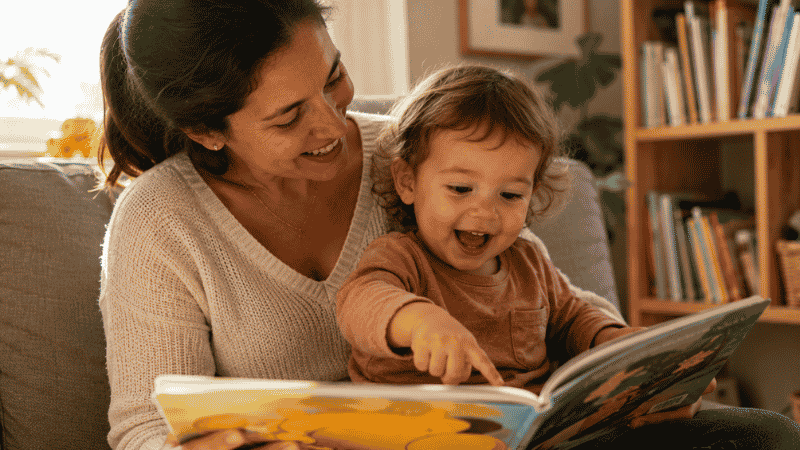
The most useful single book for understanding what is happening neurologically when your toddler has a meltdown. Siegel and Bryson explain the developing brain in terms that are genuinely accessible — the “upstairs brain” and “downstairs brain” framework is simple enough to remember in the moment when you need it most.
Why it’s worth reading: When you understand that a toddler’s prefrontal cortex is genuinely not yet capable of regulating emotion the way an adult’s is, the meltdown stops feeling like defiance and starts feeling like biology. That shift in perspective changes everything about how you respond.
Best read: Before or during early toddlerhood, when you still have brain space for a book.
How Toddlers Thrive by Tovah P. Klein
Klein is the director of the Barnard College Center for Toddler Development, and this book is the clearest explanation available of what toddlers actually need — which is often the opposite of what exhausted parents instinctively provide. The chapter on separation is particularly valuable.
Why it’s worth reading: Klein reframes the “terrible twos” not as a phase to survive but as a specific developmental achievement — a child learning to be a separate person, which is exactly as hard as it sounds. Understanding this makes the behavior more bearable and the response more effective.
If You Want Practical Scripts for Difficult Moments
How to Talk So Little Kids Will Listen by Joanna Faber and Julie King
The toddler-specific update to the classic How to Talk So Kids Will Listen. Full of specific, real-life scripts for common toddler situations — tantrums, transitions, refusals, the dinner table standoffs. Less theoretical than Siegel, more immediately applicable.
Why it’s worth reading: The fantasy that if you just understand toddler development well enough, the behavior will manage itself is a comfortable one. This book is for the moment you realize that understanding and doing are different skills and you need help with the doing.
No Bad Kids: Toddler Discipline Without Shame by Janet Lansbury
A collection of Lansbury’s most popular articles on toddler behavior — readable in short bursts, which is the only way most toddler parents can read anything. Her RIE-based approach to discipline is built on respect: treating the child as a capable person who is learning, not a problem to be managed.
Why it’s worth reading: The shame-free framing matters. Children who are disciplined without shame learn to regulate behavior; children disciplined with shame learn to hide behavior. Lansbury explains why this distinction matters and what it looks like in practice.
If You Want to Understand Language and Reading Development
The Read-Aloud Handbook by Jim Trelease
The original case for reading aloud — why it works, what it does for children’s brains, and how to do it well. Updated across multiple editions. The research section is compelling; the book list in the back is extensive and useful.
Why it’s worth reading: Most parents read aloud because they know they should. This book explains what’s actually happening developmentally when they do — which makes them better at it and more committed to continuing.
Thirty Million Words by Dana Suskind
The research on early language exposure — the famous “thirty million word gap” — presented accessibly for parents. Suskind explains what the research actually found (and what it didn’t), and what parents can do with the information without feeling guilty about what they haven’t done.
Why it’s worth reading: The research on early language exposure is often presented in ways that make parents feel terrible. This book presents the same research in a way that helps parents feel capable. The distinction matters.
How to Build a Toddler Bookshelf That Actually Gets Used
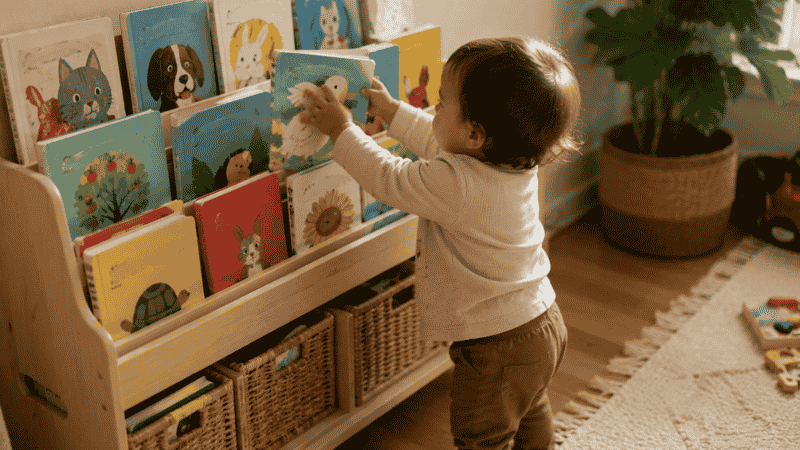
Keep it accessible. Books on low shelves with covers facing out get read. Books spine-out on high shelves don’t. Physical accessibility is the highest-leverage bookshelf intervention available.
Own fewer, read more. Eight to ten picture books owned and read deeply are more valuable than fifty books read once. The repetition your toddler craves requires ownership — a library book they can’t have tomorrow can’t be the book they request for six weeks running.
Rotate seasonally. Keep ten books on the accessible shelf at a time. Box the rest and rotate quarterly. Books that have been “away” for three months feel new again when they return.
Let them carry books. Toddlers who carry books around the house, who use them as pillows, who bring them to meals and bath time — these children are forming an attachment to books as objects. This is a feature, not a messy inconvenience.
FAQ: What Parents of Toddlers Actually Search For
What are the best books for toddlers? For reading together: Goodnight Moon, The Very Hungry Caterpillar, Brown Bear Brown Bear, Llama Llama Red Pajama, The Feelings Book, Grumpy Monkey, Don’t Let the Pigeon Drive the Bus, The Rabbit Listened, and We’re Going on a Bear Hunt. These nine form a foundation from which a toddler reading life grows naturally.
What books should a 2-year-old be reading? At two, children are ready for books with simple narrative arcs, repetitive text, and strong emotional beats — stories where something happens, a feeling is named, and the child can predict what comes next. The books in the “ages 2–3” section above are calibrated for exactly this developmental moment. Board books remain completely appropriate at two.
How many books should a toddler have? Fewer than you think. Eight to ten books on accessible, face-out shelves is plenty. The goal is deep engagement with a small library, not a large collection read once. Rotate books seasonally to keep the shelf feeling fresh without needing to buy constantly.
Should I let my toddler request the same book every night? Yes, always. Repetition is not a problem at this age — it is the developmental mechanism by which language is consolidated and narrative is understood. A book read fourteen times has been genuinely learned; a book read once has been encountered. The repeated request is your toddler telling you that the book is working.
What are the best parenting books for toddler parents? The Whole-Brain Child for neurological understanding, How to Talk So Little Kids Will Listen for practical scripts, No Bad Kids for a shame-free approach to discipline, and How Toddlers Thrive for the clearest explanation of what toddlers actually need. These four, read in any order, cover most of what parents of toddlers need to know.
When should I start reading to my toddler? You should have already started — but the honest answer is: the best time to start is right now. Reading aloud to toddlers builds vocabulary, print awareness, and the love of story that sustains reading development for years. It is never too late to begin.
What makes a good toddler book? Three things: repetition in the text (something that recurs, building anticipation), strong visual storytelling (illustrations that carry more than the words say), and a single clear emotional beat (one feeling, one character, one clear through-line). Books that have all three become the ones toddlers ask for again and again.
One Last Thing
The toddler years are exhausting and specific and over faster than anyone tells you they will be. The child who only wants the same three books tonight will be asking for chapter books before you’ve finished adjusting to the board book phase. The one who throws the book across the room in favor of the cardboard box it came in will, eventually, want to know what’s on page two.
Keep the books accessible. Keep reading together, even when it’s the fourteenth reading of the same book. Keep your voice gentle and your pace slow.
And when you need to understand what’s happening inside that small, feeling person — pick up one of the parenting books. They won’t answer every question. But they’ll help you ask better ones.
Find the right books for your toddler’s specific age:
- Best Books for 2-Year-Olds: What They’ll Actually Sit Still For
- Best Books for 3-Year-Olds: What Actually Works at Storytime
- Best Books for 4-Year-Olds: When Stories Start Getting Really Good
- Dialogic Reading: The Simple Technique That Makes Every Storytime Count
- How Many Words Should a 2-Year-Old Know?
- Classic Children’s Books Every Family Should Own: A Real Mom’s Guide by Age
References
- Whitehurst, G.J., et al. (1988). “Accelerating Language Development Through Picture Book Reading.” Developmental Psychology, 24(4), 552–559.
- American Academy of Pediatrics. (2014, updated 2023). “Literacy Promotion: An Essential Component of Primary Care Pediatric Practice.” Pediatrics. https://publications.aap.org
- Suskind, D. (2015). Thirty Million Words: Building a Child’s Brain. Dutton.
- Siegel, D.J., & Bryson, T.P. (2011). The Whole-Brain Child. Delacorte Press.
Laura Bennett is the founder of ZestRead and a mom who read Goodnight Moon approximately three hundred times and never once considered that a problem. She writes about children’s reading, toddler language development, and the books that make the exhausting years a little more meaningful. Reach her at info@zestread.com